Overview:
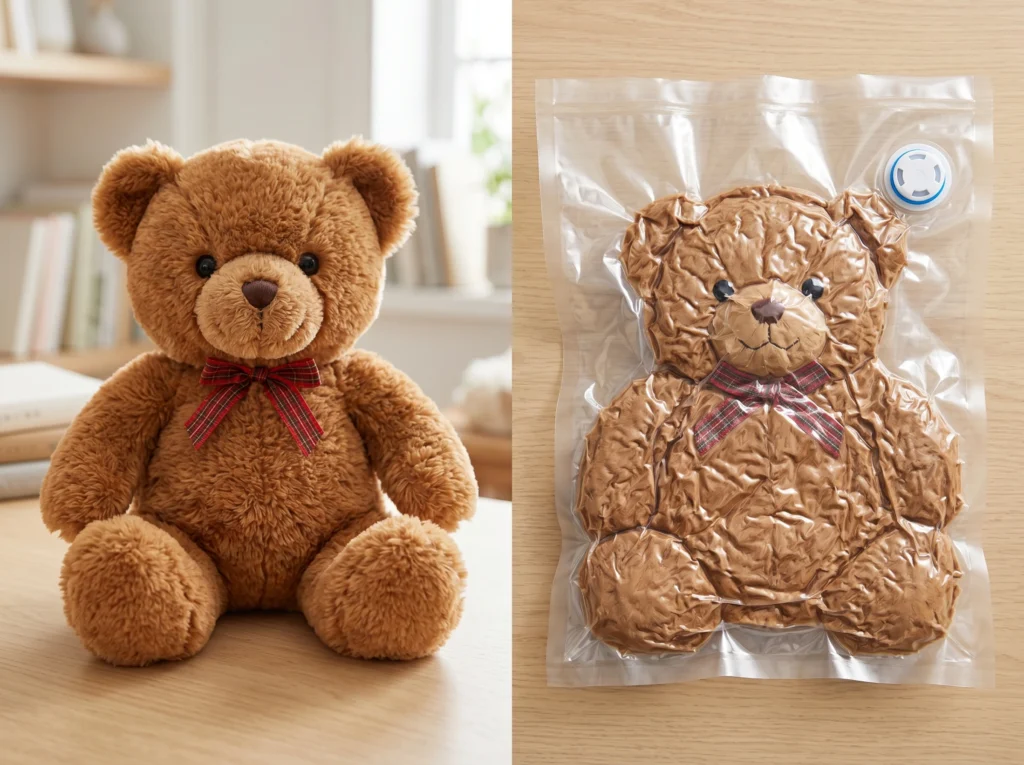
By transitioning from standard to vacuum-sealed compression packaging and optimizing master carton dimensions for 40HQ containers, our logistics team reduces cubic volume by up to 63%. This strategic optimization yields an average freight savings of $0.42 per unit, drastically improving profit margins when you buy dog toys in bulk.
The B2B Reality: When Freight Exceeds Product Value
A brand founder in Europe recently approached us after a disastrous fiscal quarter. They had sourced 20,000 oversized plush squeaky toys from another supplier, only to find that their LCL (Less than Container Load) sea freight bill completely eroded their gross margin. The root cause? The previous manufacturer shipped the items in standard, air-filled polybags haphazardly stuffed into single-wall cartons. The dimensional weight (DIM weight) was astronomical, and the client was essentially paying thousands of dollars to ship dead air across the ocean.
In B2B procurement, especially when margins are razor-thin, how you package is just as critical as what you manufacture. If your logistics strategy is an afterthought, you are bleeding capital. When you buy dog toys in bulk, you are not just purchasing fabric, TPR (Thermoplastic Rubber), or EVA foam; you are purchasing cubic meters (CBM) of space inside a shipping container. In our warehouse, we view air as the enemy of profitability. This technical breakdown will explain exactly how our supply chain team engineers your packaging to maximize container yield, protect product integrity, and drastically lower your landed costs across North America, Europe, and Singapore.
Understanding Dimensional Weight and CBM in Pet Toy Logistics
Before diving into compression techniques, procurement managers must deeply understand how freight forwarders calculate costs. Whether you are utilizing air freight for an urgent Q4 restock or ocean freight for standard inventory replenishment, carriers charge based on either the actual gross weight or the volumetric (dimensional) weight—whichever is greater.
Because dog toys—particularly plush and interactive puzzle toys—are inherently lightweight but voluminous, they almost always trigger volumetric weight pricing. The formula for dimensional weight varies depending on the mode of transport, and misunderstanding these divisors can lead to catastrophic budget overruns.
Air vs. Ocean Dimensional Divisors
| Transport Mode | Industry Standard Divisor | Calculation Formula | Typical B2B Application |
| Air Freight | 5000 | (L x W x H in cm) / 5000 | Urgent sample testing, high-margin product launches |
| Ocean Freight (LCL) | 1000 (1 CBM = 1000kg) | Volume calculated in CBM | Mid-size restocks, split-market distribution |
| Ocean Express (Matson) | 6000 | (L x W x H in cm) / 6000 | Accelerated seasonal inventory for US West Coast |
To illustrate: A standard master carton measuring 60cm x 50cm x 50cm has a physical volume of 0.15 CBM. Under air freight rules, its dimensional weight is 30 kg (60x50x50 / 5000). If the actual weight of the plush toys inside is only 8 kg, you are paying a massive premium for 22 kg of “ghost weight.” This fundamental math is why optimizing the physical footprint of every single SKU is non-negotiable for our logistics team.
Our Factory’s 4-Step Packaging Optimization Checklist
To combat the high costs of international freight, our facility in Dongguan enforces a strict, systematic approach to how every single unit is packed, compressed, and boxed before it ever reaches the loading dock.
- 📦 Step 1: Volumetric Profiling & Material Assessment: We analyze the toy’s fabric composition (e.g., corduroy vs. Oxford cloth) and internal stuffing (PP cotton grade) to determine its maximum safe compression ratio without permanently damaging the squeakers or altering the rebound memory.
- ⚙️ Step 2: Micro-Perforated Polybag Vacuuming: Instead of standard PE bags, we utilize highly durable 0.08mm thick micro-perforated PE/PET composite bags. Industrial vacuum machines extract up to 85% of the ambient air, sealing the bag instantly to lock in the compressed state.
- 📦 Step 3: Master Carton Dimensional Engineering: We mathematically size our corrugated master cartons to ensure a zero-dunnage fit. Cartons are precisely measured so that when stacked, they consume exactly 100% of the usable width and height of a standard 40HQ container (accounting for door height clearances).
- ⚙️ Step 4: Moisture & Humidity Neutralization: Because vacuum seals can trap ambient factory humidity, we insert correctly sized silica gel desiccants (typically 2g to 5g packets) into every polybag before sealing. This guarantees that ocean freight temperature fluctuations do not cause internal condensation or mold during the 30-day transit.
Standard vs. Vacuum Sealed Packaging: A Quantitative Analysis
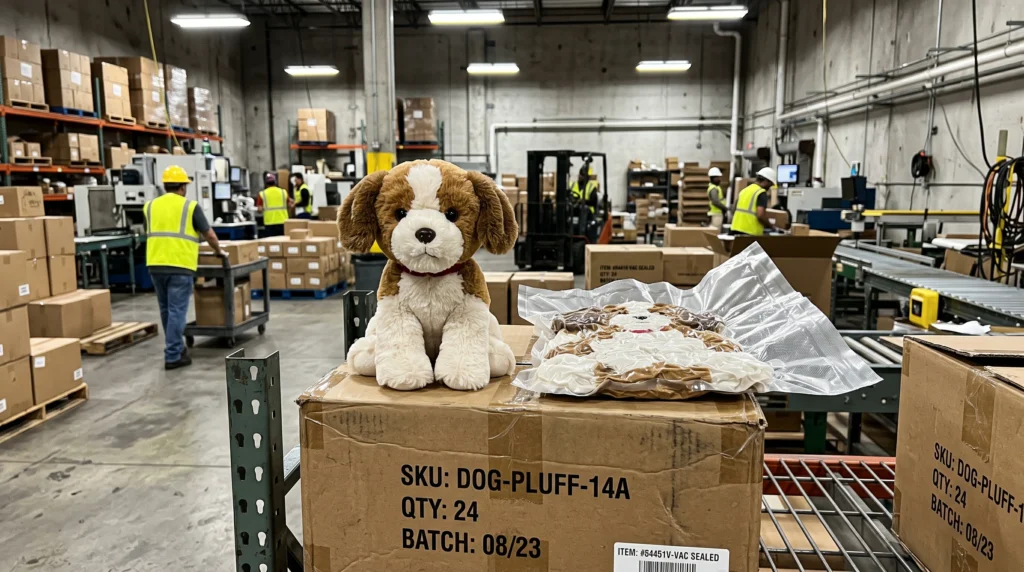
When you buy bulk dog toys, the decision between standard packing and vacuum compression is the single largest lever you can pull to reduce your landed cost. Standard packaging leaves the product in its natural state, which looks great on a retail shelf but is a nightmare for a shipping container. Vacuum sealing flattens the product into a dense, board-like state.
Below is the exact data from a recent production run of 12-inch squeaky plush dog toys shipped to a distributor in California.
Logistics Scenario Comparison
| Scenario | Units per Carton | Cartons per 40HQ Container | Estimated Freight Cost per Unit |
| Standard Packaging (Uncompressed) | 40 | 580 | $0.65 |
| Vacuum Sealed Packaging (Max Compression) | 120 | 620 | $0.23 |
The Physics of Compression and Rebound Rates
As demonstrated in the table above, vacuum compression allowed us to triple the unit density per carton, dramatically increasing the total units per 40HQ container from 23,200 to 74,400. This is how the freight cost plummeted from $0.65 to $0.23 per unit.
However, vacuum compression is a highly technical process that requires a deep understanding of textile physics. If you apply too much pressure to a low-grade PP cotton stuffing, the structural integrity of the fibers will fracture, and the toy will never return to its intended shape (a phenomenon known as “dead rebound”). When you are dealing with voluminous items like custom dog plush toys, reducing dead space is the single most effective way to lower your landed cost, provided it is done correctly.
We exclusively utilize high-resilience, multi-hollow PP cotton that boasts a 98% rebound rate within 24 hours of opening. Furthermore, our engineering team maps out the exact location of internal EVA squeakers. By strategically folding the toy so that the squeaker is shielded by the thickest layers of fabric, we prevent the plastic bladders from cracking under the immense pressure of the vacuum press.
Master Cartons: Specifications, Ply, and Drop-Test Standards
Even if the internal packaging is perfectly optimized, utilizing the wrong master carton will result in collapsed pallets, damaged goods, and rejected inventory upon arrival at FBA (Fulfillment by Amazon) or your 3PL warehouse.
In our warehouse, we do not compromise on corrugated integrity. For standard ocean freight, we strictly utilize 5-ply (double-wall) corrugated export cartons. A 5-ply carton consists of two flat outer linerboards, two fluted corrugated mediums (usually B and C flutes), and one inner flat linerboard. This construction provides exceptional vertical crush resistance, ensuring that cartons at the bottom of a container stacked to the ceiling do not buckle under the weight of the boxes above them.
Carton Material Specifications & Load Bearing
| Carton Type | Flute Structure | Edge Crush Test (ECT) standard | Max Safe Gross Weight | Optimal B2B Logistics Use Case |
| 3-Ply (Single Wall) | B or C Flute | 32 ECT | 15 kg (30 lbs) | Lightweight apparel; Not recommended for ocean freight |
| 5-Ply (Double Wall) | BC Flute | 48 ECT | 30 kg (65 lbs) | Standard FCL Ocean Freight for Plush & TPR Dog Toys |
| 7-Ply (Triple Wall) | BCA Flute | 80 ECT | 50+ kg (110 lbs) | Heavy rubber chew toys, mixed LCL consolidation shipments |
To guarantee survivability, all our master cartons must pass the ISTA 1A (International Safe Transit Association) drop test protocol. This involves dropping the fully loaded carton from specific heights onto its corners, edges, and flat faces to simulate the brutal realities of global transit. As part of our comprehensive OEM/ODM services, our logistics team re-engineers your packaging from the ground up, ensuring your products survive the journey from our factory floor to your customer’s doorstep without a single crushed box.
Container Utilization: Floor Loading vs. Palletization
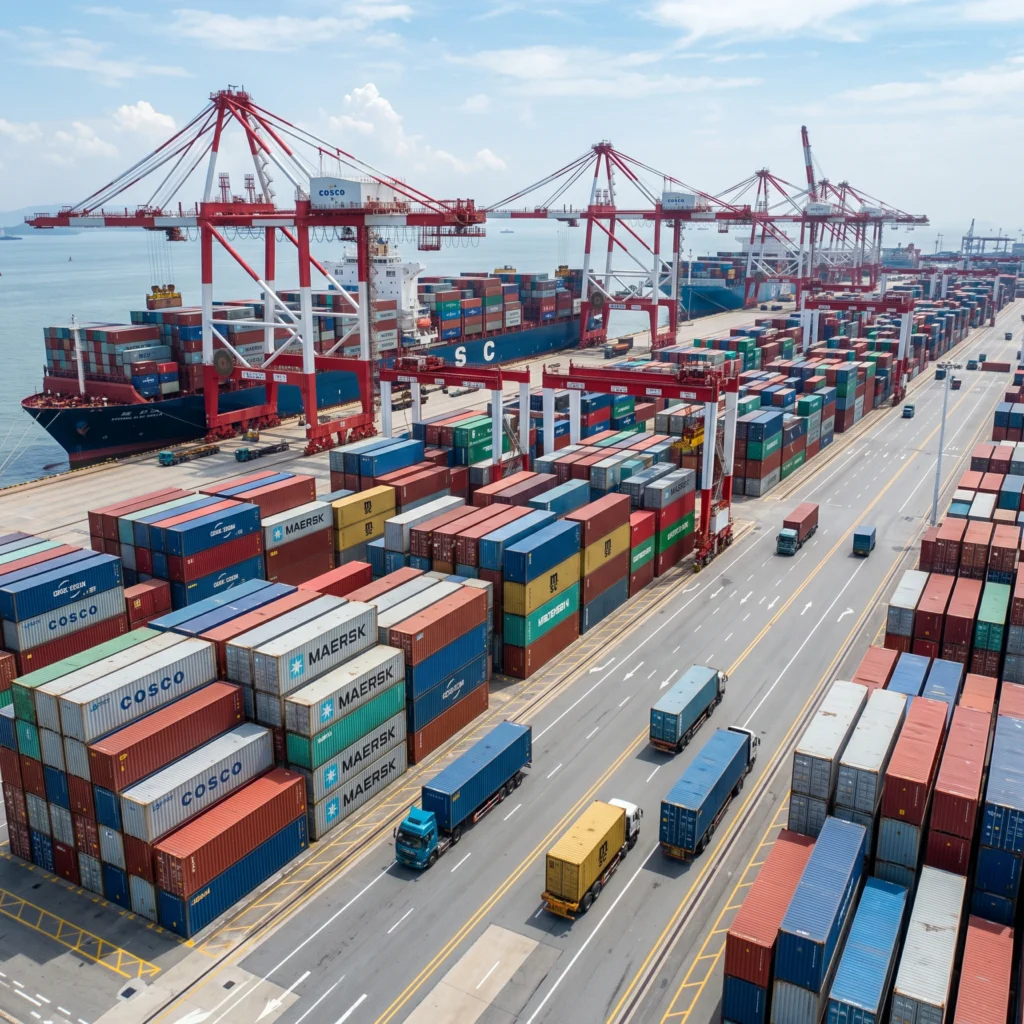
When calculating how many master cartons will fit into a standard 40-foot High Cube (40HQ) container, buyers often make the mistake of using the theoretical maximum volume (76.2 CBM). In reality, due to the internal dimensions, door frame constraints, and the unavoidable gaps between boxes, a perfectly optimized floor-loaded 40HQ container will only yield about 68 CBM of usable space.
If your warehouse requires palletized delivery, the yield drops even further. A standard US wood pallet (48″ x 40″) or a Euro pallet (1200mm x 800mm) consumes significant vertical and horizontal space. Furthermore, the height of the pallet itself (usually around 15cm) and the clearance required for the forklift tines subtract from the usable interior volume. When palletizing, a 40HQ container typically yields only 55 to 58 CBM of actual product.
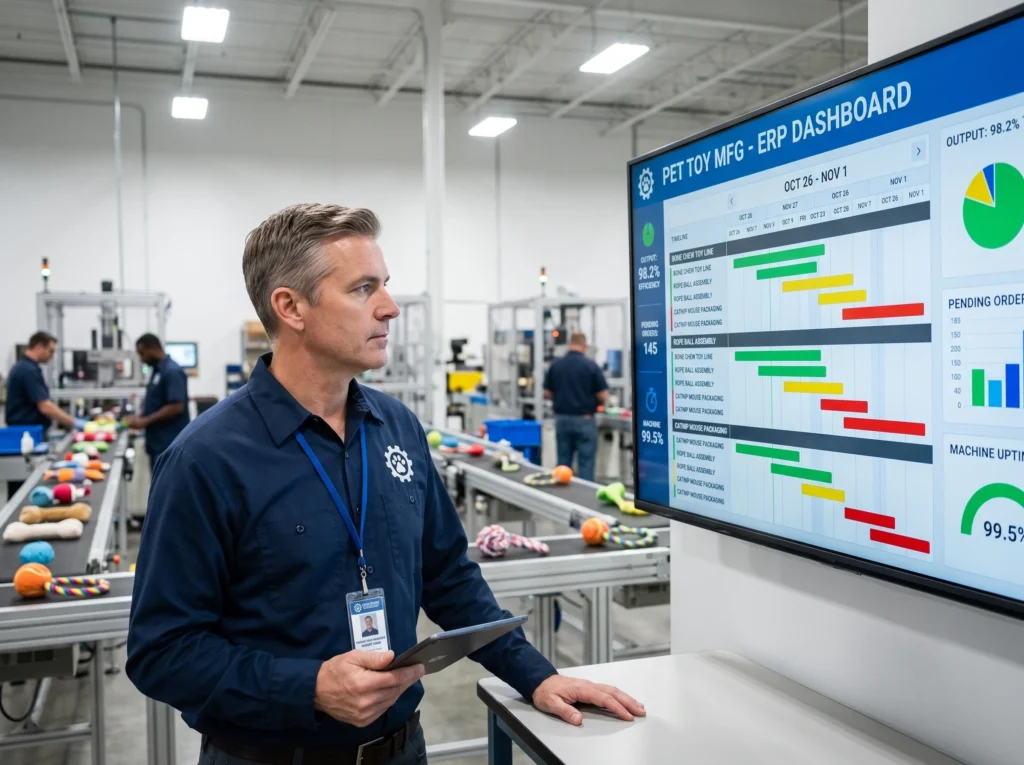
This is why we meticulously calculate box dimensions. We use 3D cargo planning software to simulate the exact loading sequence, ensuring that every master carton acts as a perfect building block, eliminating “dead voids” whether we are block-stacking on the floor or pinwheel-stacking on pallets.
Navigating FCL vs. LCL for the USA, Canada, Europe, and Singapore
Different target markets impose distinct constraints on how pet toys must be packaged and shipped.
USA and Canada (North American Market):
For our North American buyers, especially those utilizing Amazon FBA, strict compliance with polybag suffocation warnings is legally mandated. Any polybag with a 5-inch opening or larger must bear a printed warning. Additionally, FBA has rigorous box weight limits (typically not exceeding 50 lbs / 22.6 kg per carton unless it is a single oversized item). We engineer our master cartons specifically to hit a 20 kg sweet spot, maximizing density while staying safely under the penalty threshold.
Europe (EU and UK Markets):
European buyers are currently navigating stringent environmental regulations, particularly the Extended Producer Responsibility (EPR) packaging laws. When exporting to Germany, France, or the UK, we often pivot from traditional PE polybags to biodegradable PLA/PBAT composite bags or opt for minimalist kraft paper belly bands for rubber toys. While this slightly alters the compression metrics, we counterbalance it by utilizing interlocking master carton geometries.
Singapore (Southeast Asia):
Singapore’s logistics profile is unique. Transit times from our Dongguan facility are remarkably short (often 4 to 7 days by sea). Because the total freight journey is brief, buyers frequently opt for LCL (Less than Container Load) shipments rather than full containers. In LCL scenarios, your cartons share space with heavy industrial goods from other manufacturers. For Singapore-bound LCL freight, we upgrade our standard 5-ply cartons to reinforced 7-ply with heavy-duty corner edge protectors, ensuring our pet toys are not crushed by heavier cargo during the consolidation and deconsolidation processes at the Port of Singapore.
To stay ahead of fluctuating container costs across these routes, we highly recommend that procurement teams regularly consult leading global shipping indices, such as the Freightos Baltic Index, to forecast rates and time their bulk orders appropriately.
Conclusion & Strategic Takeaways
Purchasing dog toys at wholesale prices is only half the battle. If your supply chain lacks a rigorous, data-driven packaging strategy, your negotiated factory discounts will be immediately wiped out by inefficient freight costs. By demanding vacuum compression for textiles, insisting on 48-ECT 5-ply master cartons, and engineering box dimensions to match container geometries, B2B buyers can reclaim their profit margins and scale their brands aggressively.
Do not accept “standard packaging” as the default. Every cubic centimeter of air you ship is money removed directly from your bottom line. Demand mathematical precision from your manufacturing partners, and watch your landed costs plummet.
Ready to maximize your margins? Stop losing your profit margin to inefficient shipping. Send our logistics team your current product dimensions, weights, and order volumes today. We will engineer a custom CBM analysis and provide a free, no-obligation packaging optimization report to drastically lower your landed costs. Contact Us to start optimizing your next shipment.
Frequently Asked Questions (FAQ)
1. How long does it take for a vacuum-sealed plush dog toy to regain its original shape?
Upon cutting open the vacuum-sealed polybag, our high-resilience PP cotton stuffing typically rebounds to 90% of its original volume within 3 minutes. Full structural recovery (100% rebound) takes approximately 12 to 24 hours at standard room temperature. Massaging the toy briefly can accelerate this process.
2. Does vacuum compression damage the internal squeakers in dog toys?
No, provided the factory utilizes proper folding techniques. Our logistics team strategically positions the internal EVA plastic squeakers within the thickest layers of the toy’s fabric and stuffing before compression. This acts as a protective buffer, preventing the squeaker bladders from rupturing under the vacuum press.
3. What is the maximum weight a 5-ply master carton can hold for heavy-duty rubber toys?
Our standard 5-ply (double-wall) corrugated export cartons are rated at 48 ECT (Edge Crush Test) and can safely hold up to 30 kg (65 lbs) of gross weight. However, for Amazon FBA compliance or standard warehouse ergonomics, we intentionally design our packing configurations to cap the carton weight at 22 kg (48.5 lbs).
4. How do I calculate the CBM for my bulk dog toy order?
CBM (Cubic Meters) is calculated by multiplying the Length, Width, and Height of a single master carton in meters (L x W x H = CBM). You then multiply that number by the total number of cartons in your order. Our team provides automated CBM calculations and 3D container loading plans during the quoting phase.
5. Is it better to ship LCL or FCL when I buy bulk dog toys for the European market?
If your total order volume exceeds 12 to 15 CBM, it is almost always more cost-effective and secure to upgrade to a 20-foot container (FCL). LCL (Less than Container Load) exposes your lightweight pet toys to a higher risk of damage because they are consolidated with unknown, potentially heavy cargo from other suppliers.
6. Can your factory print our brand logo directly on the vacuum-sealed polybags?
Yes. We offer fully customizable micro-perforated PE/PET composite bags. We can print your brand logo, barcode (UPC/EAN), suffocation warnings, and tracking lot numbers directly onto the plastic film before the vacuum sealing process occurs.
7. What are the palletization standards for sending dog toys to Amazon FBA in the USA?
Amazon FBA requires standard GMA 4-way access wooden pallets measuring 48″ x 40″. The total height of the fully loaded pallet must not exceed 72 inches, and the total gross weight must be under 1,500 lbs. We meticulously configure our master carton dimensions to maximize this exact pallet footprint without any overhang.