Overview: The Business Case for Strategic White Labeling
For modern Amazon Sellers, Boutique Pet Shops, and Promotional Merchandisers, the pet product market presents a unique dichotomy: consumer demand for highly branded, premium aesthetics is at an all-time high, yet the barrier to entry for fully custom-molded products remains restrictively expensive. Developing a custom dog toy from scratch requires 3D modeling, prototype sampling, physical mold creation, and extensive safety testing, often pushing upfront tooling costs into the thousands of dollars and extending lead times by 45 to 60 days.
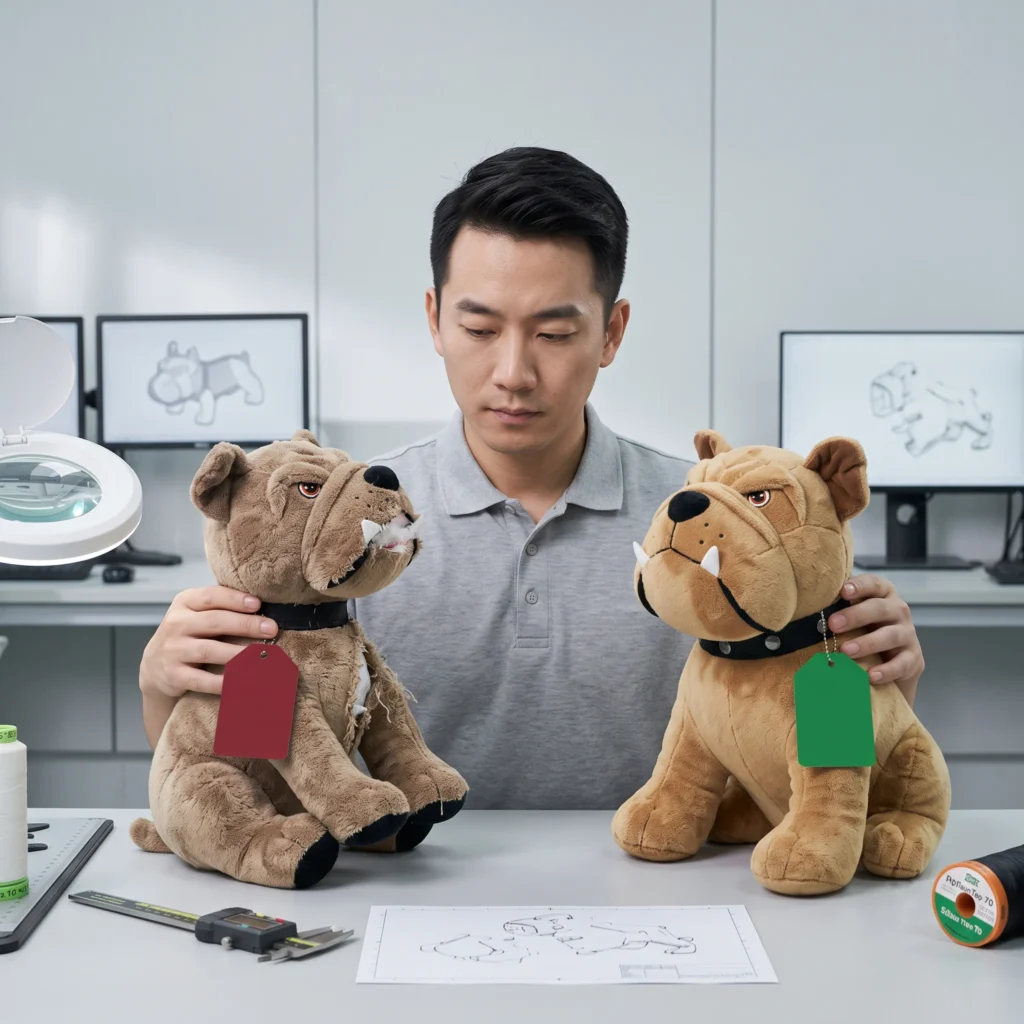
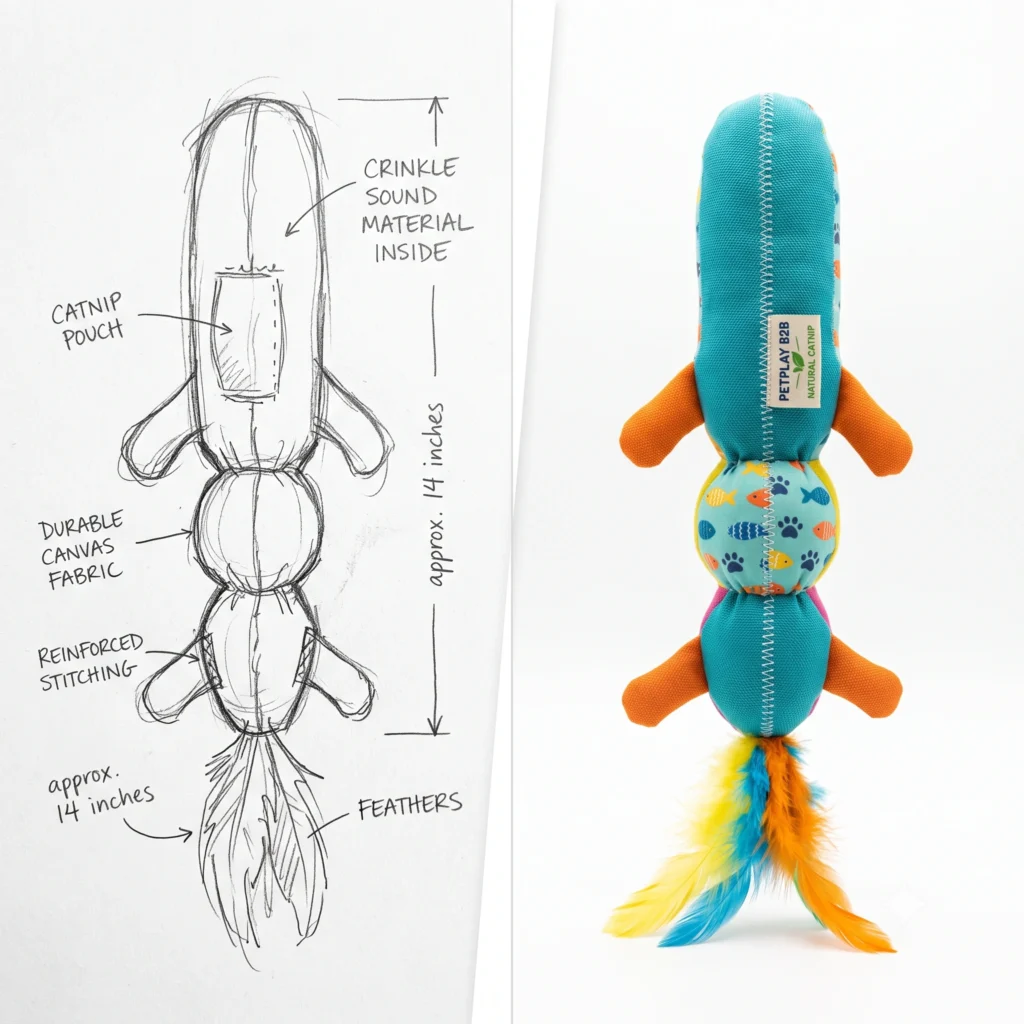
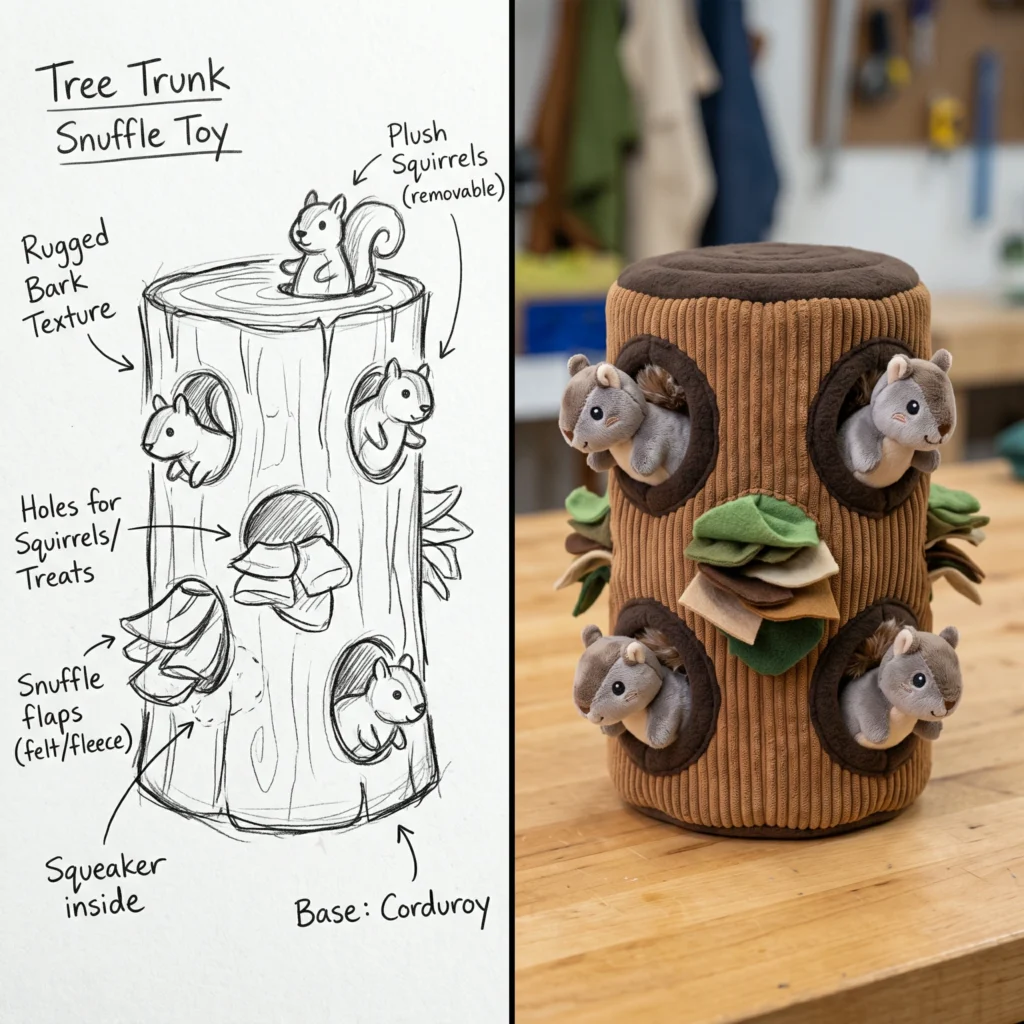
The most viable business model to circumvent these capital expenditures while still establishing strong brand equity is leveraging white label dog toys. By selecting proven, market-tested stock designs from a reliable manufacturing partner and applying highly customized, legally compliant private labeling, brands can dramatically reduce their time-to-market. This strategy allows businesses to redirect capital from mold fees into aggressive PPC campaigns and inventory scaling. In this case study, we pull back the curtain on our factory floor at Wehaopets to demonstrate exactly how we upgrade standard stock plush designs into premium, retail-ready branded assets that hit the target user’s pain points: durability, brand consistency, and strict regulatory compliance.
The Project Brief
- Client Goal: Launching a premium, bespoke brand line of heavy-duty plush squeaker toys for the North American market using our existing stock toy shapes to completely eliminate new mold costs and reduce lead time by 4 weeks.
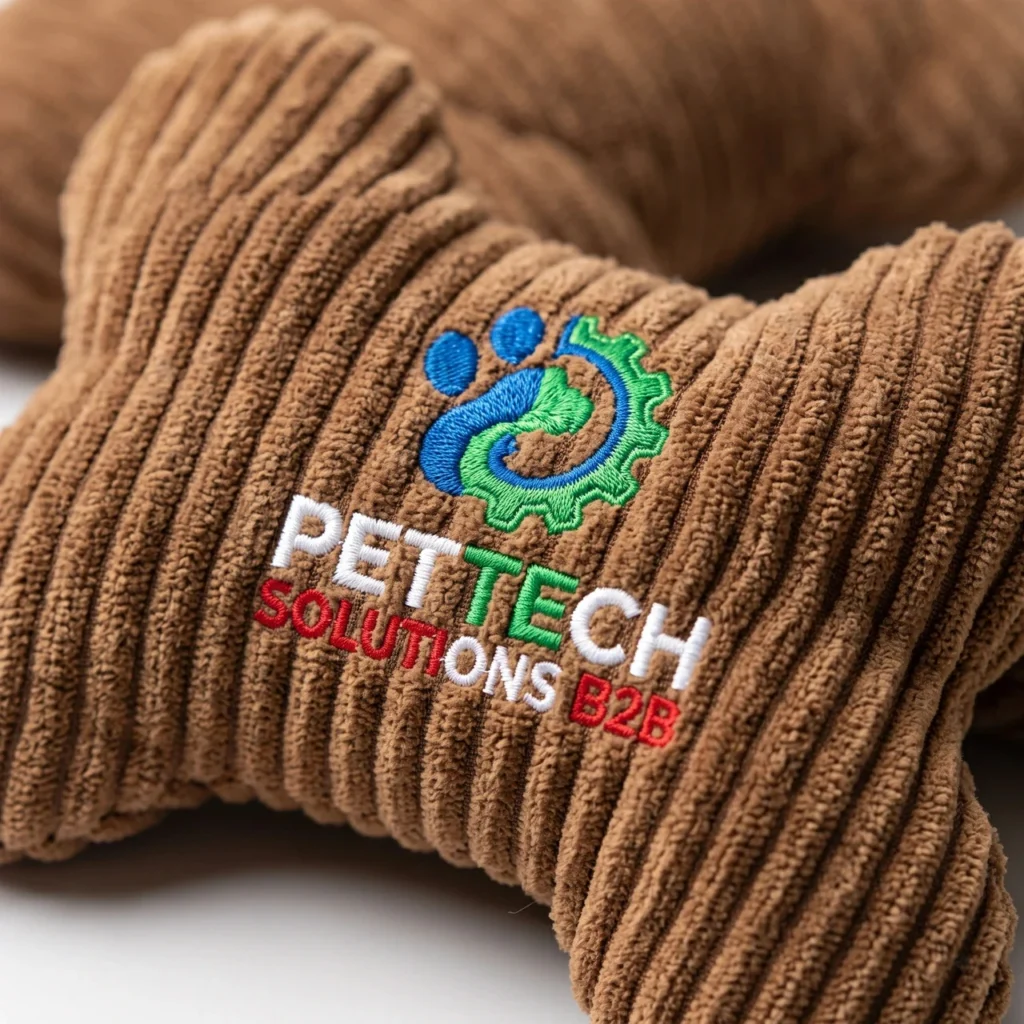
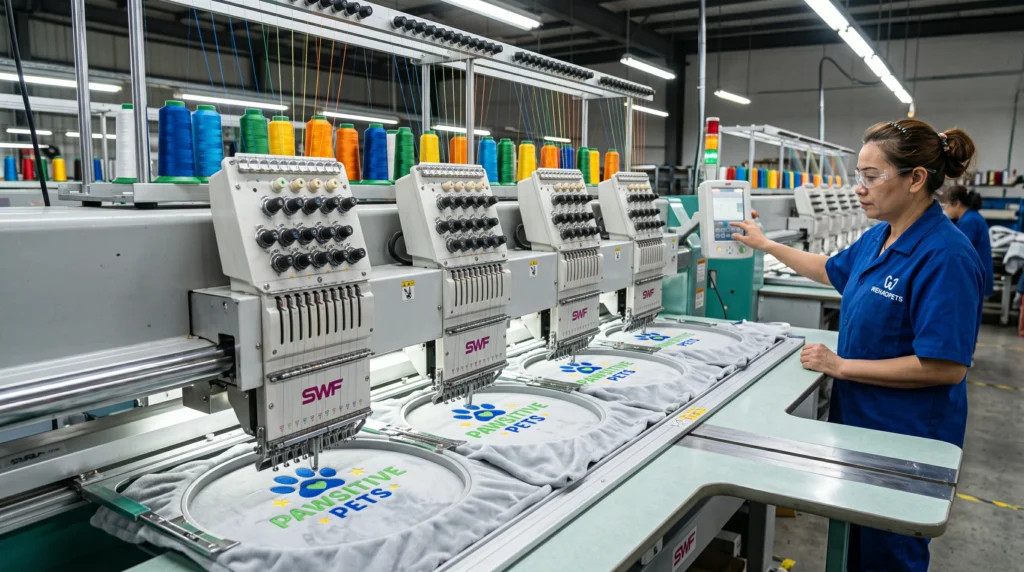
- The Branding Challenge: The client required a high-density embroidered logo on the main body of the toy. However, the selected toy utilized a high-stretch, 250 GSM 100% polyester velboa fabric. Initial digitizing resulted in severe embroidery puckering, fabric distortion, and needle-cut damage to the underlying structural mesh.
- The Wehaopets Solution: In our branding workshop, our production engineers adjusted the stitch density (spacing to 0.4mm), reprogrammed the underlay stitches for multi-directional stretch, and implemented a double-layered water-soluble backing stabilizer to support the high-tension thread load without compromising the plush texture.
- Cost Impact: The engineering adjustments and premium materials resulted in a nominal increase of +$0.15 per unit for direct embroidery and +$0.12 per unit for ultrasonic-cut woven damask seam labels. The client avoided $1,200 in sampling and mold fees, maintaining a 68% gross profit margin at their target retail price.
The Strategy Behind White Label Dog Toys
Why Private Labeling Trumps Custom Molds for Scaling
When operating in a high-velocity retail environment like Amazon FBA, inventory turnover and Cash Conversion Cycle (CCC) are the lifeblood of your business. Every week spent in the prototyping and mold-revision phase is a week of lost sales velocity. Our white label strategy allows partners to browse our extensive wholesale squeaky dog toys catalog, select shapes with historically low return rates and high tear-resistance, and immediately move into the branding phase.
To illustrate the financial and operational divergence between these two sourcing models, we have compiled the empirical data from our factory floor over the last four fiscal quarters.
Custom Mold vs. White Label Stock Designs – Operational Comparison
| Metric / Requirement | Fully Custom Molded Toy | White Label Dog Toys (Stock Base) | Impact on Amazon Seller |
| Upfront Tooling/Mold Cost | $500 – $2,500+ | $0 (Pre-existing molds/patterns) | Preserves working capital for advertising |
| Sampling Lead Time | 21 – 35 Days (Multiple revisions) | 5 – 7 Days (Branding application only) | Faster time-to-market; catch seasonal trends |
| Minimum Order Quantity (MOQ) | 3,000 – 5,000 units per SKU | 500 – 1,000 units per SKU | Lowers inventory holding risk |
| Safety Testing (ASTM/CPSIA) | Requires new lab certification ($400+) | Base materials already factory-certified | Rapid compliance clearance |
| Structural Reliability | Unproven until bulk stress testing | Market-tested, historically low defect rate | Reduces negative review velocity |
As the data indicates, utilizing white label stock designs provides a mathematically superior return on investment for brands looking to scale a wide catalog of SKUs quickly.
Technical Execution of Branding on Plush Fabrics
Overcoming Embroidery Puckering on Velboa
The execution of private labeling separates amateur sourcing from professional manufacturing. When the client requested direct embroidery on our stock triceratops plush, our engineering team immediately identified the mechanical friction points. The fabric in question, a 250 GSM warp-knitted velboa, possesses significant horizontal stretch.
When a computerized multi-head embroidery machine drives hundreds of stitches per minute into stretch fabric, the tension of the top thread pulls the fabric inward, creating a “puckering” effect. To combat this on our embroidery line, we do not simply rely on standard tear-away paper backing. Instead, we mandate the use of water-soluble stabilizers (often a PVA film) on top of the plush pile to prevent the stitches from sinking into the fabric, combined with a heavy-duty cut-away stabilizer on the reverse side to lock the fabric matrix in place.
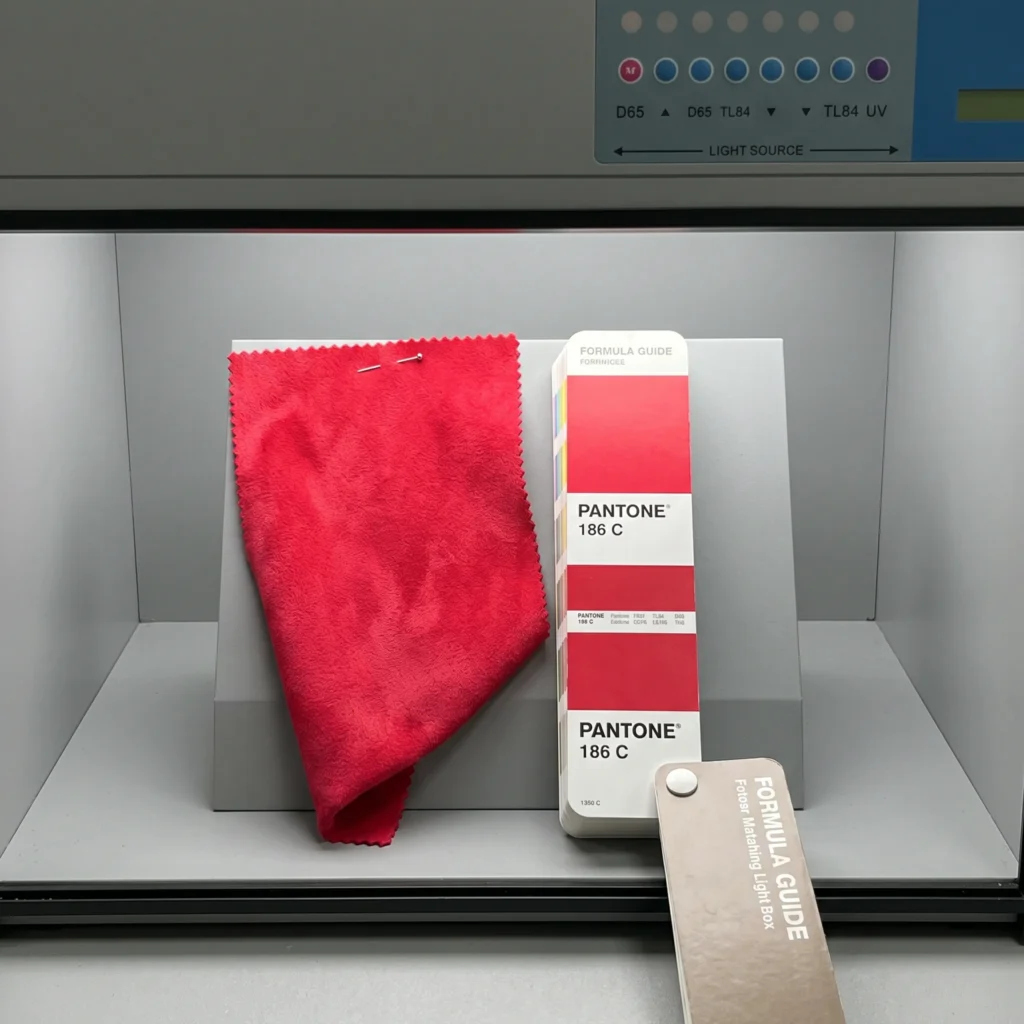
Furthermore, our digitizing technicians meticulously map the pantone thread matching, ensuring the client’s vector logo translates perfectly into physical thread. We utilize high-tensile polyester thread over rayon for pet toys, as polyester withstands canine saliva and aggressive chewing without snapping or bleeding dye.
The Customization Matrix
Selecting the correct branding application is highly dependent on the base material of the toy and the client’s target MOQ. Wehaopets provides a strict framework for these decisions.
Wehaopets Branding & Customization Matrix
| Customization Type | Best Fabric / Material Match | Technical Application Details | Impact on MOQ | Cost Tier |
| Direct Embroidery | Velboa, Corduroy, Oxford Cloth | High stitch count (up to 15k stitches); requires backing stabilizers. High durability. | Medium (+500 units) | $$$ |
| Woven Damask Label | All plush and rope toys | Sewn directly into the main structural seam. Ultrasonic cutting prevents frayed edges. | Low (Standard MOQ) | $$ |
| Heat Transfer Print | Smooth Nylon, Neoprene, Canvas | Cured at 180°C. Best for complex, full-color gradients and small text. | Low (Standard MOQ) | $ |
| Silicone / PVC Patch | Heavy-duty Nylon, Tactical Gear | 3D micro-injection molding. Stitched onto the exterior. Extremely chew-resistant. | High (+1000 units) | $$$ |
| Screen Printing | Cotton, Flat Canvas | Direct ink application. Requires curing tunnel. Can fade with aggressive abrasion. | Medium (+500 units) | $ |
Labeling Compliance and Factory Rules
Building a brand is not solely about aesthetics; it is fundamentally about legal compliance and liability protection. When importing white label dog toys into the United States or the European Union, regulatory agencies require highly specific labeling data. Failure to comply can result in Customs and Border Protection (CBP) seizing your inventory at the port.
At Wehaopets, our production managers enforce a zero-tolerance policy regarding label placement and structural integrity.
Mandatory Placement Checklist
Before any batch enters mass production, our quality assurance engineers verify the branding layout against our internal compliance framework.
🧵 1. Seam-Integrated Legal Woven Labels: All mandatory legal information (Country of Origin, e.g., “Made in China”, and material composition) must be printed on a woven damask or spun polyester label and double-stitched deep into the primary load-bearing seam of the toy. Surface stitching is strictly prohibited as dogs can easily rip it off, removing vital safety information.
🧵 2. Ultrasonic Edge Sealing: All brand logo labels and compliance tags must undergo ultrasonic cutting. Traditional cold or hot knife cutting leaves microscopic frayed edges. Ultrasonic cutting melts the polyester fibers at a frequency that permanently seals the edge, preventing fraying that could become a choking hazard if ingested by a pet.
🧵 3. CPSIA and FTC Compliance Formatting: For toys that could potentially cross over into children’s use, or to maintain strict retail standards, labels must clearly display the importer’s details, batch/lot tracking numbers (for recall traceability), and adherence to the FTC textile labeling rules.
🧵 4. High-Contrast Hazard Warnings: If the toy contains internal squeakers or crinkle paper, the external packaging (header card or hangtag) must feature a high-contrast choking hazard warning, advising owners to supervise play and discard the toy if punctured.
Case Study Breakdown: Step-by-Step Implementation
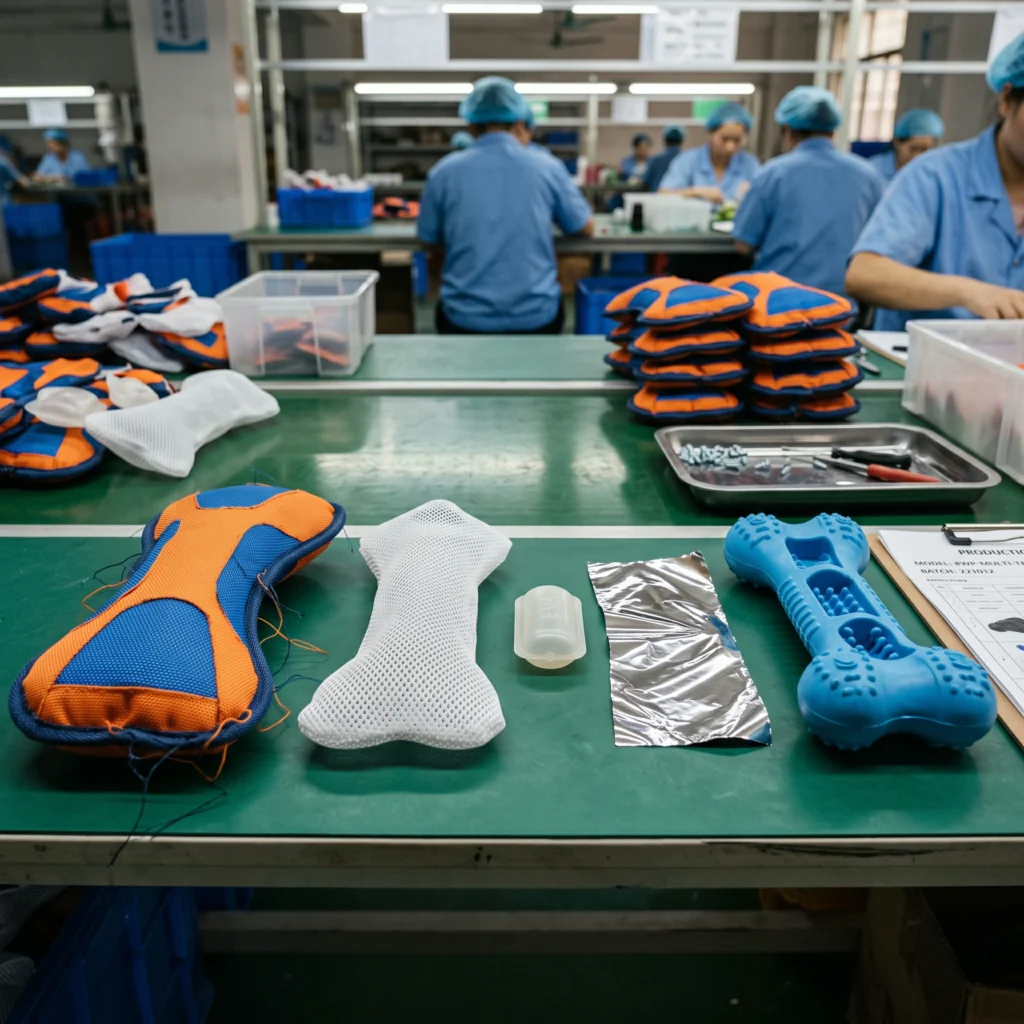
To provide a transparent view of how Wehaopets handles a 10,000-unit white label dog toy order, we have outlined the specific production milestones achieved during this client’s project. The integration of high-level quality control directly impacts the final landing cost and defect rate.
Production Milestones and Quality Control Integration
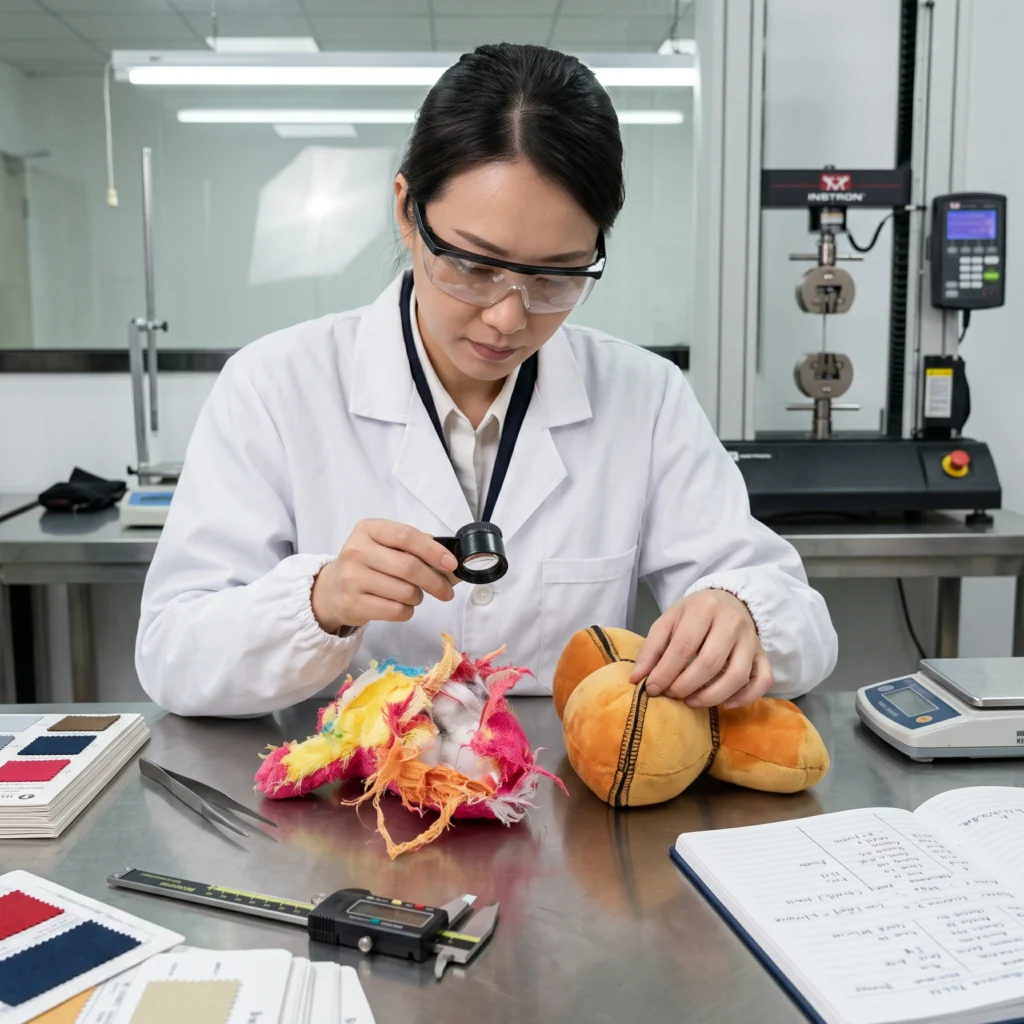
We operate under an AQL 2.5 (Acceptable Quality Limit) standard. This means our inspection protocols are mathematically rigorous, ensuring that out of thousands of units, the variance in logo placement or structural integrity is statistically negligible.
Table 3: Quality Control & Production Milestones
| Production Phase | Factory Action / Technical Process | QA Checkpoint (AQL 2.5) | Duration |
| Phase 1: Digitizing & Pre-Production | Conversion of client .AI logo into DST format. Thread tension calibration. | Physical strike-off sample approval. Verification of pantone color match. | 3 Days |
| Phase 2: Raw Material Cutting | Laser cutting of velboa fabric panels to ensure millimeter precision before embroidery. | Fabric GSM weight verification; checking for weave defects. | 4 Days |
| Phase 3: Embroidery & Branding | Hooping fabric panels, applying stabilizers, and executing multi-head embroidery. | Checking stitch density, trimming jump stitches, verifying no fabric puckering. | 7 Days |
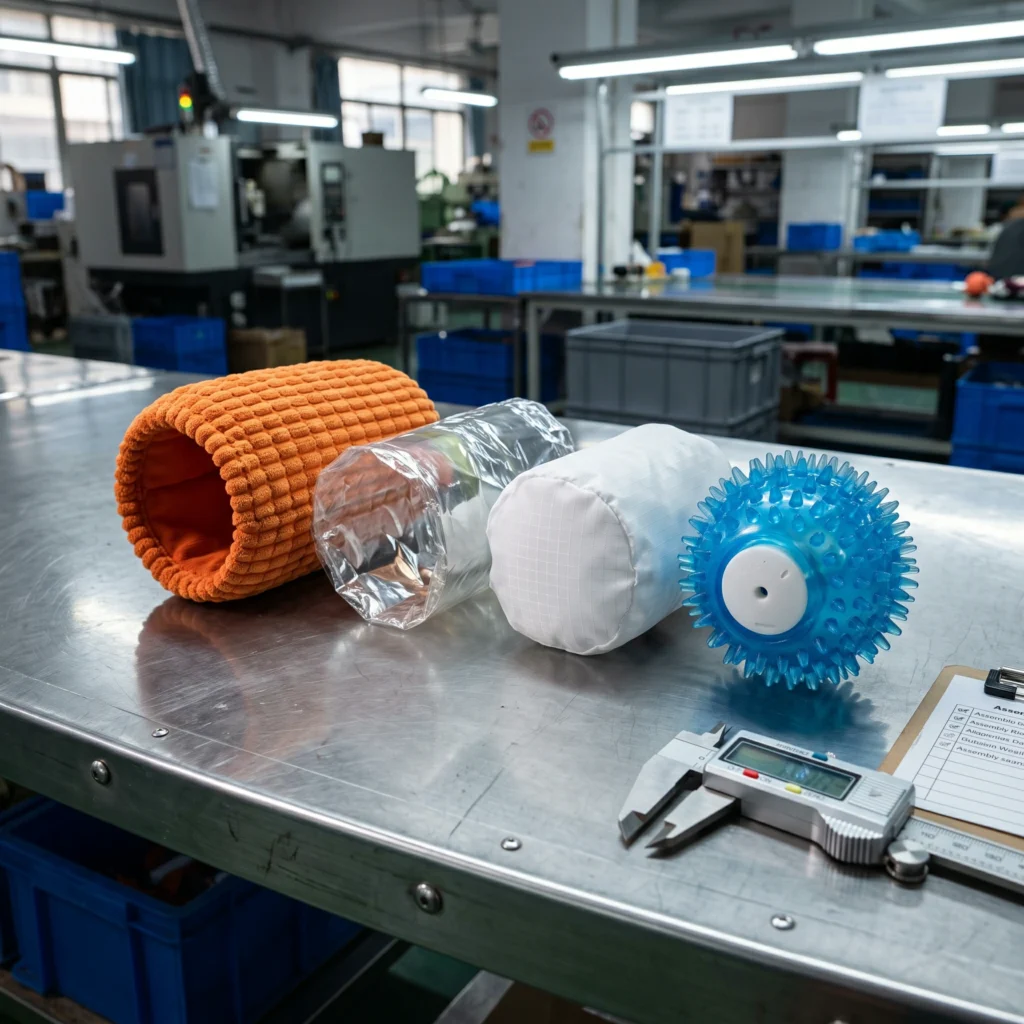
| Phase 4: Assembly & Stuffing | Sewing panels, inserting TPR squeakers, and filling with PP cotton. | Pull-testing seams (target: 15kg+ tensile strength). | 10 Days |
| Phase 5: Metal Detection & Packing | Running every finished toy through a conveyor needle detector machine. | 100% pass rate required for stray metal/broken needles. | 3 Days |
Strict Quality Assurance Protocols
Our commitment to strict quality control and safety standards is embedded in our standard operating procedures. The transition from raw fabric to a finished, branded pet toy requires multiple checkpoints.
Here is the checklist our line inspectors execute before authorizing vacuum compression and carton sealing:
- Tensile Seam Stress Testing: Utilizing a dynamometer, we apply continuous pull-force to the primary seams and the attached woven brand label to ensure it withstands aggressive tugging without thread rupture.
- Squeaker Position Verification: Ensuring the internal EVA/TPR squeaker is deeply embedded within the PP cotton stuffing, far from the exterior fabric layer, to prevent easy puncturing by canine incisors.
- Needle Clearance Protocol: Absolute 100% conveyor scanning of all plush toys to guarantee zero broken sewing needles remain inside the product, an uncompromising safety mandate.
- Label Legibility and Alignment: Manual visual inspection to ensure the direct embroidery is perfectly centered according to the tech pack, and that all text on the legal tag is crisp, legible, and unsmudged.
- Vacuum Compression Yield Testing: Verifying that the selected plush materials and internal squeakers can survive the 72-hour vacuum compression shipping process and fully regain their original shape upon unpackaging at the Amazon FBA warehouse.
Conclusion and Next Steps for Your Brand
Upgrading stock designs into premium white label dog toys is the most capital-efficient strategy for scaling a pet brand in today’s competitive e-commerce landscape. By bypassing mold fees and leveraging Wehaopets’ established, structurally sound toy patterns, brands can focus their resources on marketing, customer acquisition, and listing optimization. As demonstrated in this case study, executing this properly requires more than just slapping a logo on a product; it demands a deep understanding of fabric behavior, stitch density, compliance law, and rigorous factory-level quality control.
From mitigating embroidery puckering on high-stretch velboa to ensuring your woven labels meet all CBP and FTC import requirements, our production team handles the micro-complexities of manufacturing so you can focus on macro-level brand growth. We treat your brand’s reputation with the exact same strict operational discipline as we treat our own manufacturing floor.
Ready to elevate your product line?
Do not let poor customization ruin a great product. To get started on your private label project, please send your vector logo files (.AI or .EPS format) to our engineering team. We will analyze your artwork against our material specifications and quote the most durable, cost-effective branding application method for your chosen stock fabrics.Contact Us today to secure your production slot and discuss your specific MOQ requirements with a dedicated Customization Specialist.
Frequently Asked Questions (FAQ)
1. What is the difference between an OEM custom mold and white label dog toys?
OEM custom molded toys require you to pay for the 3D design, prototyping, and physical molds to create an entirely new shape from scratch, which takes significant time and capital. White label dog toys utilize our factory’s existing, pre-tested shapes and patterns, allowing you to simply apply your custom branding (like embroidery or woven labels) and go to market rapidly without mold fees.
2. Is there a digitizing fee for direct embroidery on plush toys?
Yes, there is usually a one-time digitizing fee (typically ranging from $30 to $60) to convert your vector logo into a machine-readable DST file. This process dictates the stitch path, underlay, and density required to properly embroider your specific logo onto stretchable plush fabric without distortion. Once digitized, this file is kept on record for all future reorders without additional fees.
3. What is the standard Minimum Order Quantity (MOQ) for custom woven labels?
While our standard toy MOQ might be 500 units, woven label factories typically require a minimum run of 1,000 to 3,000 labels due to the setup time on the weaving looms. However, Wehaopets can produce the labels in bulk to secure the lowest price per piece (often fractions of a cent) and keep the unused labels safely in our factory inventory for your future purchase orders.
4. Will the embroidery or woven labels survive aggressive chewing and machine washing?
Absolutely. We use high-tensile polyester thread for both our direct embroidery and our woven damask labels. Polyester is naturally hydrophobic, meaning it repels canine saliva, resists color bleeding during machine washing, and provides superior abrasion resistance compared to standard cotton or rayon threads.
5. How do you prevent the woven brand labels from fraying at the edges?
We utilize specialized ultrasonic cutting technology for all of our woven labels. Instead of slicing the fabric with a blade, ultrasonic sound waves melt and fuse the polyester fibers at the exact cut line. This creates a permanently sealed, smooth edge that cannot fray, eliminating a potential choking hazard.
6. Can you help ensure our white label dog toys are FTC and CPSIA compliant for US import?
Yes. Our production and compliance teams are well-versed in US and EU import regulations. We ensure your tracking labels, country of origin marks, and material composition tags are accurately printed and permanently affixed to the primary seam of the toy in accordance with strict FTC and CPSIA legal guidelines.
7. Can we use heat transfer printing instead of embroidery to save money?
Heat transfer printing is highly cost-effective and excellent for capturing fine details or full-color gradients. However, its success depends entirely on the base fabric. It works perfectly on smooth surfaces like nylon, canvas, or neoprene. We do not recommend heat transfer printing on high-pile plush or shaggy faux fur, as the heat press will crush the fibers and the design will crack over time. Our team will always advise the best application method based on your chosen stock item.