Project Brief
- Client Profile: A Fortune 500 corporate brand requiring promotional pet toys for a global marketing campaign.
- The Color Challenge: The brand’s signature Pantone 186 C (a vibrant, highly saturated red) looked dull, inconsistent, and shifted in hue (metamerism) when applied to high-pile Crystal Soft Velboa fabric.
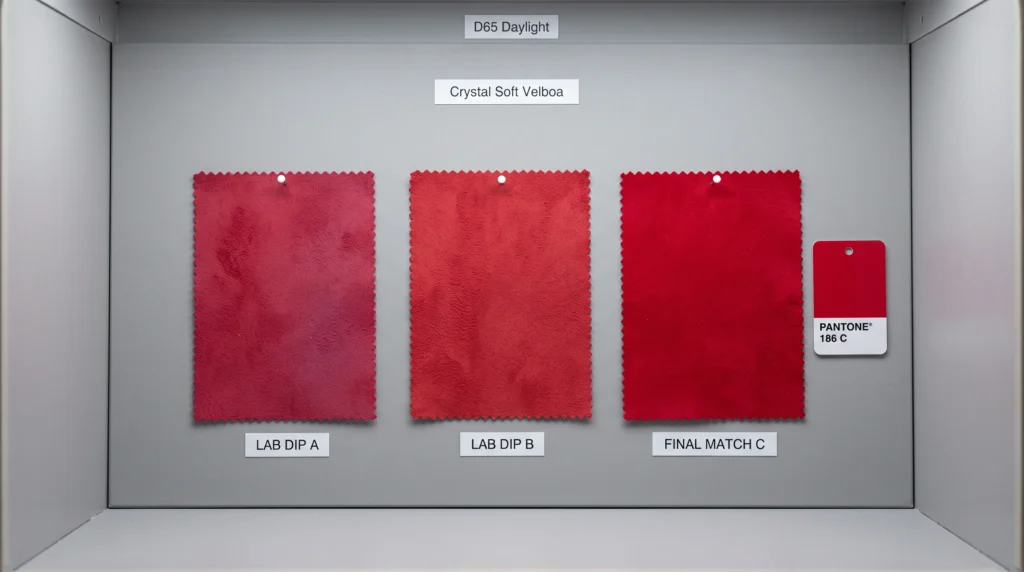
- The Wehaopets Solution: Systematically adjusting the Azo-free disperse dye formula, strictly controlling dye bath pH and temperature exhaustion curves, and conducting 4 rounds of precise Lab Dips evaluated under standard D65 daylight.
- Final Match Accuracy: > 98% visual and spectrophotometric match (ΔE < 0.8) under standardized light, passing all safety and colorfastness protocols.
Overview
Achieving exact brand color replication on high-pile polyester textiles is an intricate intersection of polymer chemistry, optical physics, and strict process engineering. In this technical case study, our dyeing lab demonstrates that reaching a Delta E (ΔE) of less than 1.0 for highly saturated shades like Pantone 186 C on Crystal Soft Velboa cannot be accomplished through linear dye concentration scaling. It requires mitigating geometric metamerism caused by the fabric’s multidirectional pile, utilizing a carefully buffered Azo-free disperse dye system, and executing rigorous reduction clearing. The implication for corporate merchandising directors is clear: precise color fidelity in plush manufacturing mandates a scientifically controlled environment, rather than simple visual approximations. Relying on an advanced custom pet toy factory ensures brand integrity is never compromised at the chemical level.
The Science of Color on High-Pile Textiles
When acting as an OEM dog toy manufacturer, we frequently encounter the assumption that matching a paper Pantone swatch to a textile is a direct translation. However, Crystal Soft Velboa presents unique optical challenges. Unlike flat-woven cotton or paper, velboa is a warp-knitted pile fabric made from micro-denier polyester yarns.
The physical structure of the pile means that light does not reflect off a flat, uniform surface. Instead, light enters the dense matrix of fibers, scattering and absorbing at multiple angles before reflecting back to the observer’s eye. This creates “geometric metamerism,” where the color appears to shift depending on the viewing angle and the direction in which the pile is brushed.
To overcome this, our fabric technologists utilize a dual-angle spectrophotometer calibrated to read the spectral reflectance of the fabric across a 400nm to 700nm wavelength range. We must establish a baseline reading that accounts for the inherent luster of the polyester polymer.
Table 1: Material Characteristics Impacting Spectral Reflectance
| Textile Parameter | Crystal Soft Velboa (Polyester) | Standard Flat Plush | Impact on Dye Formula for Pantone 186 C |
| Fiber Denier | Micro-denier (0.5 – 1.0 dpf) | Standard (2.0 – 3.0 dpf) | Requires 20-30% more dye stuff to achieve the same depth of shade due to increased surface area. |
| Pile Height | 1.5mm – 5.0mm | 1.0mm – 2.0mm | High pile traps light; requires specific dye combinations with high build-up properties to prevent a “washed-out” appearance. |
| Luster/Sheen | High (Trilobal cross-section) | Low to Medium | High luster dilutes perceived color saturation; formulation must over-compensate on chroma. |
| Dye Class | Disperse Dyes | Reactive / Acid Dyes | Disperse dyes require high heat (130°C) and pressure for diffusion into the hydrophobic polyester core. |
Formulating Azo-Free Disperse Dyes for Pantone 186 C
Pantone 186 C is a brilliant red that requires high dye concentrations. The primary constraint in our laboratory is maintaining strict adherence to global safety protocols, ensuring all formulations are strictly Azo-free and non-toxic. Wehaopets operates as a responsible branded plush toys wholesale supplier, meaning we never compromise safety for color yield. You can review our comprehensive pet product safety standards for our complete compliance matrix.
To synthesize Pantone 186 C, our lab formulated a trichromatic combination of high-energy disperse dyes. Disperse dyes are practically insoluble in water; they must be milled to a particle size of less than 1 micron and held in a stable dispersion using complex dispersing agents.
The dyeing process for the velboa requires a high-temperature, high-pressure (HTHP) exhaust method. The dye bath is buffered with acetic acid to maintain a strict pH of 4.5 to 5.0. If the pH fluctuates above 5.5, the disperse red dyes undergo alkaline hydrolysis, leading to a dull, brownish color shift—a fatal error when matching a vibrant corporate red.
The Dye Exhaustion Curve
The thermodynamic process of transferring the dye from the aqueous bath into the solid polyester fiber involves three phases:
- Adsorption: Dye molecules migrate to the surface of the velboa fibers.
- Diffusion: Under 130°C heat, the amorphous regions of the polyester polymer chain expand, lowering the glass transition temperature (Tg) and allowing the dye molecules to enter the fiber core.
- Fixation: As the bath cools, the polymer chains close, mechanically trapping the dye molecules inside the fiber.
The Iterative Lab Dip Process
Theoretical dye formulations must always be validated through physical Lab Dips. A Lab Dip is a small sample of the actual bulk fabric dyed in a laboratory-scale HTHP machine. For this Fortune 500 client, we executed a rigorous iterative process to close the Delta E gap.
Table 2: Mandatory Lab Dip Result Iterations for Pantone 186 C
| Lab Dip Iteration | Dye Formula Adjustment (Trichromatic Base) | Colorfastness Score (ISO 105-C06) | Result / Action Taken |
| Round 1 (A) | 2.5% Red, 0.2% Yellow, 0.05% Blue. pH 4.5. | 3-4 (Slight staining on nylon) | Rejected. Spectrophotometer read ΔE = 2.4. Hue was slightly too blue under D65. Adjusted yellow component to warm the shade. |
| Round 2 (B) | 2.6% Red, 0.35% Yellow, 0.02% Blue. pH 4.8. | 4-5 (Excellent) | Rejected. ΔE = 1.2. Visual match was close, but pile direction caused a slight metameric failure under store lighting (TL84). |
| Round 3 (C) | 2.65% Red, 0.32% Yellow, 0.01% Blue. Added UV absorber. | 4-5 (Excellent) | Rejected. ΔE = 0.9. Color was exact, but saturation felt microscopically dull compared to the coated paper standard. |
| Final (D) | 2.7% Red, 0.33% Yellow. Zero Blue. Optimized reduction clearing. | 5 (Perfect, no staining) | Approved. ΔE = 0.6. Flawless visual match across all angles. Color is vibrant and stable. Client signed off on swatch D. |
Overcoming Metamerism: Standardized Light Evaluation
Metamerism is the phenomenon where two colors appear to match under one light source but look different under another. This is caused by differences in the spectral power distribution of the light sources and the spectral reflectance curves of the colored objects. Since our client’s promotional pet toys would be displayed in various environments—from outdoor events to big-box retail aisles—metameric failure was not an option.
To guarantee fidelity, our QA engineers evaluate all Lab Dips inside a standardized Datacolor light box, stripping away the variables of ambient factory lighting.
Mandatory Light Box Checklist:
- 💡 D65 Daylight (6500K): This is the international standard for artificial daylight. We use this as our primary baseline for all Pantone matching. If the color fails under D65, it is immediately sent back to the lab for reformulation.
- 💡 TL84 Store Light (4000K): A narrow-band triphosphor fluorescent lamp representing standard commercial lighting found in major retail chains. We check this to ensure the red does not shift towards orange when on the shelf.
- 🔍 UV Light (Ultraviolet): Used to detect the presence of optical brightening agents (OBAs) in the base fabric and to ensure the dyes do not exhibit unwanted fluorescence, which can distort the color depth.
Validation: Colorfastness to Saliva and Washing
Matching the color is only half the engineering challenge; retaining that color when subjected to mechanical and chemical stress by a dog is the other. As a premier custom pet toy factory, we hold our textiles to rigorous testing parameters derived from the AATCC (American Association of Textile Chemists and Colorists) and ISO standards.
When a dog chews a plush toy, the fabric is subjected to friction, moisture, and the slightly alkaline nature of canine saliva. If the dye molecules are not fully fixated and cleared from the surface, they will migrate, potentially staining the dog’s fur or causing ingestion hazards.
To prevent this, our final stage in the laboratory dyeing process is “Reduction Clearing.” We treat the dyed velboa with sodium hydrosulfite and sodium hydroxide at 70°C. This chemical reaction destroys and washes away any unfixed dye molecules resting on the surface of the polyester fibers, leaving only the internally fixated dye.
Table 3: ISO 105 Colorfastness Test Matrix for Final Approved Swatch
| Test Standard | Stressor Simulated | Methodology | Target Score | Achieved Score |
| ISO 105-C06 | Machine Washing | 40°C wash with standard detergent, evaluated against a multifiber adjacent fabric. | ≥ 4 | 4-5 |
| ISO 105-X12 | Mechanical Rubbing (Crocking) | Wet and dry rubbing using a standard cotton crocking cloth under 9N downward force. | ≥ 4 (Dry), ≥ 3 (Wet) | 4-5 (Dry), 4 (Wet) |
| ISO 105-E04 | Perspiration / Saliva | Fabric soaked in simulated alkaline and acidic saliva solutions, held under pressure for 4 hours at 37°C. | ≥ 4 | 5 |
Quality Control in Mass Production
Translating a successful Lab Dip to bulk production requires scaling up from a 10-gram fabric sample to a 500-kilogram dye lot. The fluid dynamics and liquor ratios (the ratio of fabric weight to water volume) change drastically in massive jet dyeing machines.
To maintain the ΔE < 0.8 tolerance achieved in the lab, our production facility utilizes automated dye dosing systems. The exact trichromatic formula approved in the Lab Dip is programmed into the system, ensuring dye stuff and auxiliaries are dispensed to the microgram. Temperature sensors inside the dyeing vessels follow a computerized heat curve, raising the temperature by exactly 1.5°C per minute to prevent uneven dye strike (blotching).
Every bulk batch is subsequently cut and measured via spectrophotometer before being released to the cutting and sewing floors. This strict, uncompromising approach is why top-tier franchises trust us as their dedicated OEM dog toy manufacturer. We eliminate the guesswork from textile sourcing.
Conclusion and Factory Directives
Achieving an exact brand Pantone match on a complex substrate like Crystal Soft Velboa is not an accident; it is a calculated chemical process. By understanding the physics of geometric metamerism, formulating stable Azo-free dye combinations, rigorously utilizing standard illuminants, and enforcing strict reduction clearing for colorfastness, our factory ensures absolute brand consistency. The transition from a paper Pantone chip to a durable, safe, and visually striking pet toy represents the pinnacle of modern textile engineering.
Initiate Your Custom Sourcing Project
Does your brand require exact color fidelity for your next product rollout? Send our dyeing lab your exact PMS codes, fabric preferences, and safety requirements. Our fabric technologists will begin formulating your custom color swatches immediately. Contact Us today to secure your production timeline.
Frequently Asked Questions (FAQ)
Q: What is the standard MOQ (Minimum Order Quantity) for custom Pantone dyeing?
A: For custom Pantone dyeing on materials like Crystal Soft Velboa, our MOQ is typically 500 kilograms per color, which translates roughly to 1,500 to 2,000 yards depending on the fabric’s GSM (Grams per Square Meter). This ensures the stability of the jet dyeing machine’s liquor ratio.
Q: What is the lead time for producing a custom Lab Dip?
A: Our laboratory typically requires 5 to 7 business days to formulate, dye, and test initial Lab Dips (A, B, and C variations). This time includes conditioning the fabric in standard atmospheric conditions before spectrophotometer reading.
Q: Why does my brand’s Pantone color look different on my computer screen compared to the fabric?
A: Computer screens emit color using the RGB (Red, Green, Blue) additive light model, whereas textiles reflect light using subtractive dyes. Additionally, screen backlighting creates a false sense of luminosity that cannot be chemically replicated on matte or pile fabrics.
Q: How do you ensure the dyes used on custom pet toys are safe for dogs?
A: We strictly utilize Azo-free disperse dyes and conduct rigorous reduction clearing to remove unfixed surface dyes. All our custom fabrics undergo third-party testing (such as SGS or Intertek) to pass ASTM F963, EN71, and ISO 105 colorfastness standards for saliva and heavy metals.
Q: What happens if a Lab Dip fails under standard D65 daylight testing?
A: If a Lab Dip yields a Delta E (ΔE) greater than our accepted tolerance (> 1.0) or exhibits metameric failure under D65 daylight, the swatch is rejected. The dye formula is re-calculated using our Datacolor matching software, and a new round of dipping is initiated.
Q: Can you match a color from a physical fabric swatch instead of a Pantone code?
A: Yes. Our lab is equipped with a dual-angle spectrophotometer that can scan a physical fabric swatch you provide. We extract the spectral reflectance curve to generate a custom dye formula, though a Pantone code provides a more universally standardized baseline.
Q: How does pile direction on Velboa affect the perceived color of the plush toy?
A: Pile direction creates geometric metamerism. When you brush the velboa against the pile, it absorbs more light and appears darker and more saturated. Brushing with the pile reflects more light, making it appear lighter and shinier. We match the color based on a standardized 45-degree angle reading to balance this effect.