Overview: As a B2B OEM/ODM manufacturing partner, our core business model is eliminating procurement risks for global distributors. To meet target users’ demands for zero-defect inventory, all our heavy-duty toys must survive a continuous 30-lb static pull test for 15 seconds without seam separation exceeding 2mm. This stringent engineering ensures profitable, recall-free distribution.
The Core Challenge: Canine PSI vs. Standard Textiles
In our testing lab at Wehao Pets, we approach plush toy durability strictly as a mechanical and materials engineering problem. The consumer market often misunderstands product failure, attributing it to the aggressiveness of the animal rather than the structural deficiency of the product. From an engineering standpoint, a canine jaw operates as a biological hydraulic press, applying varying degrees of kinetic, static, and shearing loads directly to textile fibers.
When evaluating the performance of conventional pet products, the failure is mathematically predictable. The average German Shepherd exerts approximately 238 PSI (Pounds per Square Inch) of bite force, while larger mastiff breeds can exceed 500 PSI. Standard 210D Oxford cloth, commonly utilized in low-tier manufacturing, possesses a burst strength of roughly 80 PSI. The disparity between applied kinetic force and material yield strength inevitably results in catastrophic material failure.
To bridge this massive structural deficit, the most durable plush dog toys manufacturers must engineer multi-layered composite textiles and employ industrial-grade binding techniques. We do not rely on standard fabric grades; we calibrate our materials based on specific mechanical thresholds. Our engineers analyze the exact vector forces applied during typical canine interaction—specifically puncturing (tooth penetration), shearing (head shaking and tearing), and static pulling (tug-of-war mechanics). By quantifying these exact physical interactions, our factory develops proprietary reinforcement grids that distribute stress loads across the entirety of the toy’s surface area, rather than allowing the force to isolate and rupture a single seam.
Canine Bite Force Vectors vs. Required Material Specifications
| Canine Jaw Mechanic | Average Applied Force | Primary Point of Failure | Required Textile Engineering Threshold | Minimum Coating/Backing Standard |
| Static Crushing (Molars) | 200 – 450 PSI | Internal squeaker collapse, fabric perforation | > 600 PSI Burst Resistance | 0.5mm Thermoplastic Polyurethane (TPU) |
| Puncture & Drag (Canines) | 150 – 300 PSI | Linear fabric tearing, mesh compromise | 1680D Ballistic Nylon (Ripstop grid) | Dual-layer cross-bonded mesh |
| Shearing/Tugging (Incisors) | 50 – 150 lbs Kinetic Pull | Seam thread snapping, edge fraying | 45+ lbs Tensile Thread Strength | Quadruple-stitched nylon bindings |
Step 1: Raw Material Stress-Strain Testing and Denier Verification
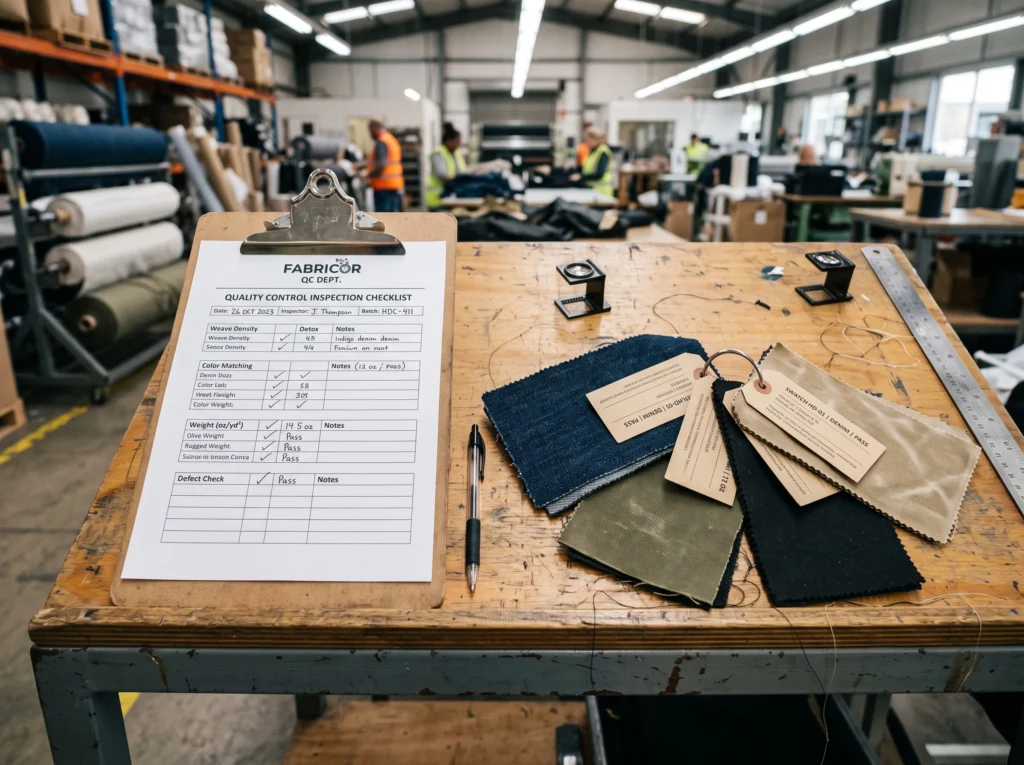
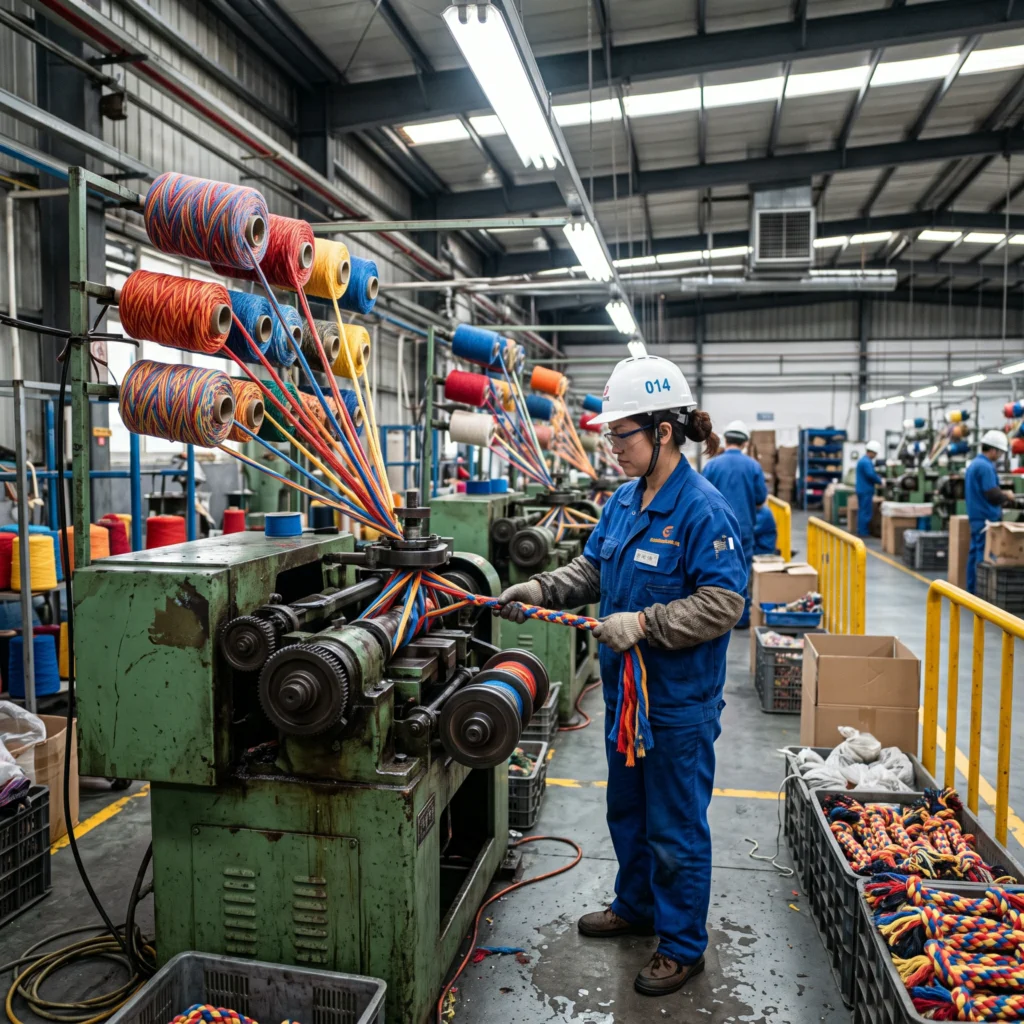
The manufacturing process for our highly robust product lines begins long before the assembly line is activated. It starts in our materials calibration laboratory, where we verify the structural integrity of every raw fabric roll that enters our facility.
Tensile Strength Calibration of Raw Textiles
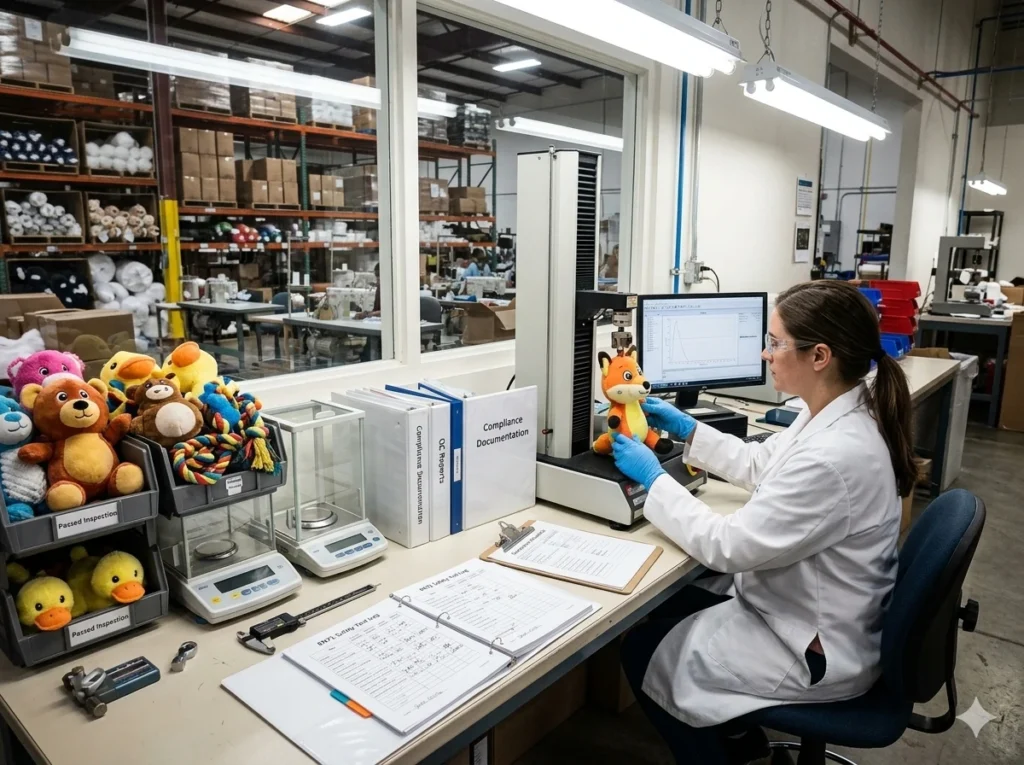
When raw textiles arrive, our engineers immediately subject random cuttings to stress-strain analysis using precision pneumatic clamps and a tensile strength gauge. We are searching for the exact yield point—the specific amount of force required to permanently deform the structural matrix of the woven fibers. Standard polyester blends typically fail our baseline diagnostics because their polymer chains lack the elasticity required to absorb kinetic shock. Instead, we utilize high-denier ballistic nylons and specialized canvas weaves. Our pneumatic machines slowly apply opposing forces to the fabric, logging the exact poundage at which the warp (lengthwise threads) or weft (crosswise threads) begin to separate.
To combat the inherent weaknesses found in commercial-grade textiles, we have identified specific structural vulnerabilities that plague the industry.
5 Critical Failure Points in Standard Plush Assemblies
- Seam Delamination: Occurs due to inferior thread tension and inadequate stitches-per-inch (SPI) calibration during the sewing phase.
- Puncture Propagation: Single-layer woven textiles lack the cross-hatch reinforcement to stop a canine tooth hole from expanding into a linear tear.
- Internal Component Collapse: Hollow plastic squeakers shatter under compressive molar loads, creating hazardous plastic shards.
- Saliva-Induced Fiber Degradation: Alkaline canine saliva breaks down standard polyurethane coatings, rapidly decreasing textile tensile strength over days of use.
- Kinetic Component Detachment: Appendages (ears, tails, limbs) are ripped away because they are top-stitched rather than deeply anchored into the internal skeleton of the toy.
Polyurethane (PU) and TPU Backing Integration
To solve puncture propagation, we do not rely solely on the outer layer. We thermally bond a dense thermoplastic polyurethane (TPU) membrane to the reverse side of our heavy-duty fabrics. This creates a waterproof and structurally rigid composite material. Before mass production, this composite undergoes hydrostatic pressure testing to ensure the lamination process was flawless. If the TPU layer separates from the nylon weave at less than 40 PSI of applied pressure, the entire batch of raw material is rejected.
Step 2: Precision CNC Fabric Cutting and Seam Architecture
Once the composite textiles pass our raw material laboratory diagnostics, they move into the structural drafting and cutting phase. The geometry of a heavy-duty dog toy dictates its survivability. Sharp corners or protruding appendages act as mechanical levers that canine jaws can grip and tear. Therefore, our CAD engineers design overarching, continuous curves that deny teeth easy gripping points.
Laser Sealing vs. Mechanical Shearing
In our Dongguan facility, we abandon traditional mechanical die-cutting for our high-durability lines. Mechanical blades crush the fabric edges, leaving micro-frays that compromise the structural integrity of the seam before it is even sewn. Instead, we utilize high-wattage CNC laser cutting arrays. The thermal precision of the laser not only cuts the 1680D nylon composite to a tolerance of 0.1mm but simultaneously cauterizes and melts the edges of the synthetic fibers. This edge-sealing prevents any potential for edge fraying inside the seam, a critical necessity when the product is subjected to heavy tugging forces.
Multi-Layer Cross-Stitching and Thread Tension
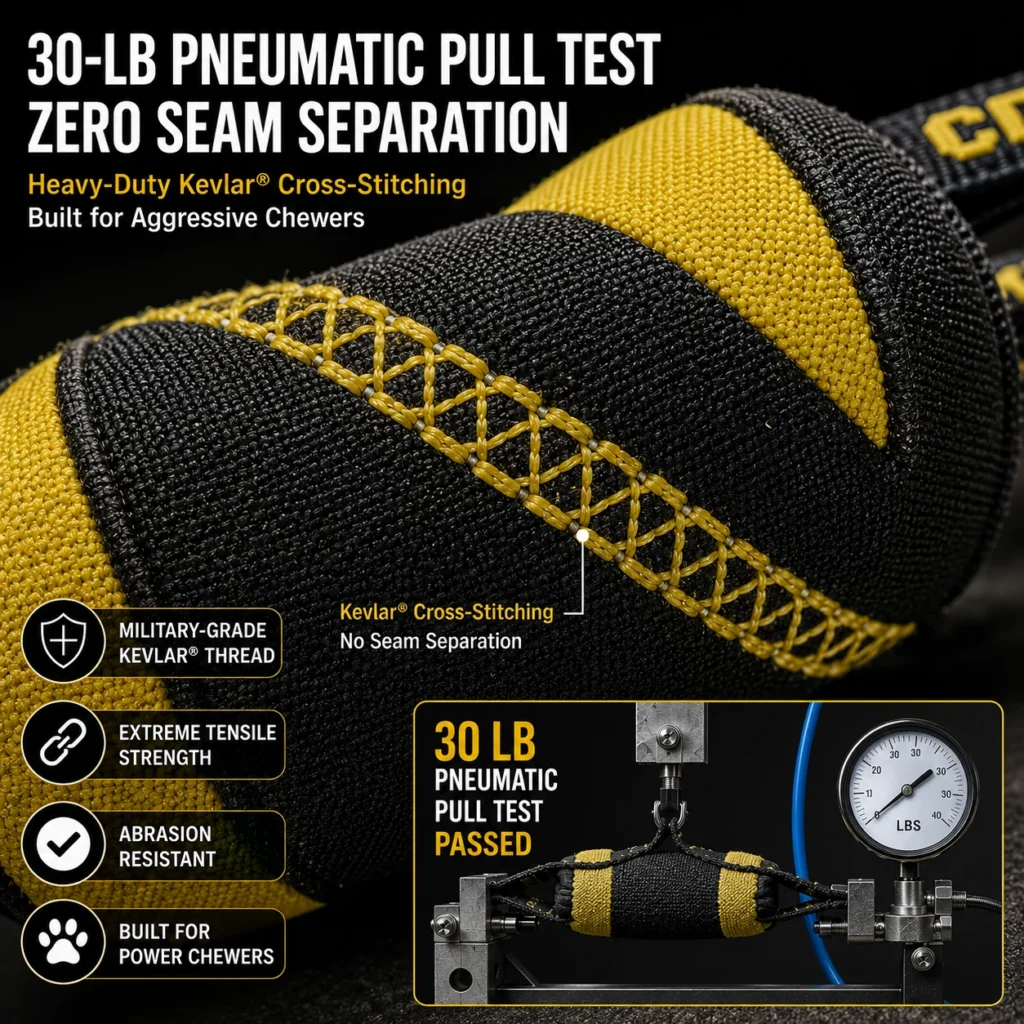
The most robust fabric in the world is useless if the seams binding it are fragile. Our assembly engineers utilize industrial walking-foot sewing machines equipped with high-tensile, bonded nylon thread (often incorporating Kevlar blends for extreme applications). We mandate a strict 9 Stitches-Per-Inch (SPI) calibration. If the SPI is too low, canine teeth easily slip between the stitches; if the SPI is too high, the needle perforates the fabric excessively, creating a micro-perforation line that will tear like a postage stamp under load.
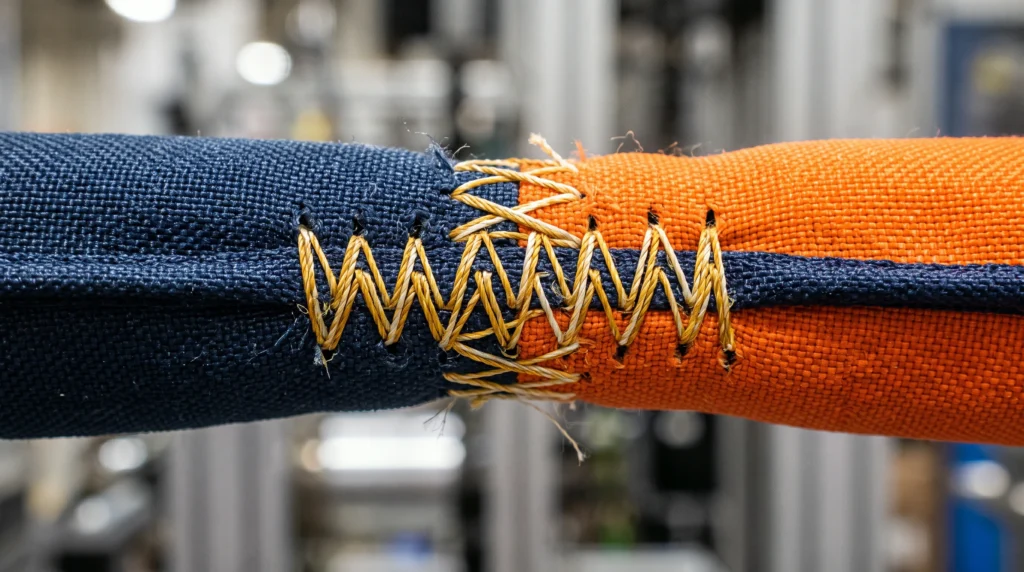
We employ a multi-layered seam architecture. First, the edges are joined with a standard straight stitch. The fabric is then folded back upon itself (a French seam hybrid) and secured with a wide zigzag overlock stitch, binding the raw edge deep inside the toy. Finally, an external edge binding tape (often made of seatbelt-grade nylon webbing) is applied and double-stitched down, creating four independent layers of mechanical defense against seam blowout.
Step 3: Multi-Axis Seam Integrity and Tensile Load Application
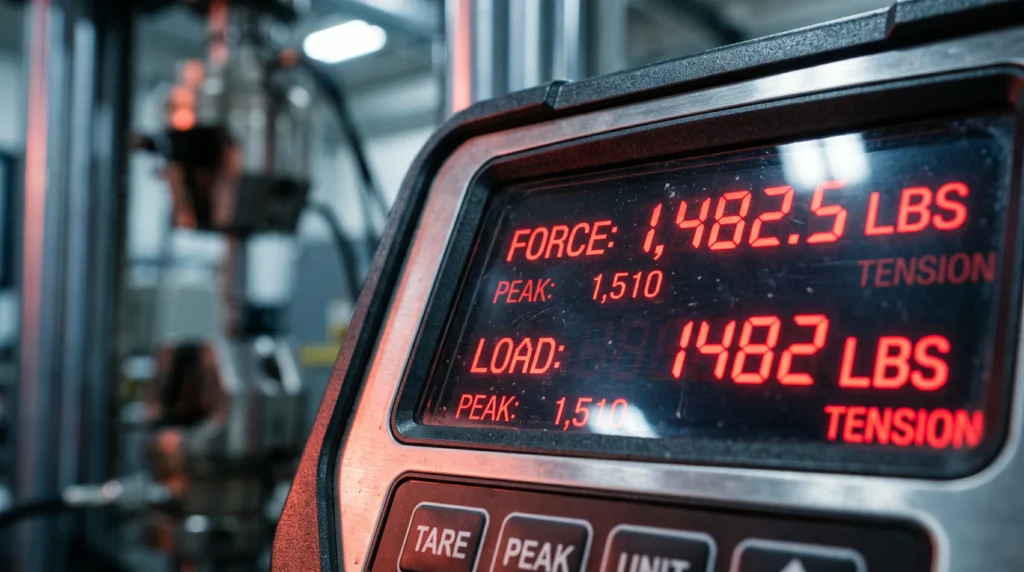
After initial prototyping, our lab conducts brutal destructive testing. We do not guess how long a product will last; we tear it apart mechanically to find its absolute failure point. This data is critical for our B2B partners who require empirical data to support their marketing claims regarding durable plush dog toys.
Static Pull Tests with Pneumatic Clamps
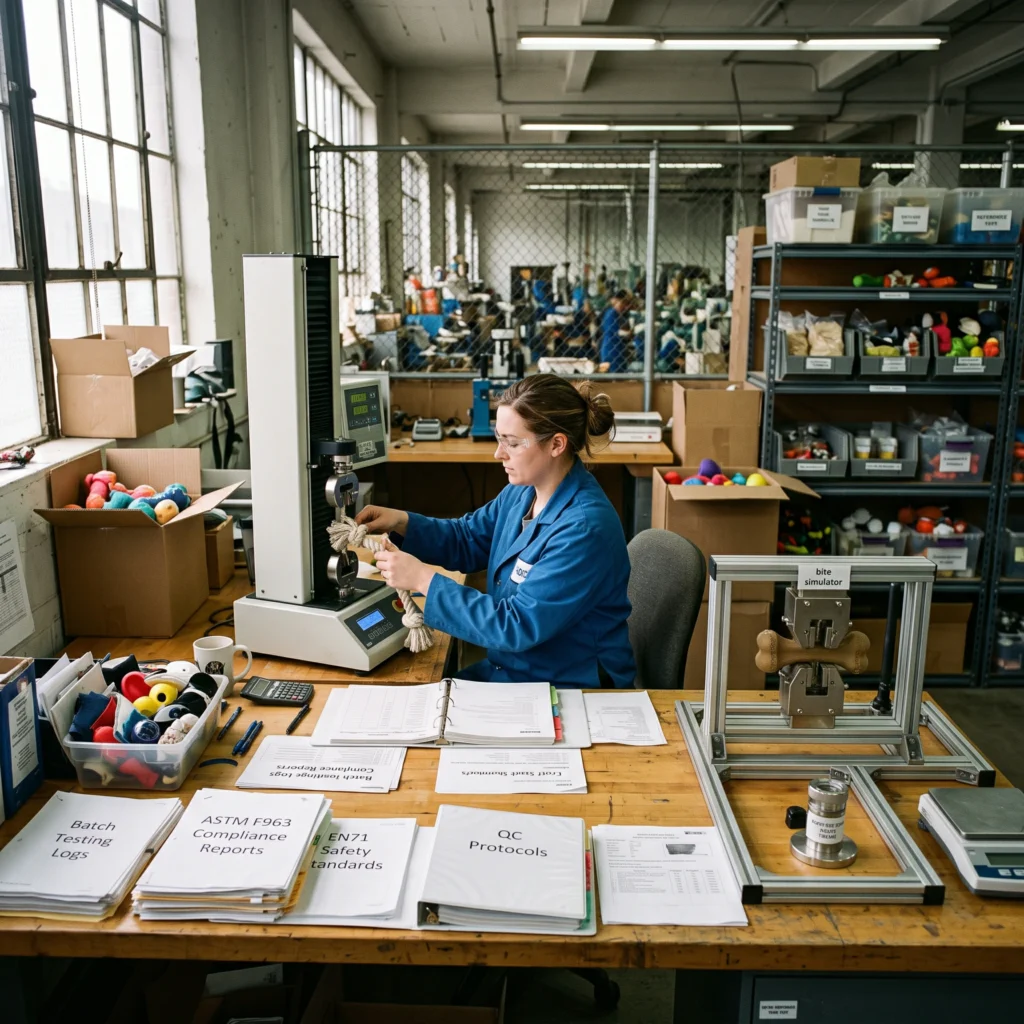
We utilize specialized testing hardware similar to the equipment manufactured by Instron’s textile testing divisions to apply controlled, measurable violence to our prototypes. The toy is secured in dual pneumatic clamps—one gripping the main body, the other gripping a specific extremity (like an arm or a rope attachment). The machine then exerts a static, increasing linear pull.
Our baseline standard requires that the seam withstand a continuous static load of 30 lbs for 15 seconds. During this 15-second window, our lab technicians utilize digital calipers to measure the seam gap. If the thread separates allowing a gap exceeding 2mm, the seam architecture is deemed a failure. A 2mm gap is wide enough for a canine incisor to hook the internal thread and apply direct shearing force, which will quickly unravel the product.
Dynamic Kinetic Load Simulation
Static pulls only tell half the story. Dogs do not pull smoothly; they jerk and thrash. We subject the prototypes to dynamic kinetic loading—a heavy mechanical arm aggressively jerks the toy with up to 50 lbs of sudden kinetic force at random intervals, simulating the violent head-shaking of a large breed.
Tensile Strength Testing and QA Parameters
| Testing Phase | Hardware Deployed | Applied Force Metric | Duration/Cycles | Maximum Allowable Tolerance (Pass/Fail) |
| Static Linear Pull | Dual Pneumatic Clamps | 30 lbs to 50 lbs | 15 continuous seconds | < 2mm seam separation, zero thread snapping |
| Kinetic Jerk Load | Mechanical Thrash Arm | 50 lbs sudden force | 100 consecutive cycles | Zero internal lining delamination |
| Shear Torsion Test | Multi-Axis Torsion Rig | 25 lbs rotating force | 360-degree rotation | Zero exterior fabric warp distortion |
Step 4: Puncture Resistance and Bite Simulation Protocols
Tensile strength prevents the toy from being ripped in half, but puncture resistance is required to stop the toy from being hollowed out. A canine tooth operates as an awl, focusing massive PSI onto an area measured in fractions of a millimeter.
Canine Tooth Penetration Modeling
In our facility, we utilize a digital penetrometer equipped with steel fixtures machined to perfectly mimic the angle, sharpness, and taper of a large breed’s carnassial and canine teeth. This machine drives the steel “tooth” into the fabric surface at varying velocities and pressure levels.
When the steel tooth penetrates our primary defense layer, we carefully monitor what happens next. In standard plush fabrics, the puncture immediately compromises the surrounding weave, leading to rapid tearing. Because we engineer our fabrics with specialized ripstop grids—a technique where thicker reinforcement threads are interwoven at regular intervals—the puncture is mechanically arrested. The steel tooth may create a 2mm hole, but the structural grid stops that hole from expanding to 3mm, even when subsequent lateral force is applied.
Multi-Axis Torsion and Shear Stress
Once the fabric is punctured, the penetrometer introduces a 45-degree rotation, simulating a dog biting down and violently twisting its head. This shear stress is the ultimate killer of pet toys. Our inner mesh linings, bonded with the TPU backing, act as a rigid internal skeleton that resists this torsion, preventing the localized area from collapsing and giving the dog access to the internal stuffing.
Step 5: Squeaker Compression and Internal Structural Audits
The internal components of a heavy-duty dog toy are just as critical as the exterior shell. A highly durable exterior is compromised if the internal squeaker shatters, creating sharp plastic fragments that pose a severe internal laceration or choking hazard to the animal.
Squeaker Enclosures and Acoustic Testing
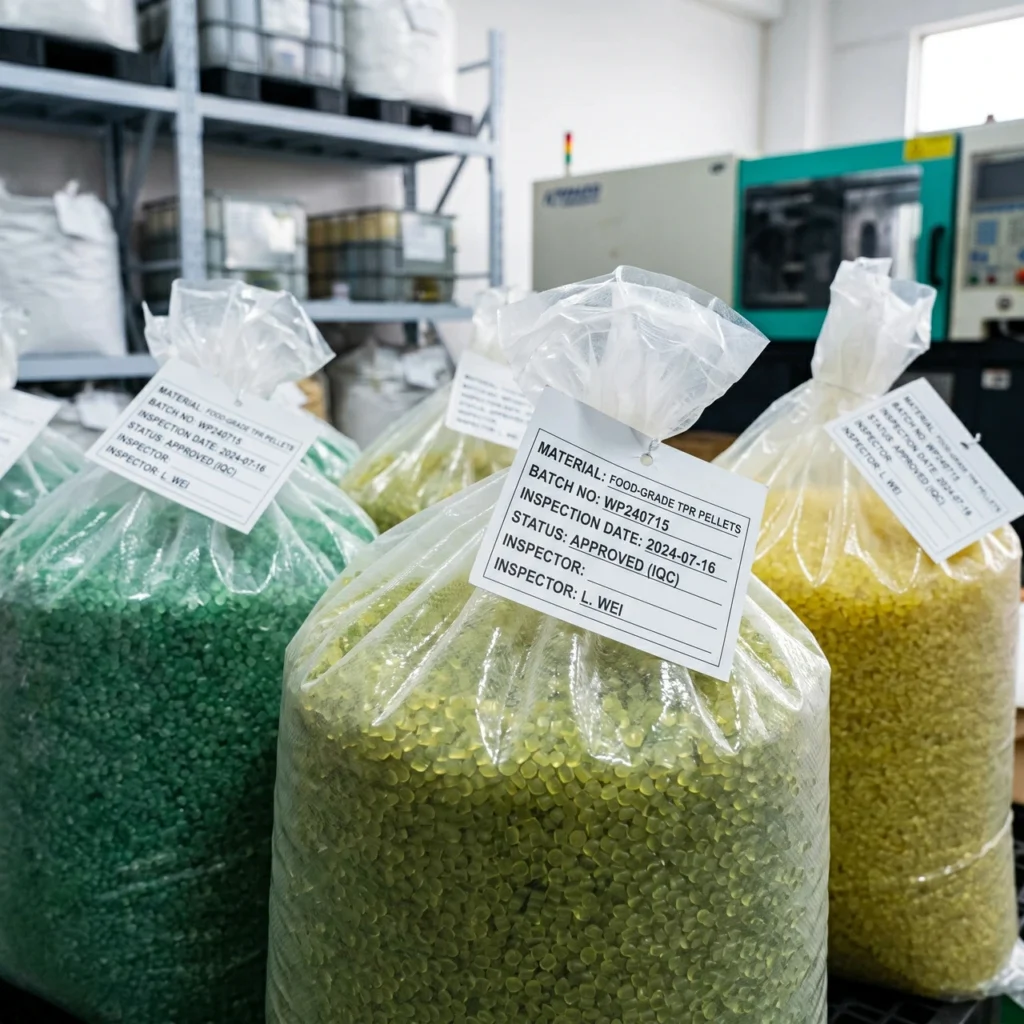
Standard Eva or PE plastic squeakers fail rapidly under 200+ PSI molar crushing loads. Our lab engineers encase our proprietary acoustic squeakers in dense, injection-molded TPR (Thermoplastic Rubber) housings. These housings act as shock absorbers. When the jaw applies crushing force, the TPR housing compresses and rebounds, protecting the fragile acoustic reed inside the squeaker mechanism. Furthermore, these squeakers are sewn into their own dedicated internal heavy-duty pouches. Even in the highly unlikely event that the outer shell is breached, the canine is met with a secondary layer of ballistic nylon, completely blocking access to the plastic component.
To execute this level of rigorous diagnostics, we rely on a specific array of industrial laboratory equipment.
6 Core Machinery Calibrated in Our Testing Lab
- Pneumatic Tensile Strength Tester (500lb capacity): Evaluates maximum thread yield limits and seam blowout thresholds.
- Digital Penetrometer: Simulates precise canine dentition punctures and tracks fabric grid resistance.
- Multi-Axis Torsion Clamp: Replicates the rotational shear stress of aggressive head-shaking.
- Spectrophotometer: Analyzes fabric colorfastness and dye stability under synthetic saliva exposure.
- Hydrostatic Pressure Gauge: Tests the integrity of internal TPU waterproofing and lamination bonds.
- Accelerated Wear Tumbler: Uses highly abrasive media to simulate months of friction and floor degradation in a 48-hour cycle.
Step 6: Environmental and Chemical QA Testing
Mechanical destruction is not the only vector of failure. Pet toys exist in a highly corrosive environment—namely, constant immersion in canine saliva, which contains enzymes and possesses varying pH levels. As an industry-leading manufacturer, ensuring compliance with global pet product safety standards is non-negotiable for our OEM/ODM clients.
Synthetic Saliva Immersion and Degradation
Our engineers submerge material prototypes in temperature-controlled vats of synthetic canine saliva for 72-hour intervals. Following immersion, the textiles are baked in an environmental chamber to simulate drying. This wet/dry cycling aggressively attacks the polymer bonds of both the thread and the polyurethane backing. After the cycling is complete, the materials are placed back into the tensile tester. If the material’s yield strength drops by more than 8% compared to its dry baseline, the chemical composition of our coatings is reformulated.
Heavy Metal and Azo-Dye Spectrometry
Beyond physical degradation, our chemical laboratory ensures absolute non-toxicity. We utilize mass spectrometry to guarantee that all dyes, pigments, and synthetic fibers are 100% free of Azo-dyes, lead, phthalates, and heavy metals. When wholesale distributors import our products into the USA, Canada, or Europe, they are armed with comprehensive chemical safety data, eliminating customs delays and shielding their brand from toxicity liability.
Step 7: AQL (Acceptable Quality Limit) and Final Batch Release
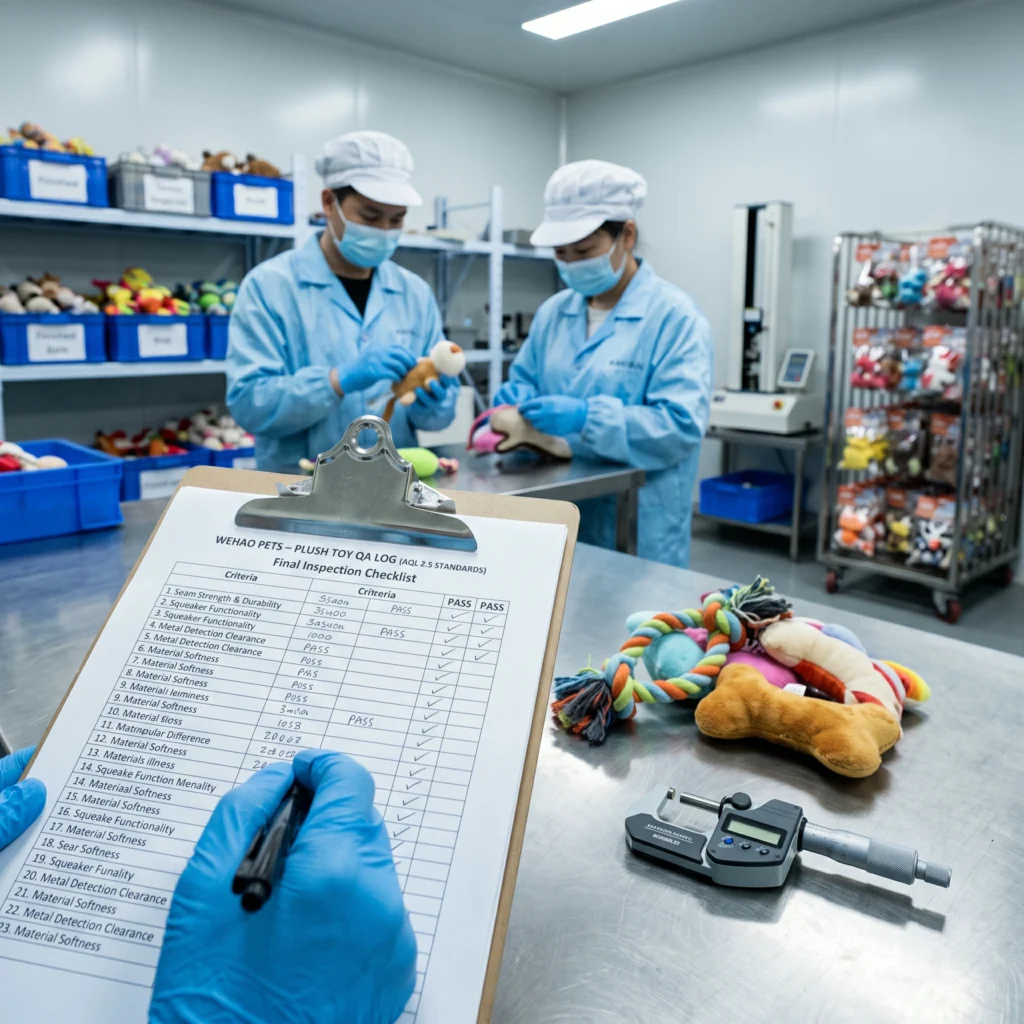
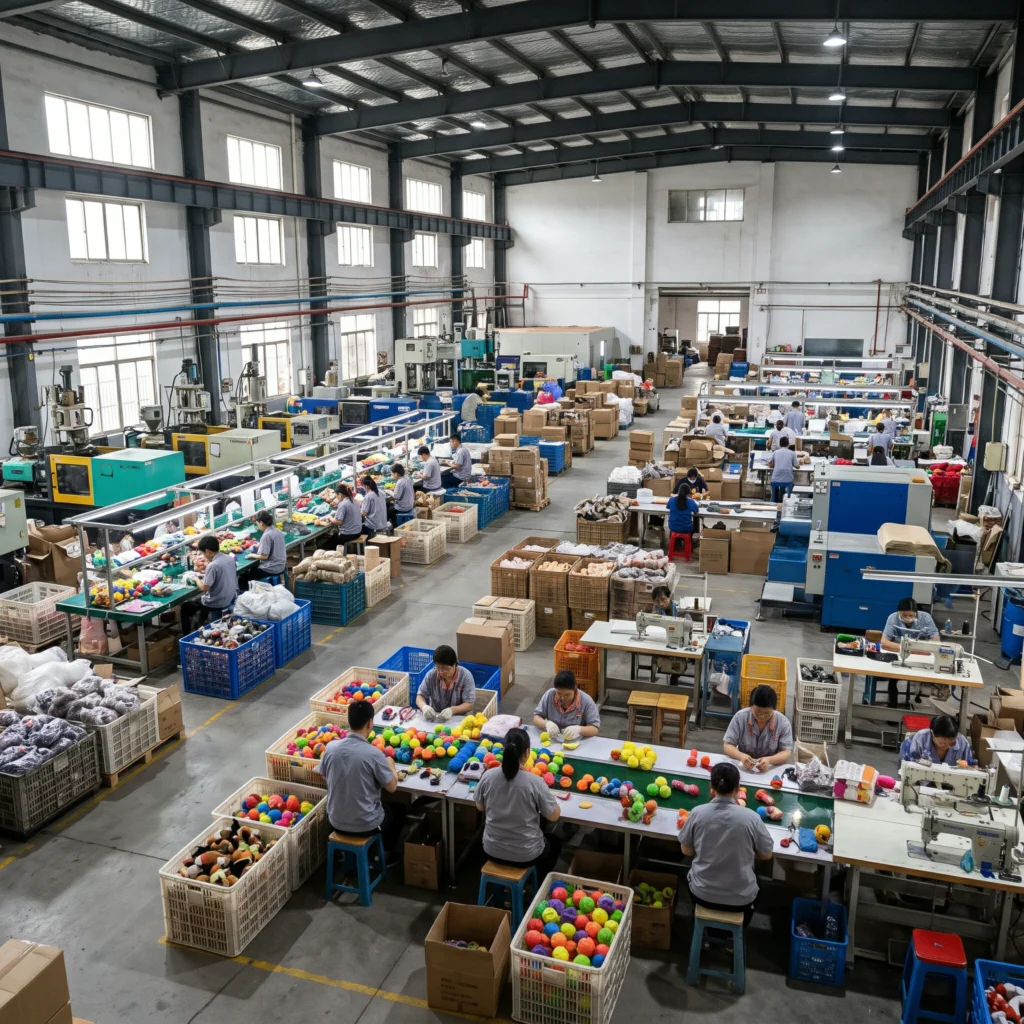
Designing an indestructible prototype in a pristine laboratory environment is one thing; scaling that quality across a 50,000-unit mass-production run is the true test of a B2B factory’s operational excellence. To guarantee consistency, we implement strict Acceptable Quality Limit (AQL) standards based on international ISO 2859-1 sampling procedures.
Statistical Sampling in High-Volume Runs
During mass assembly, our floor QA inspectors pull random samples at various stages: cutting, initial stitching, stuffing, and final closure. We employ an AQL level of 1.5 for Major Defects (e.g., missed stitches, inadequate seam allowance) and an AQL of 0 for Critical Defects (e.g., exposed squeakers, sharp internal debris, toxic dye transfer).
Failure Point Analysis and Feedback Loops
If a sample fails on the floor, the entire production line is halted. Our lab engineers perform an immediate Failure Point Analysis. Was the sewing machine needle blunt? Was the pneumatic thread tensioner out of calibration? Did a specific operator require retraining on the walking-foot sewing machine? By treating every defect as a mechanical system failure rather than human error, we systematically eliminate variances from our mass-production pipeline.
AQL 2.5 Inspection Matrix for High-Volume Wholesale
| Lot Size (Total Production Run) | Sample Size Pulled for QA | Critical Defect Tolerance (Exposed Hazards) | Major Defect Tolerance (Seam Weakness, Missed Stitch) | Minor Defect Tolerance (Slight cosmetic thread fray) |
| 3,201 – 10,000 units | 200 units | 0 (Automatic Batch Rejection) | Max 5 units allowed | Max 10 units allowed |
| 10,001 – 35,000 units | 315 units | 0 (Automatic Batch Rejection) | Max 7 units allowed | Max 14 units allowed |
| 35,001 – 150,000 units | 500 units | 0 (Automatic Batch Rejection) | Max 10 units allowed | Max 21 units allowed |
Frequently Asked Questions (FAQ)
1. What specific PSI bite force are your heavy-duty plush toys engineered to withstand?
Our high-end durable plush lines utilize multi-layered ballistic nylon engineered to resist direct puncture and shear forces from canine jaws exerting up to 250 – 300 PSI, comfortably handling the mechanical load of most large-breed dogs.
2. How do you prevent seam blowouts during manufacturing?
We utilize a multi-stage seam architecture. Fabric edges are laser-sealed to prevent internal fraying, followed by double cross-stitching using bonded Kevlar or high-tensile nylon thread calibrated to an exact 9 Stitches-Per-Inch (SPI) to prevent micro-perforation weakness.
3. What is a static pull test, and why is it important for B2B buyers?
A static pull test uses pneumatic clamps to apply a continuous linear force (e.g., 30 lbs for 15 seconds) to a toy’s extremities. Passing this test assures wholesale buyers that the product can withstand aggressive tug-of-war mechanics without catastrophic seam failure, drastically lowering return rates.
4. How does your factory handle squeaker safety in aggressive chew toys?
We encase internal acoustic mechanisms (squeakers) in shock-absorbing Thermoplastic Rubber (TPR) housings. This housing resists the molar crushing force that typically shatters standard plastic squeakers, eliminating internal sharp-edge hazards.
5. Does canine saliva affect the durability of your textiles?
Standard fabrics degrade in alkaline environments. We test our composite textiles in synthetic saliva immersion chambers for 72 hours, ensuring our thermoplastic polyurethane (TPU) backings and thread polymer chains retain 95%+ of their original yield strength.
6. What AQL standard do you apply to mass production runs?
We strictly adhere to ISO 2859-1 standards, applying a 0 tolerance policy for Critical Defects (safety hazards) and highly restrictive tolerances (typically AQL 1.5) for Major Defects, ensuring maximum consistency for global wholesale distribution.
7. Are your manufacturing materials chemically tested for global compliance?
Yes. Our materials undergo rigorous mass spectrometry testing to guarantee they are 100% free of Azo-dyes, phthalates, lead, and heavy metals, ensuring frictionless import compliance for the USA, Canada, and European markets.
Schedule a Lab Tour or Request a QA Sample
Do not rely on marketing claims to protect your brand’s reputation and supply chain integrity. We encourage all B2B distributors and brand procurement officers to verify our engineering data firsthand. Request a physical sample to run through your own internal destructive testing protocols, or schedule a virtual/in-person audit of our Dongguan QA laboratory to observe our pneumatic tensile testing machines in real-time.
Ready to scale your heavy-duty pet product line with zero-defect engineering? Contact Us today to discuss your exact manufacturing tolerances and OEM requirements.