Overview: As a B2B OEM factory, we know pet brands face high return rates on interactive products due to mechanical failures. The market frequently asks, are dog puzzle toys good for long-term profitability? Yes, but only if you master slider mechanics and material friction. Our tooling engineers reverse-engineer these defects, utilizing precise manufacturing techniques to build highly profitable, jam-free product lines that fulfill the modern pet owner’s demand for cognitive enrichment.
The 1-Star Review Crisis: Why Sliders Jam on a Standard dog puzzle toy
When we analyze the latest market data and e-commerce complaints from top sellers on the Amazon Best Sellers in Pet Supplies list, one dominant 1-star review trend emerges: consumers consistently complain that the sliding compartments on their dog puzzle toy jam, lock up, or break entirely when exposed to dog kibble dust and saliva. Many inexperienced pet brand product developers mistakenly attribute this to “user error” or “aggressive chewers.” However, as veteran tooling engineers at Wehaopets, we know exactly what this is: a fundamental failure in factory-level engineering and tolerance control.
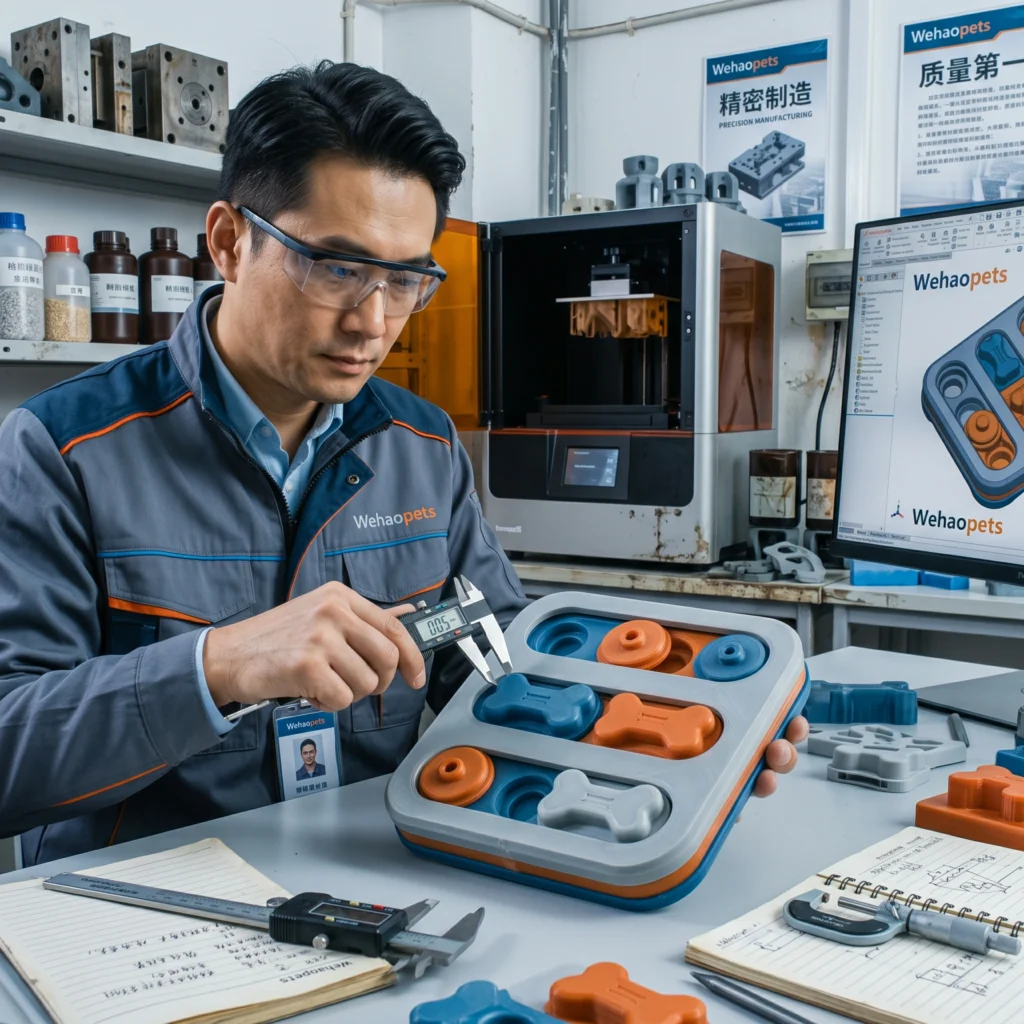
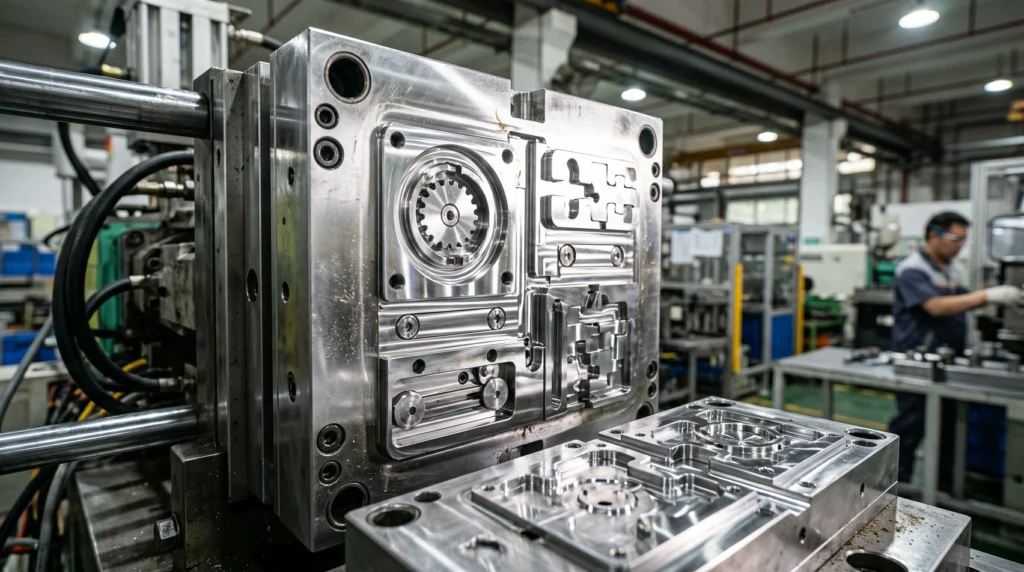
When a dog puzzle toy is designed without accounting for the realities of canine interaction, the physical mechanics degrade rapidly. If a factory relies on outdated machinery and fails to maintain strict injection molding tolerances (+/- 0.05mm), the clearance between the sliding lid and the base track becomes wildly inconsistent. If the gap is too large, the slider derails under lateral force from a dog’s paw. If the gap is too tight, microscopic kibble dust mixed with saliva acts as a crude cement, locking the mechanism completely. To solve this, our manufacturing fix relies on extreme precision, advanced polymer selection, and rigorous quality assurance protocols.
Translating Market Complaints into Factory Specifications
To help Amazon sellers and B2B buyers understand how we bridge the gap between consumer feedback and raw manufacturing data, our engineering team has developed a strict protocol for analyzing any dog puzzle toy. Below is our mandatory review-to-spec translation matrix, utilized extensively in our OEM/ODM Services.
MANDATORY REVIEW-TO-SPEC TRANSLATION TABLE
| Common Consumer Complaint (from Amazon/Chewy) | The Engineering Flaw | The Wehaopets Manufacturing Fix | Impact on Unit Cost |
| “The sliders jammed on the first day, my dog can’t move them!” | Inadequate track clearance and failure to calculate post-cooling polymer shrinkage rates. | Implement strict injection molding tolerances (+/- 0.05mm) and redesign slider draft angles for debris clearance. | Increases initial mold tooling cost, but per-unit production cost change is < $0.02. |
| “My Golden Retriever shattered the plastic, leaving sharp shards.” | Improper use of brittle Polystyrene (PS) or cheap recycled plastics without impact modifiers. | Upgrade to food-grade, high-impact ABS blended with toughening agents to maximize drop-test survival rates. | Material cost increases by 8-12%; return rates drop by over 90%. |
| “The food compartments are too deep and impossible to wash properly.” | Mold cavity designed with sharp 90-degree internal corners (dead zones). | Deploy extreme CNC mold polishing (SPI A-2 grade) and ensure all internal corners have a minimum R3 fillet radius. | Zero unit cost increase; adds 24-36 hours of CNC machining time during the mold creation phase. |
| “The sliding covers pop out entirely, creating a severe choking hazard.” | Snap-fit undercut dimensions are too shallow, leading to plastic fatigue and loss of retention force. | Recalibrate undercut geometry in the mold flow analysis and optimize the stress-relief structural ribs. | Zero unit cost increase; drastically improves safety compliance and brand liability protection. |
Material Science: ABS vs Polypropylene friction coefficients in a dog puzzle toy
When retail buyers and distributors ask, “are dog puzzle toys good additions to our catalog?”, the answer depends entirely on the mechanical longevity of the product. The mechanical feel and durability of a dog puzzle toy are dictated not just by spatial dimensions, but by the physical properties of the chosen polymers. In our facility, we conduct exhaustive research into ABS vs Polypropylene friction coefficients.
A premium dog puzzle toy cannot be molded from a single uniform material if it utilizes sliding mechanisms. Polypropylene (PP) offers excellent fatigue resistance and natural self-lubricating properties, making it an ideal choice for the static base and food chambers. Acrylonitrile Butadiene Styrene (ABS), on the other hand, provides superior rigidity, dimensional stability, and high gloss. By pairing a PP base with ABS sliders, our tooling engineers naturally reduce the dynamic friction coefficient compared to an ABS-on-ABS or PP-on-PP sliding interface. This dissimilar material pairing prevents “galling” or mechanical binding, ensuring the dog puzzle toy operates smoothly even when coated in dog saliva.
Upgrading Your Technical Documentation
If you want to ensure your next dog puzzle toy outperforms the market average, generic 3D CAD files are not enough. You must provide your manufacturing partner with a highly detailed Tech Pack.
MANDATORY TECH PACK UPGRADE LIST:
- ⚙️ Specify Dynamic Friction Thresholds: Explicitly state that the sliders on the dog puzzle toy must require no more than 1.5N of actuation force, even when tested with 5 grams of simulated debris (crushed kibble) in the tracks. This forces the factory to design proper debris-clearing channels.
- 🔧 Mandate Multi-Material Shrinkage Compensation: When specifying different materials for the base and sliders (e.g., PP and ABS), require the factory to provide a Moldflow analysis report that proves they have compensated for the differing shrinkage rates (PP at ~1.5%, ABS at ~0.5%) to maintain the required clearances.
- ⚙️ Enforce Strict Drop Test Standards: Add a non-negotiable clause to your Quality Control checklist: “Fully assembled dog puzzle toy must pass a 1.5-meter drop test onto concrete, achieving drop-test survival rates > 99% without functional deformation or part separation.”
- 🔧 Define Surface Finish Grades: Explicitly require high-grade CNC mold polishing (SPI A-2 or A-3) for all food-contact surfaces. This microscopic smoothness prevents bacterial adhesion and ensures the slider mechanics remain frictionless over years of use.
Advanced Quality Control: Maintaining dog puzzle toy Consistency
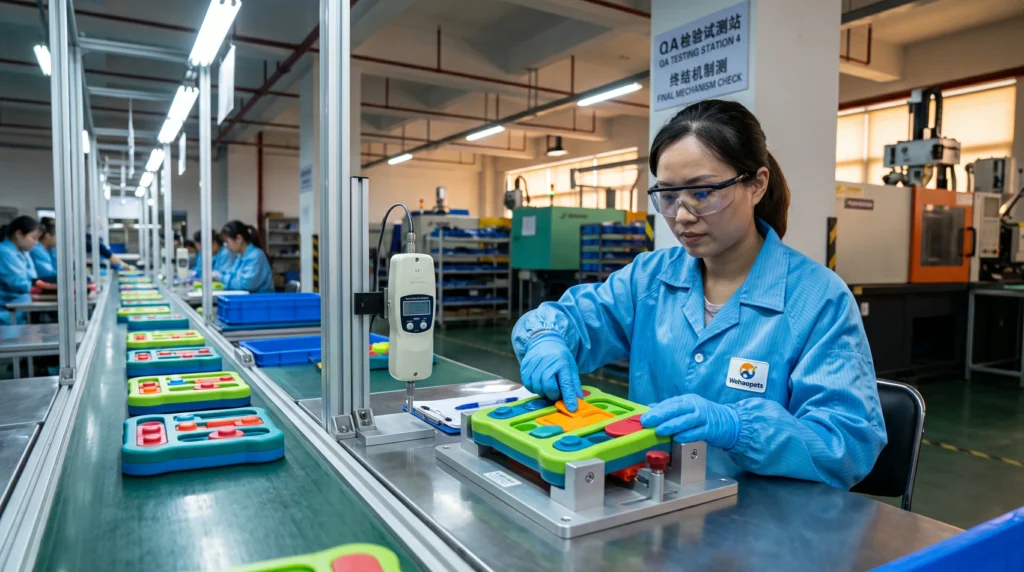
Even the most brilliant mechanical design will fail if the factory cannot maintain consistency across tens of thousands of units. Because a dog puzzle toy relies on multiple moving components interacting simultaneously, microscopic wear on the steel mold cavities can lead to catastrophic failure for a whole batch. Wehaopets implements an aggressive, multi-tier QA protocol to guarantee every dog puzzle toy functions perfectly out of the box.
To maintain our industry-leading injection molding tolerances (+/- 0.05mm), our tooling engineers utilize automated Coordinate Measuring Machines (CMM) on the first article of every production run.
Polymer Performance Metrics for dog puzzle toy Components
| Polymer Type | Dynamic Friction Coefficient | Dimensional Stability | Impact Resistance (Izod) | Recommended dog puzzle toy Component |
| High-Impact ABS | Medium | Excellent (Maintains +/- 0.05mm) | High | Sliding covers, intricate snap-fits, bone-shaped covers |
| Polypropylene (PP) | Low (Self-Lubricating) | Moderate (Higher shrinkage) | Medium | Main chassis, food compartments, static tracks |
| TPR (Thermoplastic Rubber) | High (Anti-Slip) | Poor | Very High | Anti-skid bottom feet, chewable peripheral grips |
Post-Molding Secondary Operations and Testing
The manufacturing of a high-end dog puzzle toy doesn’t stop when the plastic ejects from the mold. The assembly and secondary testing phases are critical.
Wehaopets Standardized Secondary Testing Protocols
- Bite-Force Simulation: We subject the sliding components of the dog puzzle toy to pneumatic crush tests that simulate the jaw pressure of a 60-lb canine, ensuring the sliders do not crack or permanently deform under stress.
- Thermal Cycling Stress Tests: Because the dog puzzle toy uses mixed materials (ABS and PP), we cycle the fully assembled units through temperatures ranging from -20°C to 60°C. This verifies that differing thermal expansion rates won’t cause the sliders to lock up during international shipping.
- Debris and Saliva Slurry Tests: We introduce a standardized mixture of water, synthetic saliva, and abrasive sand into the tracks of the dog puzzle toy. The toy must remain fully functional and clear the debris through its integrated runoff channels.
- Acoustic Friction Analysis: During the final manual assembly, technicians slide every component of the dog puzzle toy to listen for plastic-on-plastic grinding, which indicates a molding flash defect that bypassed the CNC mold polishing stage.
Are dog puzzle toys good for B2B Profitability? A Deep Dive into Tooling Economics
Many emerging pet brands hesitate when evaluating their product roadmap, asking: “Are dog puzzle toys good investments considering the high initial mold costs?” From a tooling engineer’s perspective, this is one of the most lucrative categories in the pet space, precisely because the barrier to entry is high.
A standard squeaky rubber toy requires a simple two-plate compression mold. However, a premium dog puzzle toy often requires complex injection molds with multiple cavities, hot runner systems, and intricate side-actions (sliders/lifters) to form the internal undercuts. While the initial tooling investment is higher, it acts as a massive moat against low-quality competitors. By investing in superior CNC mold polishing and exacting tolerances, your dog puzzle toy will command a retail premium of $25 to $45, compared to the $10 race-to-the-bottom pricing of basic chew toys.
ROI Analysis of Tooling Upgrades for a dog puzzle toy
| Manufacturing Variable | Standard Cheap Tooling (Market Average) | Wehaopets Precision Tooling | B2B Commercial Impact |
| Tolerance Control | +/- 0.15mm (Prone to jamming) | +/- 0.05mm | Eliminates mechanical lockups; reduces Amazon return rates by >15%. |
| Surface Finish | Standard EDM Texture | CNC mold polishing (SPI A-2) | Creates a food-safe, easy-to-clean dog puzzle toy; boosts 5-star reviews. |
| Runner System | Cold Runner (Causes internal stress) | Hot Runner System | Maximizes drop-test survival rates by eliminating weld lines; reduces post-sale liability. |
| Overall Profitability | Short lifecycle, plagued by 1-star reviews. | 20-30% higher initial mold cost. | Secures Amazon Best Seller status; long-term net margins increase by 35%+. |
When brands ask if are dog puzzle toys good for their bottom line, we point to the data in Table 3. The brands that dominate the dog puzzle toys wholesale market are the ones who treat their products like consumer electronics, demanding absolute precision from their tooling engineers.
The Wehaopets Engineering Advantage in dog puzzle toy Manufacturing
Building a successful dog puzzle toy is an exercise in applied physics. You must balance the ABS vs Polypropylene friction coefficients, ensure perfect dimensional stability, and create a product that can survive the chaotic environment of a dog’s mouth. At Wehaopets, we don’t just inject plastic; we engineer solutions. We understand the specific pain points that Amazon Sellers and Pet Brand Product Developers face, and we have the factory floor capabilities to solve them before mass production begins.
Whether you need a completely custom OEM design or you want to customize an existing dog puzzle toy from our catalog, our tooling engineers are ready to elevate your brand’s quality standards.
Manufacturing Teardown and Improvement Quote
Are you currently selling a dog puzzle toy that suffers from high return rates? Are your customers leaving 1-star reviews because the sliders are jamming or breaking? Do not let poor manufacturing tolerances destroy your brand equity.
We challenge you to send your current Amazon competitor ASIN, or your CAD files, directly to our engineering team. Our tooling engineers will perform a comprehensive “Manufacturing Teardown and Improvement Quote.” We will identify the exact points of failure in their ABS vs Polypropylene friction coefficients, highlight where they failed their drop-test survival rates, and provide you with a competitive quote to manufacture a far superior dog puzzle toy.
👉 Ready to engineer a flawless product? Contact Us today and let our tooling engineers build your next Best Seller.
Frequently Asked Questions (FAQ): dog puzzle toy Tooling & Manufacturing
Q1: Why do the sliders on my current dog puzzle toy always jam after a few uses?
Jamming is typically caused by a failure to maintain strict injection molding tolerances (+/- 0.05mm) or incorrect material pairing. If the factory ignores ABS vs Polypropylene friction coefficients, the mechanisms will bind when exposed to dog saliva and food debris.
Q2: Are dog puzzle toys good for long-term OEM profitability given the high initial mold costs?
Absolutely. While the initial tooling cost for a multi-component dog puzzle toy is higher than a standard chew toy due to the need for precise CNC mold polishing and complex slide mechanisms, the high retail premium ($25-$45) and long product lifecycle offer a significantly higher ROI for B2B brands.
Q3: What is the typical tooling cost to develop a complex interactive dog puzzle toy?
Mold costs for a complex interactive dog puzzle toy generally range from $3,500 to $8,500+. This depends entirely on the number of cavities, the requirement for hot runner systems, and the extreme precision needed for the sliders to achieve perfect injection molding tolerances (+/- 0.05mm).
Q4: How long is the prototyping timeline for a new dog puzzle toy design?
SLA 3D printed prototyping takes about 3-5 days. However, to truly test the ABS vs Polypropylene friction coefficients and slider mechanics under real-world stress, a soft mold (rapid tooling) might take 12-15 days. Full production steel molds typically require 35-45 days to complete.
Q5: How does CNC mold polishing affect the overall quality of a dog puzzle toy?
High-grade CNC mold polishing (such as SPI A-2) ensures that the food chambers and sliding tracks are perfectly smooth at a microscopic level. This not only makes the dog puzzle toy much easier for pet owners to wash, but it also drastically reduces the mechanical resistance of moving parts, preventing jams.
Q6: What engineering parameters ensure high drop-test survival rates for a dog puzzle toy?
Achieving exceptional drop-test survival rates requires using high-impact resistant plastics (like toughened ABS), avoiding sharp internal corners by using generous fillets (minimum R3), and engineering precise snap-fit joints that distribute impact stress evenly across the toy’s structure instead of concentrating it at the seams.
Q7: Can Wehaopets reverse-engineer a competitor’s dog puzzle toy to fix its flaws?
Yes. By sending us the competitor’s ASIN or physical sample, our tooling engineers can perform a deep teardown analysis. We will identify their engineering flaws and quote you an improved manufacturing plan with upgraded materials, superior drop-test survival rates, and ultra-precise tolerances.