Overview
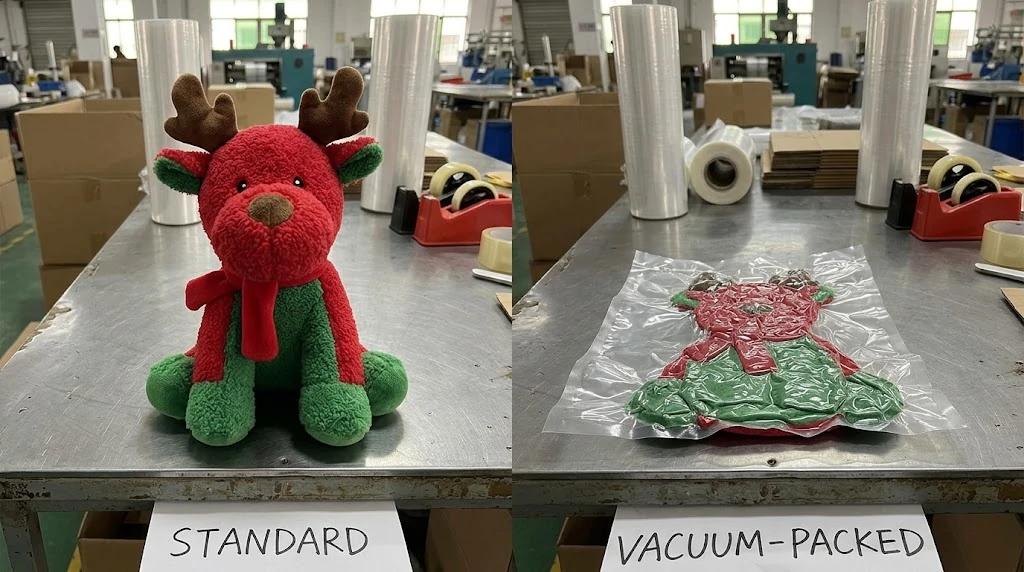
For pet retail chains, Amazon FBA aggregators, and regional distributors, Q4 profit margins on seasonal plush inventory are frequently eroded by dimensional weight charges and peak-season ocean surcharges. When you bulk buy Christmas dog toys directly from our Dongguan manufacturing facility, implementing stage-two vacuum compression and custom 5-ply master carton engineering reduces per-unit freight costs by 58.3% ($0.42 to $0.175 per unit), increasing 40HQ container yield from 19,200 to 46,200 units while guaranteeing on-shelf retail readiness before the critical November 1st holiday cutoff.
The Q4 Dimensional Weight Trap: Why Seasonal Plush Kills Margins
Last October, a procurement director for a mid-sized North American pet retail chain approached our logistics team in a state of panic. They had placed an order with a trading company for 15,000 holiday plush toys—specifically oversized plush snowmen and antlers—intended for a November 15th in-store display. Because production slipped by two weeks, the buyer was forced to pivot from Less-than-Container-Load (LCL) ocean freight to air freight to save their retail contract. When the forwarder issued the airway bill, the freight invoice was $28,400—exceeding the $24,000 FOB value of the merchandise itself.
Why did this happen? Because standard plush toys are roughly 78% trapped air.
When CFOs, sourcing directors, and inventory planners prepare to bulk buy Christmas dog toys, the primary threat to gross margin is never the ex-factory unit cost; it is the volumetric inefficiency of holiday SKUs. Festive designs—such as our Wholesale Standing Christmas Reindeer Dog Toy or oversized Custom Plush Santa Dog Toy Wholesale lines—rely on high-loft virgin 7D and 15D hollow conjugated siliconized polyfill to achieve that plump, giftable shelf appeal on retail endcaps.
In international freight, you do not pay for the weight of polyester fiber; you pay for the Cubic Meters (CBM) it occupies inside a steel box or an aircraft fuselage. Under standard International Air Transport Association (IATA) rules, volumetric weight is calculated as:
$$\text{Volumetric Weight (kg)} = \frac{\text{Length (cm)} \times \text{Width (cm)} \times \text{Height (cm)}}{6000}$$
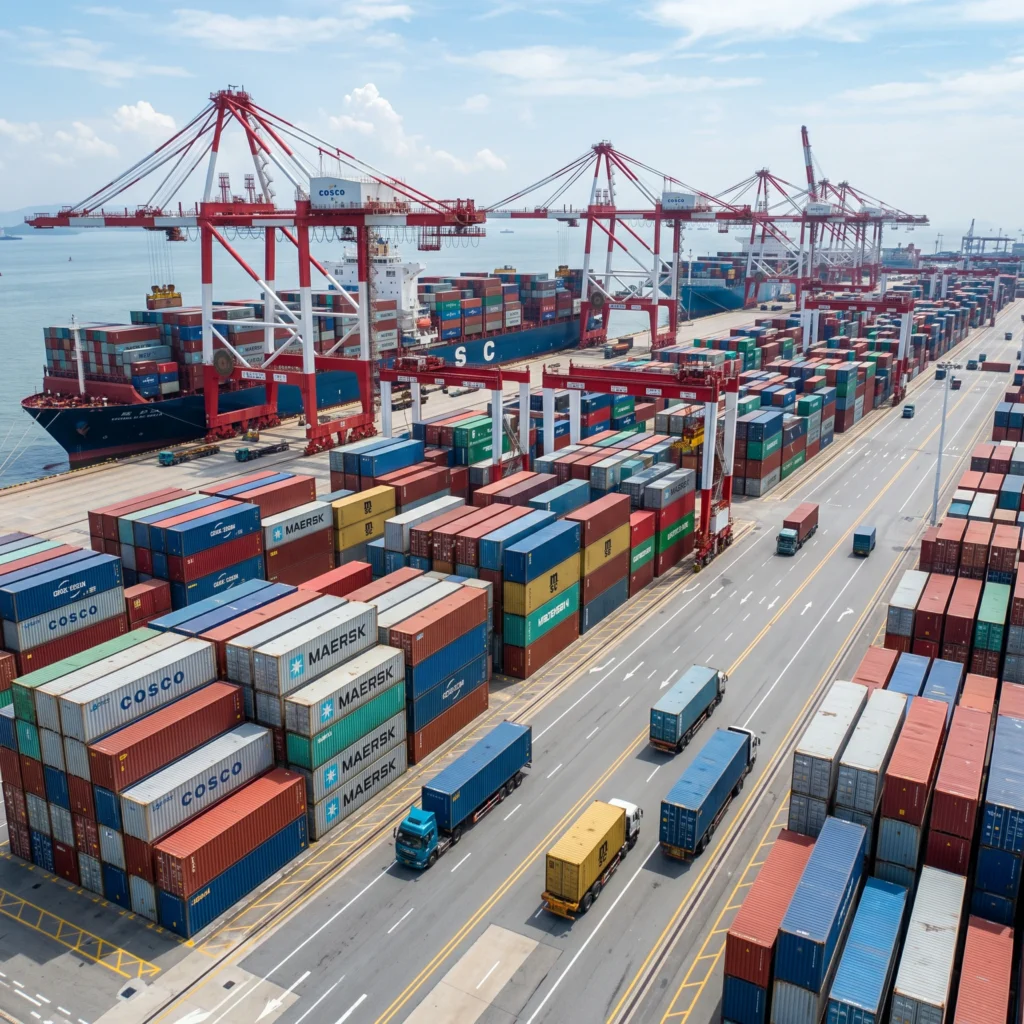
Even in ocean freight—where Full Container Load (FCL) rates on the Trans-Pacific Eastbound (TPEB) and Asia-North Europe lanes spike by 35% to 50% during the Q3/Q4 General Rate Increases (GRI) and Peak Season Surcharges (PSS)—shipping uncompressed plush means you are paying thousands of dollars to transport Dongguan air to warehouses in Los Angeles, Rotterdam, Felixstowe, Toronto, or Singapore.
As a direct manufacturer, our engineering and logistics teams treat packaging geometry and container utilization with the same technical rigor as fabric tensile testing. To protect your landed cost structure when you source Q4 holiday Christmas pet toys, your supply chain strategy must transition from passive freight booking to aggressive volumetric density engineering.
Volumetric Engineering: Standard Packing vs. Stage-Two Vacuum Compression
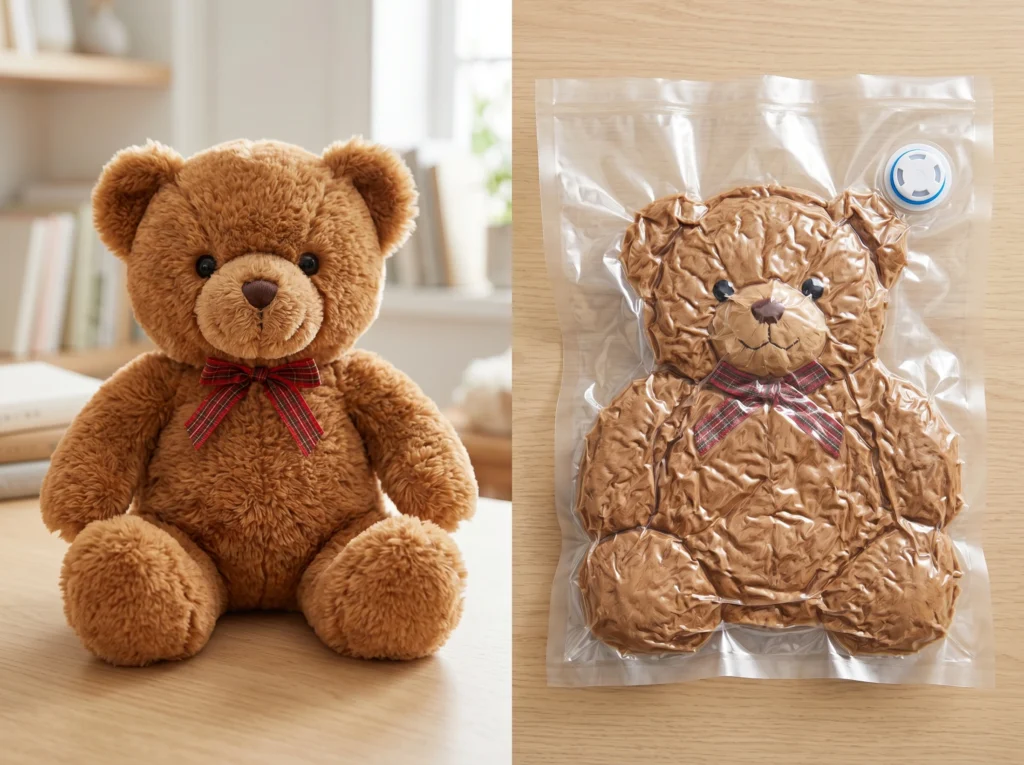
The single highest-leverage intervention in our Dongguan warehouse is Stage-Two Controlled Vacuum Compression. However, many B2B buyers hesitate to approve vacuum sealing for seasonal inventory due to two common engineering failures experienced with low-tier factories: permanent fiber creasing and internal squeaker crushing.
Solving the Squeaker Crushing & Rebound Problem
When a standard pneumatic heat-sealing machine pulls -0.09 MPa of vacuum on a plush toy, the atmospheric pressure exerts roughly 9 metric tons of force per square meter across the surface of the polybag. If a toy contains a cheap, thin-walled polyethylene (PE) bladder squeaker (wall thickness < 0.6mm), that pressure permanently collapses the air chamber, rendering the reed valve silent upon decompression. Furthermore, if the toy is stuffed with recycled, low-resilience shoddy fiber, it will emerge from the bag looking like a flattened pancake, requiring costly manual steaming at your destination 3PL warehouse.
At Wehao Pets, our OEM & ODM engineering team eliminates these risks through three material and mechanical controls:
- High-Memory 15D Siliconized Virgin Fiber: We blend 7D (softness) and 15D (structural spring) virgin hollow conjugated polyester fibers. The microscopic silicone coating prevents fiber-on-fiber friction lock under extreme compression, guaranteeing a 98.5% volumetric loft rebound within 45 minutes of opening the polybag.
- Crush-Resistant EVA/Thick-Wall Ultrasonic Squeakers: For compressed holiday shipments, we upgrade internal noisemakers to 1.2mm wall-thickness EVA/PP blend squeakers equipped with an internal vertical support rib that resists up to 35 kg of direct planar compression without deforming.
- Differential Vacuum Calibration (-0.065 MPa): Rather than pulling a blind 100% vacuum, our heat-compression chambers are calibrated to compress volume by exactly 62% to 68%, stopping right at the mechanical threshold where fabric wrinkling begins.
Financial Impact: 40HQ Container Load Comparison
To illustrate the exact impact on your balance sheet, let us examine a real-world commercial shipment from our facility via Yantian Port to the Port of Long Beach (assuming a peak-season all-in FCL 40HQ port-to-door rate of $8,100 USD). The SKU analyzed is our 28cm Wholesale Sitting Christmas Reindeer Dog Toy.
| Scenario | Units per Carton | Cartons per 40HQ Container | Total Units per 40HQ | Gross Weight per Carton (kg) | Container Utilization (68 CBM Max) | Estimated Freight Cost per Unit (USD) |
| Scenario A: Standard Bulk Loose-Pack (Individual 0.04mm PE bag, no compression) | 60 pcs | 320 cartons | 19,200 pcs | 9.8 kg | 66.8 CBM (98.2%) | $0.422 / unit |
| Scenario B: Single-Unit Vacuum Sealed (0.08mm PA+PE co-extruded bag, 60% reduction) | 120 pcs | 320 cartons | 38,400 pcs | 18.6 kg | 66.8 CBM (98.2%) | $0.211 / unit |
| Scenario C: Multi-Pack Flat Matrix Vacuum Brick (6-unit pre-sorted retail brick in 0.10mm PA+PE bag) | 140 pcs | 330 cartons | 46,200 pcs | 21.5 kg | 67.3 CBM (99.0%) | $0.175 / unit |
Note: Calculations are based on our standardized export master carton dimensions of 63cm × 45cm × 74cm (0.2098 CBM per carton) for Scenarios A & B, and 60cm × 45cm × 75cm (0.2025 CBM) for Scenario C.
By transitioning from Scenario A to Scenario C, a procurement manager ordering ~46,000 units for a regional retail rollout eliminates the need for 1.4 additional 40HQ containers, generating an immediate bottom-line freight savings of $11,412 USD per container load. For a deeper dive into the physics of decompression, review our technical guide on bulk pet toys shipping vacuum compression.
Master Carton Architecture & Container Floor-Loading vs. Palletization
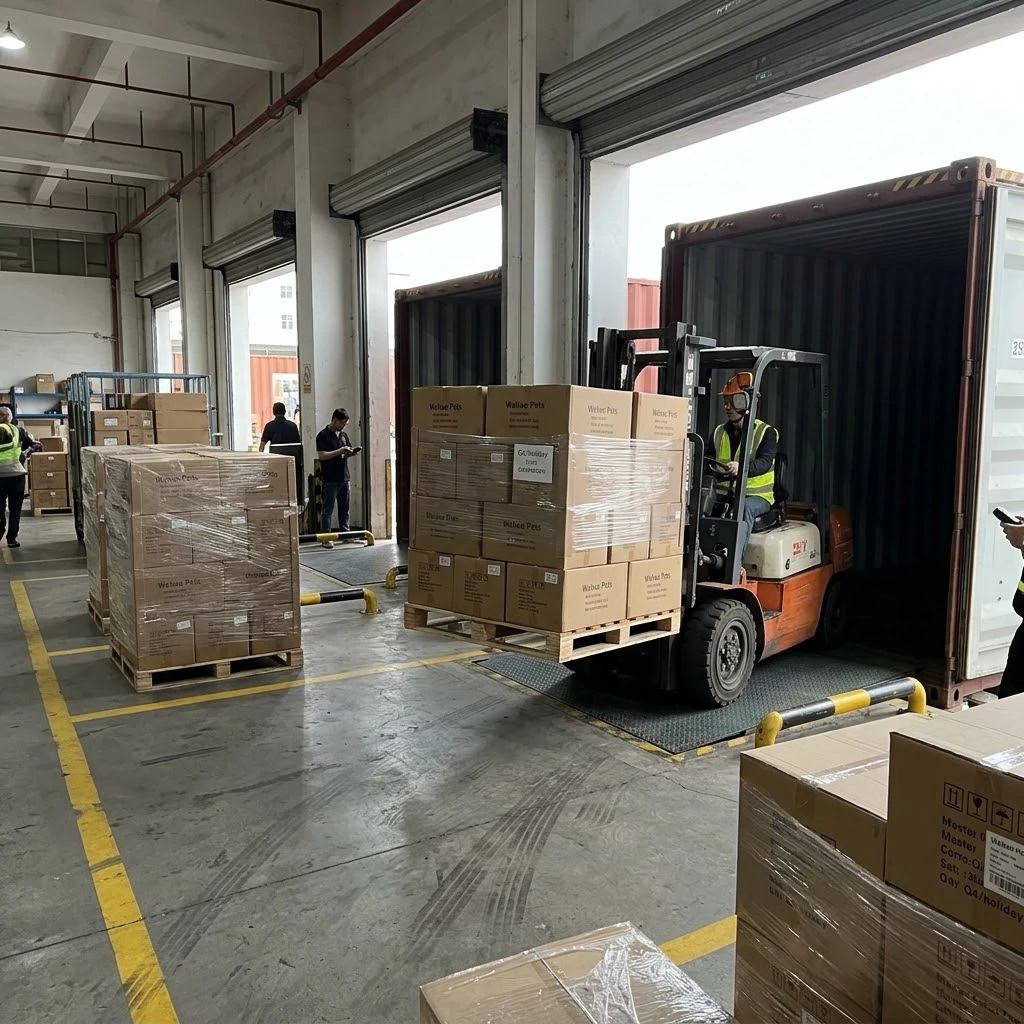
Optimizing the individual toy volume is only half the equation; if your master cartons bulge during high-humidity ocean transit or leave a 25cm void along the ceiling of a 40-foot High Cube (40HQ) container, you lose up to 14% of your container capacity.
5-Ply Export Corrugated Engineering (BC-Flute K=K)
A frequent point of failure when brands bulk buy Christmas dog toys from unverified workshops is carton blow-out. Vacuum-sealed bags are subject to slow micro-leakage if punctured by plastic hangtag fasteners (kimble tags), or they exert outward lateral pressure if packed warm. Furthermore, ocean containers crossing the Pacific or Indian Ocean experience relative humidity swings from 45% to 92%, which degrades standard recycled cardboard structural integrity by up to 40%.
In our warehouse, every export master carton is engineered to ISTA-1A and ISTA-3A 10-point drop-test standards using the following material specifications:
- Board Grade: 5-Ply Double Wall Corrugated Board (BC-Flute combination, 7mm total thickness).
- Linerboard Material: K=K (250gsm Virgin Kraft outer liner / 180gsm high-strength medium / 250gsm Virgin Kraft inner liner).
- Edge Crush Test (ECT) & Bursting Strength: Minimum 48 ECT and 275 lbs/sq.in Mullen Burst rating, ensuring bottom-tier cartons stacked 4-high (up to 2.65 meters inside a 40HQ) sustain zero vertical buckling over a 35-day voyage.
Our 5-Step Factory Packaging & Loading Optimization Workflow
To ensure zero wasted cubic space and zero customs or warehouse receiving rejections, our logistics department executes a mandatory 5-step operational protocol on every seasonal bulk order:
- ⚙️ Step 1: Kimble-Free Hangtag Shielding & Polybag Spec Selection: Before vacuum sealing, our packing line folds custom holiday hangtags inward against the plush belly and covers the plastic swiftach barb with a 2cm EVA foam patch. We then seal the toy inside a 0.08mm (80-micron) PA/PE (Nylon/Polyethylene) co-extruded barrier bag rather than standard LDPE, preventing pinhole punctures and maintaining vacuum integrity for up to 12 months in storage.
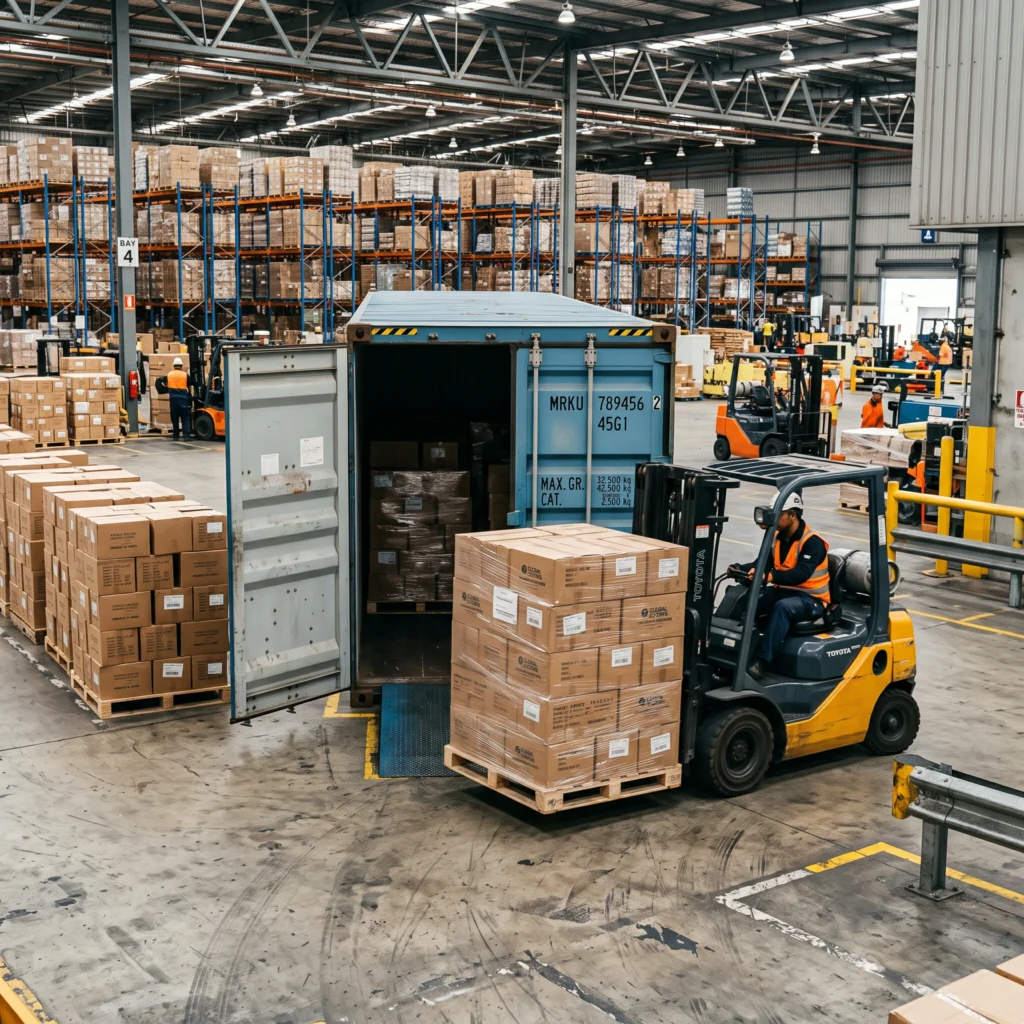
- 📦 Step 2: 3D Container Load Simulation (Cape Pack / TOPS Software): Before ordering cartons from our corrugate mill, our logistics engineers input your exact SKU assortment—whether mixing Custom Dog Plush Toys with dense rubber items—into 3D load-planning software. We reverse-engineer carton dimensions from the internal dimensions of a 40HQ container (12.03m L × 2.35m W × 2.69m H) to achieve a minimum 94% cube utilization.
- ⚖️ Step 3: Heavy-Light Cargo Interleaving (Cube-Out vs. Weigh-Out Balancing): If your holiday PO combines lightweight plush with high-density items like our WholesaleChristmas Reindeer Snuffle Dog Toy or heavy Wholesale Squeaky Dog Toys featuring TPR cores, we place high-density cartons on the bottom two tiers of the container floor to lower the center of gravity and prevent plush carton crushing.
- 🔬 Step 4: Post-Vacuum Metal Detection & ISTA Drop-Testing: Every sealed vacuum brick passes through a calibrated conveyorized needle detector (Fe $\ge$ 1.0mm) before cartonization. We then pull 1 carton per 100 produced to execute a 76cm free-fall drop test onto a steel plate across 1 corner, 3 edges, and 6 flat faces.
- 🚛 Step 5: Moisture-Controlled Container Stuffing & Container Desiccant Placement: Prior to loading at our Dongguan dock, we inspect the container floor with a pinless moisture meter (rejecting any container reading >18% wood moisture content). We install 12×1000g Calcium Chloride hanging desiccant poles along the container walls to eliminate “container rain” during transit from warm South China waters to freezing North American or Northern European winter ports.
For buyers who require specialized retail-ready PDQ (Pretty Darn Quick) display trays or Amazon FBA single-unit barcode compliance, you can review our comprehensive bulk dog toys packaging optimization protocols.
Freight Mode Economics: LCL vs. FCL and Regional Routing Strategies
Not every brand founder or regional distributor starts their Q4 campaign with a 46,000-unit order. Often, buyers testing new holiday collections—such as bundling a Wholesale Christmas Reindeer Pineapple Fleece Dog Toy
with a seasonal calming item—will order between 3,000 and 10,000 units across 3 to 5 SKUs.
This creates a critical financial decision point: When does Less-than-Container-Load (LCL) become more expensive than booking a dedicated 20GP or 40GP Full Container Load (FCL)?
The Hidden Destination Costs of LCL Consolidation
In LCL shipping, freight forwarders often lure B2B buyers with artificially low origin ocean rates (sometimes $10 to $25 per CBM from Shenzhen/Yantian). However, once the consolidated container arrives at the destination Container Freight Station (CFS) in Los Angeles, New York, Felixstowe, or Hamburg, the consignee is hit with punitive destination charges: CFS devanning fees, port security, chassis split fees, and documentation charges that easily scale to $110–$165 per CBM.
Below is our logistics team’s break-even matrix across our four primary export markets (USA, Canada, Europe, and Singapore), helping you decide the exact volume threshold to switch from LCL to FCL when you bulk buy Christmas dog toys:
| Target Market & Primary Port | Optimal Transit Mode (< 13 CBM) | The LCL-to-FCL Break-Even Threshold | Recommended FCL Equipment (> 15 CBM) | Port-to-Port Transit Time | Critical Q4 Customs & Receiving Bottleneck |
| USA (West Coast: LA / Long Beach; East Coast: Savannah / NY) | LCL Consolidated (Matson CLX for urgent WC orders) | 13.5 CBM (Above 13.5 CBM, a dedicated 20GP is cheaper than LCL CFS fees) | 40HQ (Best CBM/Dollar ratio; 20GP costs ~72% of a 40HQ for only 41% of the volume) | WC: 14–18 Days EC: 28–34 Days | PierPASS fees, chassis shortages in Oct/Nov, and FDA/CPSC random holds if HTS codes are misdeclared. |
| Canada (Vancouver / Prince Rupert $\rightarrow$ Toronto/Montreal Rail) | LCL to Vancouver CFS | 14.0 CBM | 40HQ (High rail dwell times for 20GP containers due to CN/CPKC weight pairing rules) | Port: 15–19 Days Inland Rail: +8–12 Days | Severe winter rail congestion at Vancouver port terminals starting mid-October; book FCL without transshipment. |
| Europe (Rotterdam / Hamburg / Antwerp / Felixstowe) | LCL Ocean or China-Europe Express Rail (Chongqing/Yiwu to Duisburg) | 12.5 CBM (European destination CFS de-consolidation fees are exceptionally high) | 40HQ | Ocean (Cape of Good Hope routing): 38–46 Days Express Rail: 20–25 Days | Red Sea/Suez Canal rerouting adds 10–14 days to ocean schedules; EN71 compliance documentation checks. |
| Singapore (PSA Singapore Terminal) | LCL Direct Weekly Consolidation | 16.0 CBM (Short-sea intra-Asia LCL rates remain highly competitive) | 20GP or 40HQ | 5–7 Days Direct from Yantian / Shekou | Rapid turnaround, but strict pallet fumigation (ISPM-15) and GST import permit pre-declaration required. |
To monitor real-time container spot rate volatility before locking in your Q3/Q4 shipping contracts, we strongly advise procurement teams to track the Freightos Baltic Index (FBX) Global Container Freight Index.
Floor-Loaded vs. Palletized: The Math of Amazon FBA and Retail DC Compliance
When shipping to the USA, Canada, or Europe, buyers must weigh Floor-Loaded FCL against Palletized FCL:
- Floor-Loaded 40HQ (65–67 CBM usable): Cartons are hand-stacked from floor to ceiling by our Dongguan loading crew. This maximizes container volume by 22%, making it the indisputable choice if your destination warehouse charges a flat container devanning fee (typically $350–$550 per 40HQ) or if you are shipping to a 3PL that breaks cartons down for e-commerce fulfillment.
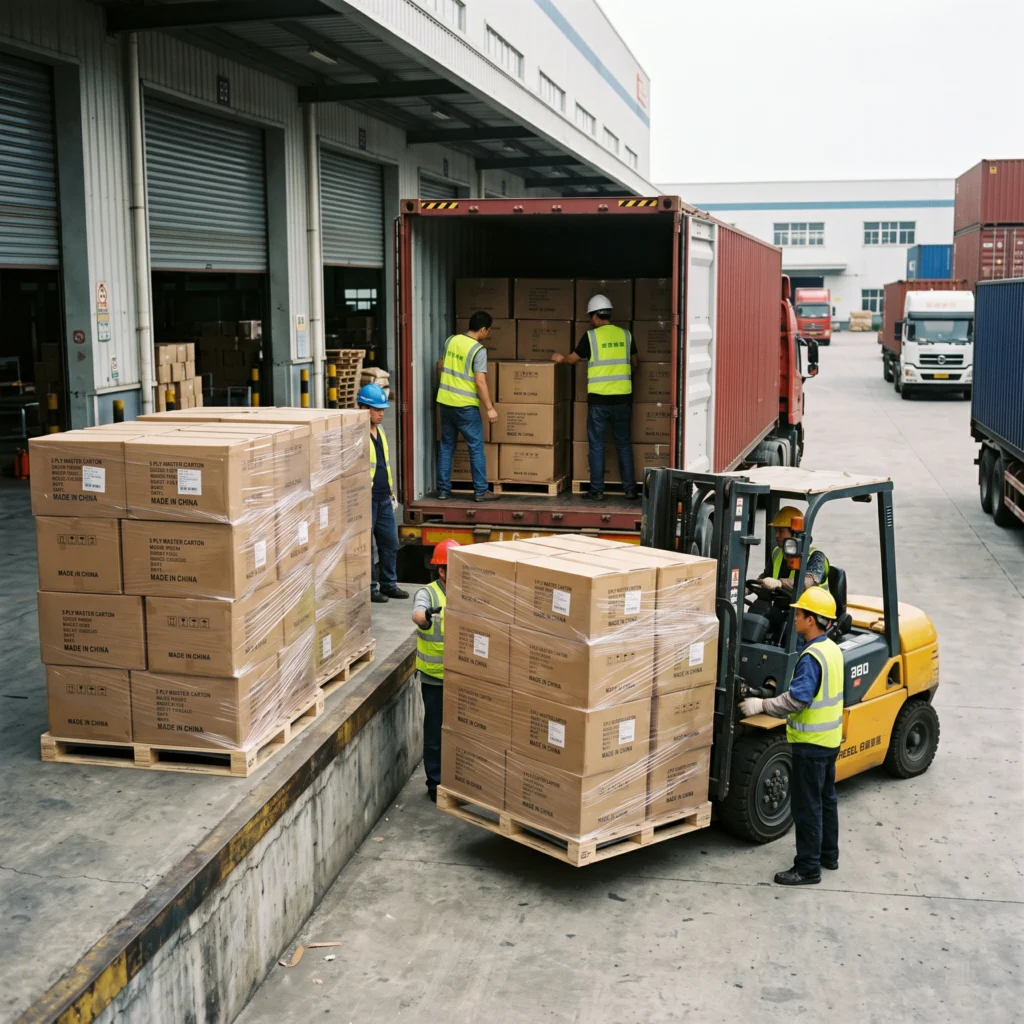
- Palletized 40HQ (50–54 CBM usable): Required by major big-box retail distribution centers (e.g., PetSmart, Petco, Fressnapf) and preferred for direct Amazon FBA LTL/FTL deliveries to avoid manual lumper fees ($800+ at unionized US ports) and reduce Amazon check-in wait times by up to 7 days during Peak Q4. We utilize ISPM-15 heat-treated fumigated wooden pallets or zero-fumigation heavy-duty export plastic pallets (1200mm × 1000mm for US/UK; 1200mm × 800mm Euro-pallets for Continental Europe), wrapped with 5 layers of high-tensile blown stretch film and reinforced with 4 vertical cardboard corner boards.
Backwards Q4 Critical Path Timeline: Avoiding the October Freight Crunch
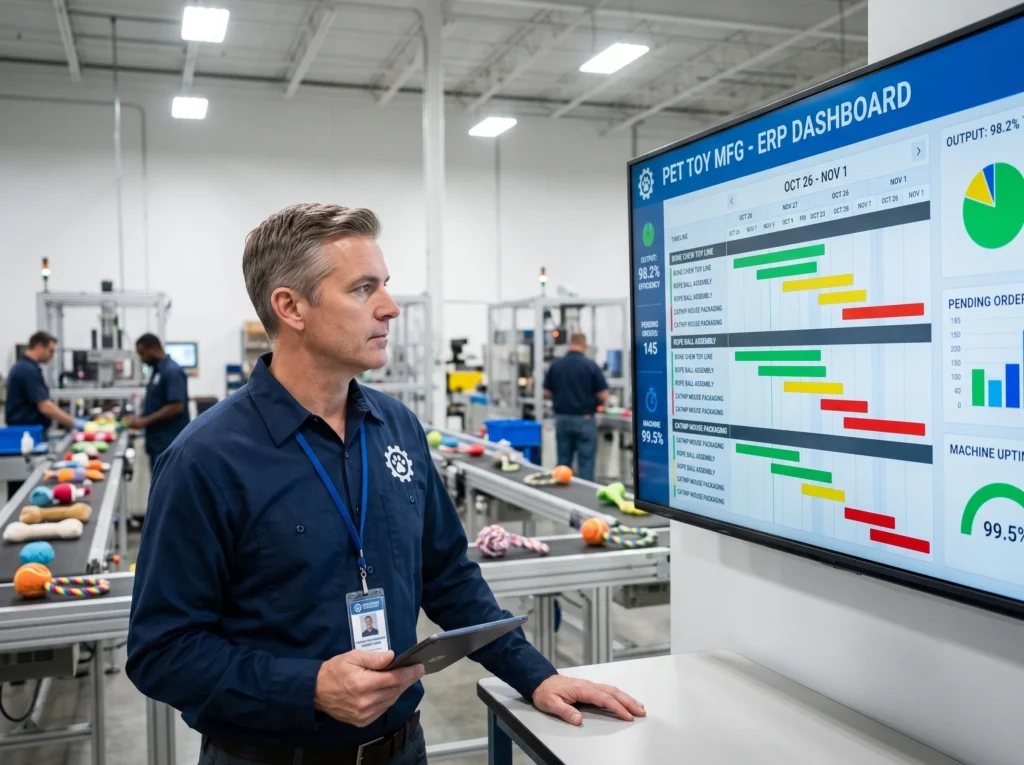
A brilliant packaging strategy cannot save a seasonal campaign if your goods are still floating in the Pacific Ocean on Black Friday. When you bulk buy Christmas dog toys, your procurement calendar must account for both factory manufacturing lead times (fabric dyeing, custom embroidery, needle detection) and the inevitable Q3/Q4 logistics bottlenecks—such as China’s Golden Week (October 1–7), blank sailings, and Amazon FBA’s November inventory cutoffs.
For a deeper breakdown of how our production lines manage seasonal capacity spikes, see our analysis on Q4 pet toy production lead time. Below is our mandatory reverse-engineered critical path schedule for a guaranteed November 1st warehouse arrival:
| Milestone Phase | Target Completion Window | Factory & Supply Chain Action Items | Risk Mitigation & Financial Impact |
| Phase 1: Tech Pack, Sampling & Pantone Lock | May 15 – June 20 | Finalize 3D plush patterns, approve physical pre-production samples (PPS), and lock custom festive velboa Pantone dye lots. | Prevents a 15-day fabric mill queue in July when global apparel and toy brands flood Guangdong dye houses. |
| Phase 2: Bulk PO Deposit & Raw Material Booking | June 25 – July 10 | Issue 30% deposit; our purchasing team locks in virgin 15D polyfill, custom squeakers, and 5-ply K=K cartons at off-peak prices. | Insulates your unit cost from the annual 8%–12% Q3 raw polyester and paperboard price hikes. |
| Phase 3: Mass Production, QC & Safety Testing | July 15 – August 25 | Cutting, sewing, stuffing, 100% metal detection, AQL 1.5/4.0 third-party inspection, and lab testing (ASTM F963 / EN71). | Leaving a 10-day buffer for seam re-inspection guarantees zero quality defects before vacuum sealing. |
| Phase 4: Vacuum Packaging & FCL Booking | August 26 – September 10 | Execute Stage-Two vacuum compression; submit Shipping Order (SO) to forwarder 14 days prior to Estimated Time of Departure (ETD). | Secures container equipment and vessel space before the late-September pre-Golden Week rate surge and roll-pools. |
| Phase 5: Customs Clearance & Inland Drayage | October 10 – October 25 | Ocean arrival at destination port, ISF/customs clearance, de-consolidation/de-vanning, and 48-hour plush loft recovery before FBA check-in. | Guarantees 100% live, buyable inventory on Amazon or retail shelves prior to the November 1st Q4 holiday shopping kickoff. |
Four Non-Negotiable Customs & Compliance Checkpoints for Holiday Shipments
Even when your vessel docks on schedule, customs holds or Amazon receiving rejections can freeze your capital for weeks. When importing seasonal pet toys into North America, Europe, or Singapore, ensure your commercial invoice, packing list, and carton markings adhere to these 4 compliance checkpoints:
- 🛡️ 1. Precision HTS / HS Code Classification (Avoiding Toy Tariff Traps): Never allow an inexperienced broker to classify dog toys under HS Code
9503.00(Children’s Tricycles, Dolls, and Stuffed Toys). While9503.00often carries a 0% base duty rate, it automatically flags the shipment for mandatory CPSC Children’s Product Certificate (CPC) review in the US or strict CE Toy Safety Directive (2009/48/EC) border inspections in the EU—causing immediate customs detention for pet products. Instead, we classify textile/plush pet toys under6307.90.7500(Other made-up textile articles: Toys for pets) or4201.00.6000(Saddlery and harness for any animal), ensuring smooth clearance. Read our complete breakdown on importing from a China dog toy factory and customs duties. - 📋 2. Mechanical & Chemical Safety Documentation on File: Even though pet toys are exempt from children’s CPC mandates, major retailers and Amazon frequently trigger random safety audits on seasonal SKUs. All holiday plush produced at Wehao Pets is engineered to pass pet toy safety standards modeled on ASTM F963-23 (70N seam tensile test so eyes/noses cannot be ripped off) and EU REACH Annex XVII (azo-free dyes and phthalate-free squeakers).
- ⚠️ 3. Polybag Suffocation Warning & Transparency Rules: Because vacuum-compressed holiday toys utilize heavy-duty polybags with openings often exceeding 5 inches (12.7cm), Amazon FBA and US state regulations (California, New York, Massachusetts) mandate a printed Suffocation Warning in minimum 10pt–24pt bold font (depending on bag dimensions). Additionally, if individual units are vacuum-sealed for direct FBA fulfillment, the polybag must be 100% transparent so warehouse scanners can read the FNSKU barcode without opening the vacuum seal.
- 🏷️ 4. Country of Origin Marking Statute (19 U.S.C. § 1304): US Customs and Border Protection (CBP) strictly enforces permanent “Made in China” labeling on both the outer export master carton and every individual retail unit (via woven seam label or hangtag). Missing origin markings result in a mandatory 10% marking duty penalty on the total appraised value of the shipment plus weeks of bonded warehouse re-labeling charges.
Frequently Asked Questions (FAQ)
1. Does vacuum compression permanently flatten Christmas plush dog toys or damage internal squeakers?
No—provided the factory engineers the filling and noisemaker specifically for vacuum shipping. At Wehao Pets, we stuff our holiday plush with a custom blend of 7D and 15D virgin hollow siliconized polyester fiber rather than cheap recycled cotton, and we utilize 1.2mm thick-walled EVA/PP ultrasonic squeakers with internal vertical support ribs. By calibrating our vacuum chambers to -0.065 MPa (a 62%–68% volume reduction) rather than a crushing 100% vacuum, our toys achieve a 98.5% loft recovery within 45 minutes of opening the bag, with zero squeaker failures.
2. How much can I actually save on ocean freight when I bulk buy Christmas dog toys using vacuum packaging?
On average, our B2B clients reduce their per-unit ocean freight cost by 50% to 58.3%. For a standard 28cm holiday plush reindeer, loose packing yields only 19,200 units per 40HQ container ($0.422/unit freight cost at an $8,100 container rate). Using our Stage-Two Multi-Pack Flat Matrix Vacuum Brick, we load up to 46,200 units into the exact same 40HQ container, dropping your freight cost to $0.175 per unit and saving over $11,400 per container load.
3. Can Amazon FBA receive vacuum-sealed dog toys directly, or do they need to be decompressed first?
It depends on your packaging configuration. If you sell a multi-pack holiday gift bundle (e.g., a 3-pack of Christmas toys) sealed inside a single retail vacuum bag with an FNSKU barcode and suffocation warning printed on the exterior, you can ship directly into Amazon FBA; the end consumer decompresses the toys upon opening. However, if you sell single open-shelf plush units where we vacuum-seal 20 units together into a bulk factory polybag to save ocean CBM, the shipment must first route through your local 3PL warehouse to slice open the master vacuum bags, allow 45 minutes of loft rebound, and cartonize for FBA check-in.
4. What is the exact CBM break-even point between LCL and FCL for Q4 holiday pet toy shipments?
While standard logistics textbooks suggest 15 CBM, during Q3/Q4 peak season our data shows the true financial break-even point is 12.5 CBM for Europe, 13.5 CBM for the USA, and 14.0 CBM for Canada. Once your shipment volume crosses ~13 CBM (roughly 62 of our export master cartons, or ~7,500–9,000 vacuum-packed toys), destination LCL de-consolidation (CFS) fees and port handling charges exceed the flat cost of booking a dedicated 20GP Full Container Load (FCL)—which also shaves 5 to 8 days off your total port-to-door transit time.
5. How do you prevent master cartons from collapsing or absorbing moisture during a 35-day winter ocean voyage?
We reject standard 3-ply domestic cardboard and exclusively manufacture our export cartons using 5-ply BC-flute double-wall Virgin Kraft board (K=K grade) rated at 48 ECT (Edge Crush Test) and 275 lbs/sq.in bursting strength. This ensures the bottom tier of cartons inside a 2.69m-tall 40HQ container suffers zero vertical buckling. To combat condensation (“container rain”) when vessels move from warm South China ports to freezing North American or European terminals, we test container floor moisture (<18%) and install 12×1000g Calcium Chloride desiccant poles in every container.
6. When is the absolute latest deadline to place a bulk PO for Christmas dog toys to guarantee November 1st delivery?
For ocean freight to the US East Coast or Northern Europe (particularly with current Cape of Good Hope vessel rerouting adding 12+ days), your bulk PO must be confirmed no later than July 10th, with vessel departure by September 1st. For the US West Coast (LA/Long Beach) or Vancouver, POs should be locked in by July 25th for a mid-September sailing. For Singapore and Southeast Asia, orders confirmed by August 25th easily clear November 1st shelves. If you miss these windows, we can utilize Matson CLX fast-boats (11 days to Long Beach) or China-Europe Express Rail (22 days to Duisburg) to rescue your timeline without paying astronomical air freight rates.
7. What HS Code should we use to import plush Christmas dog toys without triggering customs delays?
Never use HS Code 9503.00 (Children’s Toys), as it triggers automatic CPSC Children’s Product Certificate (CPC) holds in the USA and strict CE Toy Directive holds in the EU. For plush and textile dog toys, we declare HTS Code 6307.90.7500 (Other made-up textile articles: Toys for pets) or 4201.00.6000 (Articles and equipment for pets). For holiday toys predominantly composed of natural rubber or TPR, we utilize 4016.99.2000, ensuring smooth, rapid customs clearance across North America, Europe, and Singapore.
Stop Paying to Ship Air: Get Your Free Q4 Packaging & CBM Optimization Audit
Are peak-season freight surcharges and oversized master cartons eating into your Q4 holiday margins? Before you lock in your seasonal freight contracts, send our Dongguan engineering and logistics team your current SKU dimensions, target order quantities, and destination port. Within 24 hours, we will calculate a free, custom Packaging & Container Load Optimization Report—showing you the exact carton specs, vacuum-compression rebound ratios, and per-unit freight savings we can engineer for your order.
👉 Contact Us Today to Request Your Free CBM & Freight Optimization Audit