Overview
For pet brands, wholesalers, and private-label distributors, selecting rope materials affects more than purchase price. Lower-cost cotton can reduce initial spending but may increase replacement claims, while poly-blends introduce different production and safety considerations. We compare both materials through durability testing, manufacturing yield, and total ownership cost to support profitable bulk sourcing decisions.
Why Lower Rope Prices Can Increase Procurement Costs
A rope toy quoted at $0.68 FOB may appear more attractive than a comparable product quoted at $0.79. For a procurement manager ordering 50,000 units, the difference represents $5,500 in initial expenditure. However, material cost alone cannot determine the economic outcome. If the lower-priced construction experiences greater fiber shedding, premature knot loosening, inconsistent finished dimensions, or higher customer return rates, the apparent saving can disappear before the product reaches its intended selling period. At Wehao Pets, we approach material selection by examining the relationship between raw material specifications, manufacturing losses, finished product performance, and downstream commercial risk.
The purchasing decision therefore involves four financial variables:
- Material acquisition cost: The actual cost of usable rope after supplier minimums, color matching, and processing losses.
- Production yield: The percentage of manufactured units meeting the approved technical specifications.
- Product durability: The ability of the finished construction to withstand defined pulling, flexing, moisture exposure, and abrasion conditions.
- Total cost of ownership: The combined impact of FOB expenditure, inspection, returns, replacements, and supply chain disruptions.
These considerations are particularly relevant when developing wholesale dog rope toys for the United States, Canada, Europe, and Singapore, where distribution structures and customer expectations may differ. A technically stronger yarn does not automatically produce a longer-lasting toy. Rope diameter, twist consistency, knot geometry, fiber composition, and manufacturing control must be evaluated together.
Cotton Rope vs. Poly-Blend Rope: Material Performance
Cotton Rope: Absorbency, Surface Friction, and Processing Behavior
Cotton rope consists of natural cellulose fibers twisted or braided into a structural assembly. Its relatively soft texture and surface friction make it suitable for certain tugging products, particularly when brands prioritize natural-fiber positioning and moderate mechanical loading. However, cotton absorbs moisture readily. Repeated wetting and drying can alter rope flexibility, increase drying time, and influence dimensional stability. Cotton also lacks the elastic recovery characteristics of many synthetic fibers, making its mechanical response dependent on yarn construction and conditioning.
The relevant properties include:
- Moisture absorption: Cotton absorbs water, increasing wet mass and potentially extending drying time.
- Fiber abrasion: Surface fibers may progressively loosen under repeated friction.
- Knot behavior: Fiber friction can support knot stability, although this depends on twist and compression.
- Dimensional consistency: Natural fiber variability requires attention to yarn diameter and moisture conditioning.
- Color processing: Dye uptake and color consistency depend on pretreatment, dyestuffs, and batch controls.
For procurement, these characteristics create a trade-off between material positioning and maintenance-related durability.
Poly-Blend Rope: Strength Retention and Manufacturing Consistency
Poly-blend rope combines two or more fiber types, commonly cotton with polyester or another synthetic component. The actual mechanical performance depends on the blend ratio, yarn count, filament structure, and how fibers are distributed within the rope. Polyester generally has lower moisture absorption than cotton and can provide higher abrasion resistance in suitable constructions. Its inclusion may improve dimensional consistency and reduce certain forms of surface deterioration. Nevertheless, poly-blend rope should not be treated as a universally stronger alternative.
A poorly engineered blend can introduce stiffness, inconsistent knot compression, exposed synthetic filaments, or undesirable failure behavior.
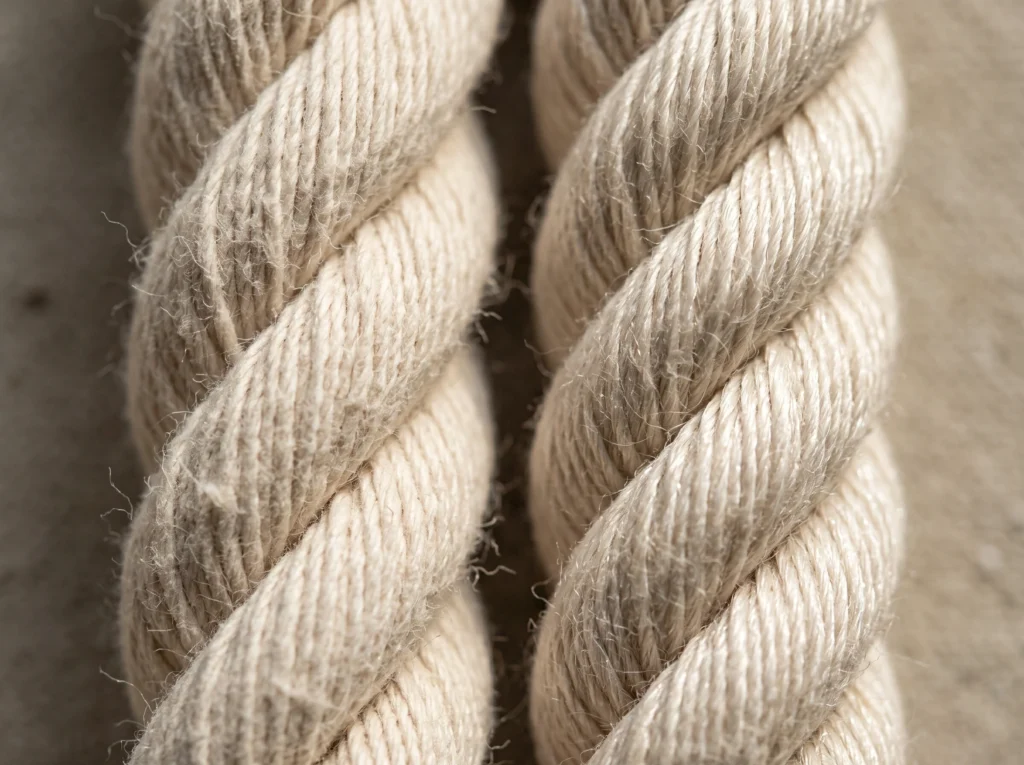
Cotton and Poly-Blend Rope Comparison
| Performance factor | 100% cotton rope | Cotton-polyester blend |
|---|---|---|
| Fiber composition | Natural cellulose | Natural and synthetic fibers |
| Moisture absorption | Relatively high | Generally lower as polyester content increases |
| Drying behavior | Typically slower | Often faster |
| Abrasion resistance | Sensitive to fiber and twist quality | Potentially improved |
| Elastic recovery | Relatively limited | Depends on blend and construction |
| Knot stability | Supported by surface friction | Requires construction-specific verification |
| Material consistency | Influenced by natural fiber variation | Potentially more uniform |
| End-of-life considerations | Depends on dyes and finishes | Mixed fibers complicate recycling |
| Principal procurement concern | Shedding and moisture retention | Blend verification and filament exposure |
These comparisons are directional rather than guaranteed performance rankings. Both constructions require testing under equivalent conditions before a purchasing decision.
How Rope Construction Determines Tug Toy Lifespan
Rope Diameter and Yarn Twist
Rope diameter influences load distribution, handling characteristics, and material consumption. Increasing diameter may improve resistance to certain tensile loads, but it also raises unit weight and may change knot tightness. Twist density is equally important. An insufficiently twisted yarn may exhibit excessive fiber movement. Excessive twist can create stiffness and alter flexibility, potentially concentrating stress near knots.
For comparative testing, we recommend holding the following variables constant:
- Nominal rope diameter and permitted tolerance.
- Finished toy length and target unit weight.
- Number of rope strands and braid configuration.
- Knot quantity, position, and tightening method.
- Fiber composition, conditioning, and finishing process.
Without these controls, a difference in failure load cannot reliably be attributed to fiber composition.
Knots and Structural Failure Points
The knot is frequently a critical structural feature in tug toy engineering. During repeated loading, stress may concentrate around tightly curved rope segments. Internal strand movement can also change knot geometry. A rope that performs well in a straight tensile test may behave differently after knot formation.
For this reason, we distinguish between three measurements:
| Test characteristic | What it measures | Procurement relevance |
|---|---|---|
| Straight rope tensile strength | Maximum force before rope specimen failure | Screens incoming rope quality |
| Finished toy pull resistance | Strength of the complete knotted construction | Evaluates assembled product integrity |
| Cyclic pull retention | Structural condition after repeated loading | Indicates fatigue-related deterioration |
| Knot displacement | Movement under defined loading | Reveals construction instability |
| Fiber shedding | Mass or quantity of material released | Supports wear and safety assessment |
The failure location should be recorded alongside the measured force. A specimen breaking at the knot may indicate a different engineering problem from one failing through the straight rope section.
Why Higher Tensile Strength Is Not Enough
Tensile strength measures resistance to a defined pulling force. It does not establish resistance to chewing, puncture, sharp-tooth cutting, or ingestion hazards. Likewise, a product that survives repeated machine pulls may still lose fibers during concentrated chewing. For durable dog chew toys, we therefore separate tensile durability from chewing-related material degradation. This distinction prevents procurement teams from accepting a single numerical result as proof of comprehensive product safety.
Production Yield and Waste Reduction
Incoming Rope Quality and Batch Variation
Incoming material inspection affects both manufacturing stability and finished product consistency. For rope-based products, the inspection process should verify composition, diameter, color, mass per unit length, strand consistency, and visible contamination. Inconsistent rope diameter changes cutting calculations and knot dimensions. Yarn variation can also influence machine feeding or manual knotting efficiency. In a production-cost model covering 50,000 units, even a small increase in rejection rate can affect the delivered cost per accepted product.
We recommend identifying three categories of loss:
- Incoming material rejection: Rope failing diameter, composition, color, or appearance requirements.
- Conversion waste: Offcuts created during length measurement, cutting, and knot formation.
- Assembly rejection: Units failing dimensional, knot integrity, or appearance criteria.
- Final inspection rejection: Finished products failing mechanical or documented acceptance requirements.
These losses should be measured separately rather than combined into a single unexplained allowance.
Dyeing Vat Minimums and Color MOQ
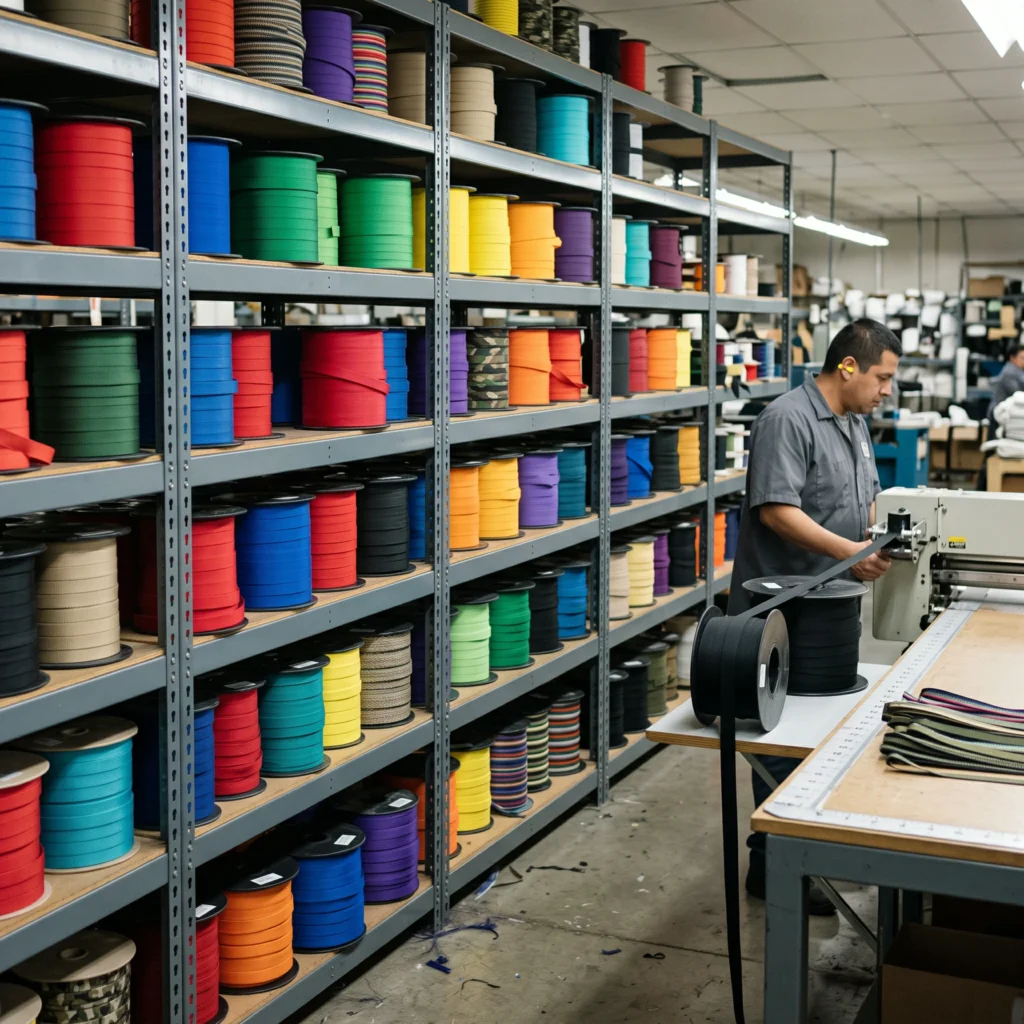
Color customization creates another important cost variable. Dyeing vat minimums, or dyeing MOQ requirements, can determine whether a supplier accepts a small custom-color order without additional charges. A manufacturer may need to purchase more dyed yarn than the actual production quantity requires. This creates unused inventory and potential color obsolescence. For private-label programs, we distinguish between stock-colored rope, custom-dyed rope, and rope constructed from already-colored yarns. Each option produces different lead-time and inventory implications.
Cutting Efficiency and Machine Downtime
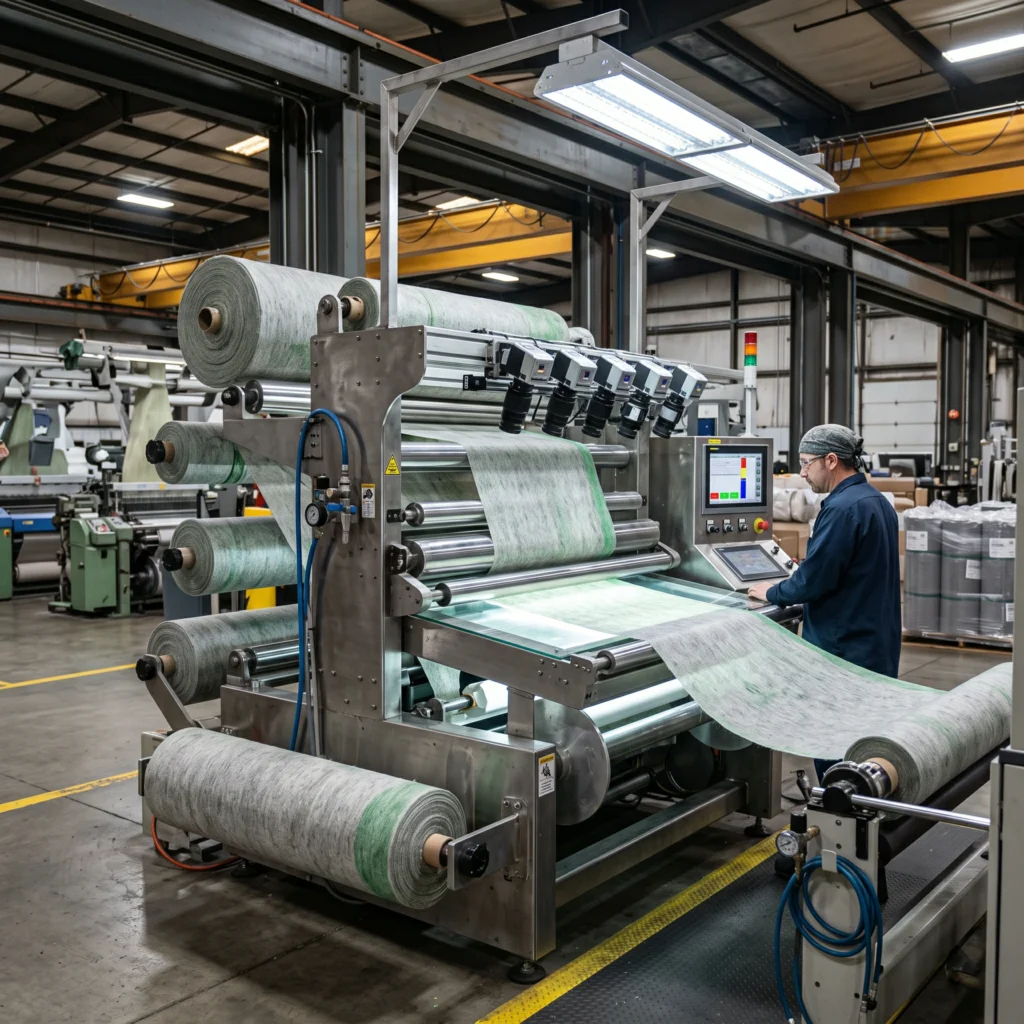
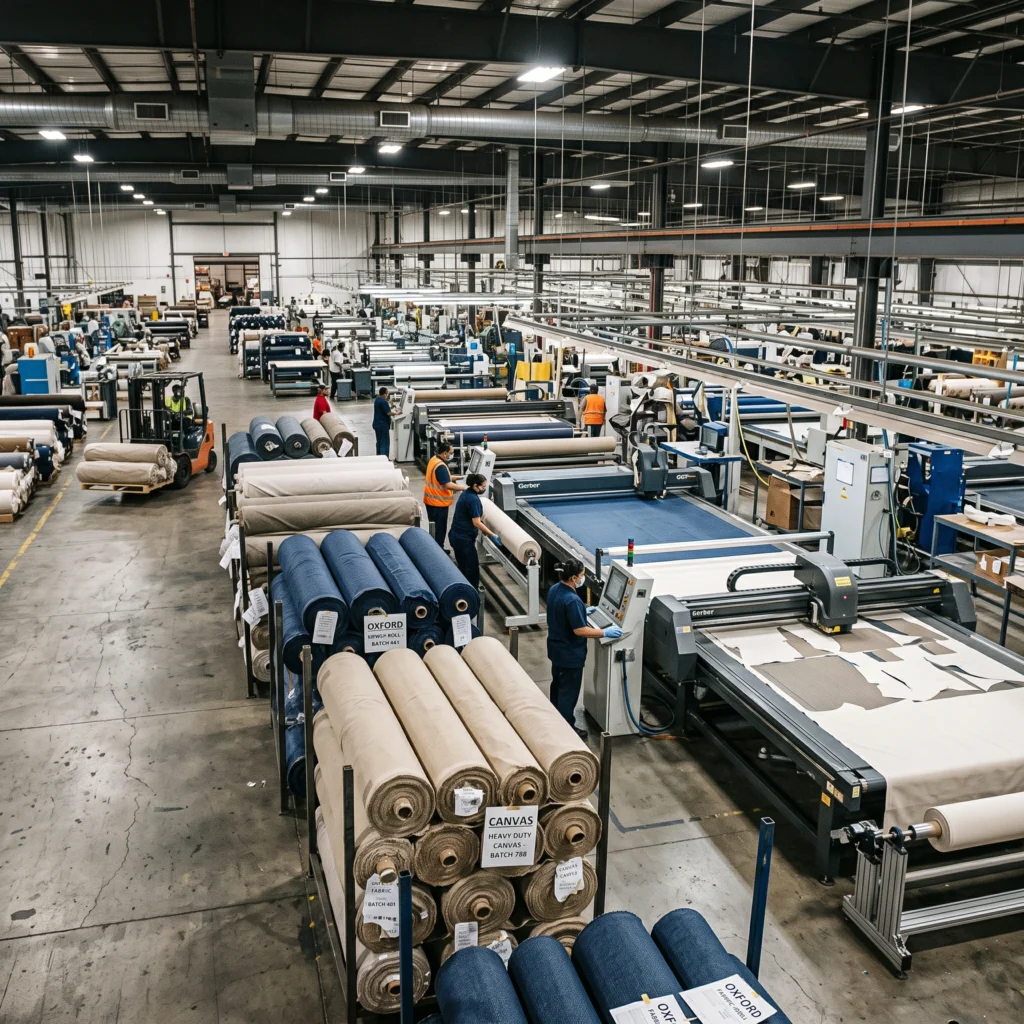
For straight rope components, cutting waste is generally associated with length optimization, damaged ends, and setup variation. When hybrid products also contain fabric panels, fabric roll wastage during automated cutting becomes an additional cost element. Automated fabric cutters may reduce edge waste when nesting efficiency improves, but savings should be calculated from actual marker utilization rather than assumed percentages. Machine downtime also matters. Blade maintenance, rope-feeding jams, equipment cleaning, and product changeovers all reduce available production capacity.
Illustrative Production Yield Model
| Production metric | Cotton rope scenario | Poly-blend scenario |
|---|---|---|
| Production starts | 50,000 | 50,000 |
| Assumed material and processing rejection | 4.0% | 2.5% |
| Accepted units | 48,000 | 48,750 |
| Rejected units | 2,000 | 1,250 |
| Hypothetical FOB production value per started unit | $0.68 | $0.79 |
| Production value divided by accepted units | $0.708 | $0.810 |
Illustrative financial model only. The rejection rates and prices are hypothetical assumptions, not measured Wehao Pets production results or supplier quotations. The model demonstrates why accepted-unit cost differs from quoted unit cost. Although the poly-blend scenario has a higher yield, its material premium is not fully offset by the assumed rejection reduction. A final decision requires evidence of downstream durability benefits or other commercial advantages.
Total Cost of Ownership: Evaluating the Real Financial Difference
A Cost Model Beyond FOB Pricing
FOB pricing represents only one component of the procurement decision. For an importer or private-label distributor, total cost of ownership includes the additional expenditure required to deliver acceptable products and resolve post-sale problems. We use the following simplified evaluation model:
Total Procurement Cost = Initial Product Cost + Inspection Cost + Rework Cost + Freight + Return Handling + Replacement Cost
The model can be expanded to include customs duties, inventory carrying costs, and marketplace deductions when reliable data is available.
Consider two hypothetical purchasing alternatives involving 50,000 units.
Illustrative Total Cost Comparison
| Cost component | Cotton rope | Poly-blend rope |
|---|---|---|
| Purchase quantity | 50,000 | 50,000 |
| FOB price per unit | $0.68 | $0.79 |
| Initial FOB expenditure | $34,000 | $39,500 |
| Assumed replacement claim rate | 5.0% | 2.0% |
| Affected units | 2,500 | 1,000 |
| Assumed handling and replacement cost per affected unit | $3.00 | $3.00 |
| Total claim-related cost | $7,500 | $3,000 |
| Combined modeled expenditure | $41,500 | $42,500 |
Figures are hypothetical and exclude common freight, inspection, tax, and inventory costs. Claim rates are assumptions for illustrating sensitivity, not measured product reliability data. Despite the assumed reduction in replacement claims, the poly-blend option remains $1,000 more expensive. This result illustrates why improved physical performance does not necessarily justify a higher material price.
Calculating the Break-Even Return Rate
The premium for the poly-blend alternative is $5,500. If each avoided claim saves $3.00, the additional material expenditure requires approximately 1,834 avoided claims to break even. Across 50,000 units, this means a required claim-rate reduction of approximately 3.67 percentage points. If the cotton product generates a 5% claim rate, the poly-blend alternative would need to reduce claims to approximately 1.33% or less, assuming other costs remain unchanged. We recommend treating this calculation as a purchasing threshold rather than a prediction. Actual replacement economics depend on the sales channel. Marketplace sellers may face return processing, refunds, and lost fulfillment fees, while wholesale distributors may process consolidated credit claims. The economically preferable material can therefore differ between two customers purchasing an identical construction.
Mechanical Testing for Wholesale Tug Dog Toys
Tensile Testing and Load Retention
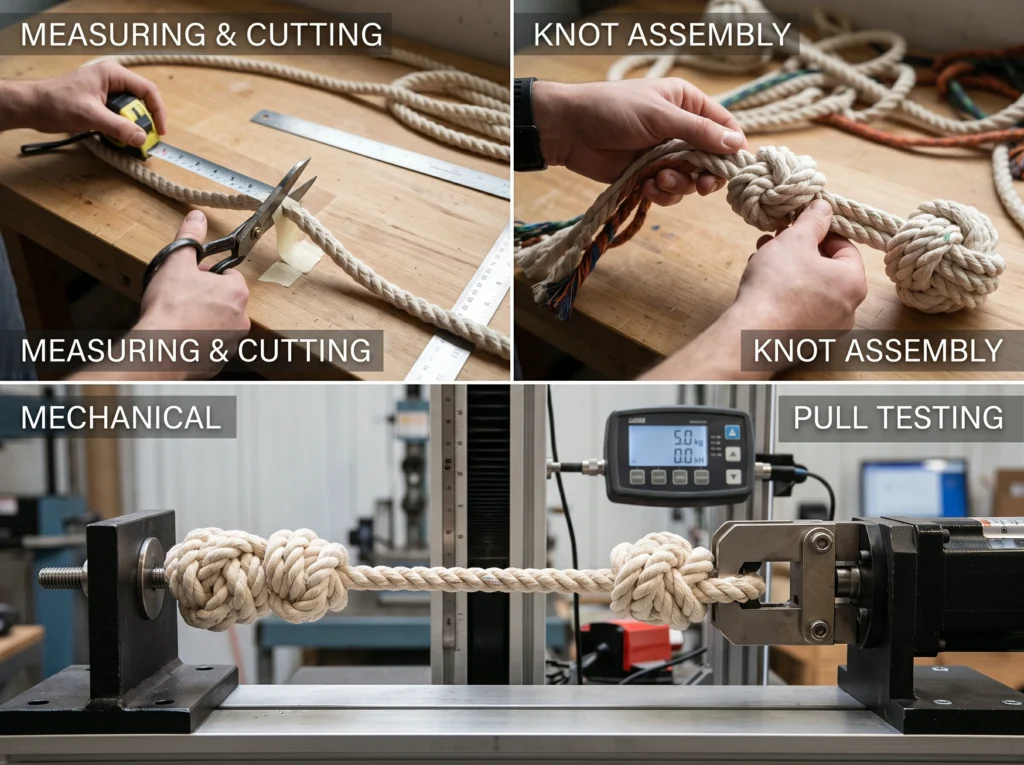
We recommend testing the completed toy rather than relying exclusively on raw yarn specifications. An assembled tug toy contains structural transitions, knots, and potentially stitched or molded attachments. These components create failure conditions that cannot be predicted from the rope’s nominal tensile strength alone. A controlled test protocol should record the equipment, specimen conditioning, grip geometry, loading speed, maximum force, elongation, and observed failure mode. For finished rope toys, the loading arrangement should reproduce relevant forces without allowing grip damage to determine the outcome. Where textile strip testing is appropriate, ISO 13934-1 provides a recognized reference for evaluating maximum force and elongation of textile fabrics. Its scope is not a complete finished-rope-toy testing method, so a separate documented protocol is necessary.
ISO
Cyclic Loading and Abrasion Assessment
Repeated loading often provides more useful comparative information than a single destructive pull test. A development program can apply identical cycles to cotton and blended constructions, followed by measurements of knot movement, visible damage, and residual strength. Abrasion assessment should also evaluate the amount and nature of detached fibers.
For an internally developed screening procedure, we suggest documenting:
- Specimen conditioning: Stabilize samples under a defined temperature and humidity before testing.
- Initial measurement: Record length, weight, diameter, and knot position.
- Repeated loading: Apply a specified force range and cycle count using consistent fixtures.
- Surface evaluation: Record abrasion, protruding filaments, fiber loss, and visible deformation.
- Residual performance: Measure remaining structural integrity after loading.
- Failure classification: Distinguish fiber rupture, knot opening, accessory detachment, and cutting damage.
Loading limits must be established through risk assessment and validated product development. An arbitrary cycle count should not be described as a universally accepted pet toy certification requirement.
Establishing a Material Approval Matrix
We recommend approving materials against measurable specifications agreed between the manufacturer and buyer.
Suggested Material Qualification Framework
| Inspection item | Evaluation method | Required approval decision |
|---|---|---|
| Fiber composition | Supplier declaration and laboratory verification where needed | Match approved formulation |
| Rope diameter | Calibrated measurement across multiple positions | Meet agreed tolerance |
| Finished dimensions | Measurement after conditioning | Meet drawing requirements |
| Pull resistance | Documented finished-product loading test | Meet buyer-defined minimum |
| Knot stability | Displacement measurement after cyclic loading | Remain within approved limit |
| Fiber shedding | Controlled abrasion and fiber collection | Meet agreed acceptance criteria |
| Color consistency | Comparison with approved master sample | Remain within approved tolerance |
| Chemical screening | Market-specific risk-based laboratory testing | Meet applicable requirements |
This framework separates measurable performance characteristics from broader claims such as “indestructible” or “chew-proof.” We do not consider such absolute durability claims technically defensible for textile rope products.
Chemical Safety and Export Market Requirements
Fiber Composition and Chemical Risk
Fiber type alone does not establish chemical safety. Cotton and polyester rope can contain dyes, finishing chemicals, residual processing agents, or other substances introduced during manufacturing. For European distribution, the REACH framework may impose restrictions or information obligations depending on the substances present. The European Chemicals Agency explains that articles containing Candidate List substances of very high concern above specified thresholds can trigger supply-chain communication obligations and, under applicable conditions, other reporting requirements.
ECHA
We therefore recommend reviewing ECHA guidance on substances in articles when determining the appropriate chemical documentation for EU shipments. For the United States and Canada, chemical requirements should be checked against the product’s actual classification, destination, and applicable federal, state, or provincial rules.
Avoiding Incorrect Certification Claims
Pet toys should not automatically be classified as children’s toys. ASTM F963 addresses toys intended for children, and its mandatory application under US children’s product safety rules does not automatically extend to products intended exclusively for animals.
U.S. Consumer Product Safety Commission
We recommend that importers distinguish between legally applicable requirements, voluntary test methods, customer contractual standards, and material supplier declarations. Our approach to material inspection and quality control emphasizes documented specifications and traceable production requirements rather than unsupported universal compliance claims. For each target market, an appropriate technical file should identify the product specification, material composition, applicable requirements, relevant reports, production lot, and label information.
Choosing Rope Materials for Different Wholesale Programs
Cotton Rope for Cost-Controlled Collections
Cotton can be commercially appropriate when the intended product has moderate loading expectations and a positioning strategy that values natural fiber content. A cost-controlled cotton construction still requires attention to strand quality, knot security, fiber shedding, and moisture-related deterioration. We would not automatically substitute a lower yarn grade simply to meet an aggressive FOB target. A change in yarn grade can influence several physical properties simultaneously, making direct price comparison misleading.
Poly-Blend Rope for Durability-Oriented Programs
Poly-blend constructions may be appropriate for products requiring stronger dimensional control, reduced moisture retention, or improved resistance to certain forms of abrasion. However, polyester content must be specified rather than described only as “mixed rope.” A 20% polyester blend and a 70% polyester blend may behave differently under identical loads. The design team should therefore evaluate blend ratio together with twist, diameter, and finished toy geometry. Our heavy-duty dog toys wholesale collection provides a relevant product category for comparing rope-based and reinforced constructions during OEM product planning.
Material Selection by Business Model
| Buyer profile | Principal business requirement | Material evaluation priority |
|---|---|---|
| Private-label startup | Controlled MOQ and initial investment | Available colors, tooling needs, unit economics |
| Amazon-focused brand | Consistent product performance | Claim frequency, fiber shedding, lot consistency |
| Regional distributor | Repeatable replenishment | Production yield, lead time, specification stability |
| European importer | Documented material and chemical controls | Traceability, applicable chemical requirements |
| Promotional product buyer | Cost and delivery reliability | Stock rope availability, assembly simplicity |
We recommend that buyers prioritize the characteristics connected to their actual selling model. A higher-cost material can be justified where measurable durability benefits reduce commercial losses. Conversely, a carefully specified cotton construction may offer a lower total cost where the expected loading profile does not require the characteristics of a synthetic blend.
OEM Specification and Bulk Order Approval
From Sample Approval to Mass Production
The purpose of sampling is to establish a repeatable manufacturing specification. A visually acceptable prototype is insufficient when production will involve multiple yarn lots, operators, or equipment settings.
Before approving a purchase order, we recommend documenting:
- Fiber composition and permitted raw material substitutions.
- Rope diameter, finished dimensions, and unit weight tolerance.
- Approved colors, dyeing MOQ, and batch identification requirements.
- Knot structure, construction drawing, and approved reference sample.
- Mechanical testing methods and acceptance criteria.
- Packaging specification, carton quantity, and inspection requirements.
- Change-control procedures for future replenishment orders.
We also recommend retaining reference samples from the approved production lot. These samples provide physical comparison points when investigating dimensional variation or material-related claims.
Managing Supplier Changes and Production Risk
A material substitution should trigger a documented review, even when the replacement rope appears visually identical. Different yarn suppliers may use different fiber lengths, twist processes, dye systems, or finishing methods. These changes can affect processing performance and product characteristics. For repeat wholesale programs, the procurement specification should require advance approval before changing fiber ratios or nominated material sources. This practice reduces the risk of unnoticed performance variation between shipments.
Conclusion
The decision between cotton rope and poly-blend rope should be based on verified product performance and total procurement economics rather than material price alone. Cotton may offer a commercially suitable solution for controlled-cost collections, while carefully specified polyester blends may improve certain durability characteristics. Neither material guarantees safety or service life independently of its construction. We recommend comparing equivalent finished designs through controlled mechanical testing, measurable production yield, and documented claim-cost assumptions before finalizing a wholesale specification. For long-term sourcing programs, consistency between approved samples and repeat manufacturing lots is as important as the initial material choice.
Frequently Asked Questions
1. Is poly-blend rope stronger than 100% cotton rope for wholesale dog toys?
Poly-blend rope can provide higher tensile strength and improved abrasion resistance when the synthetic fiber content and construction are properly engineered. However, performance varies with fiber ratio, rope diameter, twist density, and manufacturing quality.
We recommend comparing finished products under identical testing conditions rather than assuming polyester content guarantees greater durability. Knot stability, fiber shedding, and failure behavior must also be evaluated.
2. What is the recommended cotton-to-polyester ratio for durable dog tug toys?
There is no universally suitable cotton-to-polyester ratio. A 70/30 or 50/50 cotton-polyester formulation can serve as a development candidate, but neither ratio guarantees a particular lifespan or safety performance.
We recommend evaluating multiple formulations using identical rope diameters and knot configurations. Final selection should depend on measured performance, handling characteristics, material availability, and target FOB cost.
3. How can buyers reduce fiber shedding in bulk rope dog toys?
Fiber shedding can be reduced through appropriate yarn selection, controlled twist, consistent strand tension, and effective finishing. The degree of improvement depends on the specific rope construction and abrasion conditions.
We recommend evaluating shed fibers under repeatable abrasion and cyclic loading procedures. Acceptance criteria should address both the amount of material released and the hazards associated with detached strands.
4. Does increasing rope diameter automatically improve tug toy durability?
Increasing rope diameter may improve resistance to certain pulling loads because more material shares the applied force. However, the relationship is affected by fiber composition, strand arrangement, and the final construction.
We evaluate diameter alongside knot geometry, flexibility, unit weight, and material consumption. A thicker rope may increase FOB cost without proportionately improving the relevant failure resistance.
5. What testing documents should an OEM dog rope toy supplier provide?
An OEM supplier should provide an approved product specification, material composition declaration, relevant inspection records, and mechanical test results based on agreed procedures. Chemical documentation should reflect destination-market requirements.
We recommend identifying each test method, sample quantity, acceptance criterion, and production batch. A generic test report without product identification or technical traceability provides limited procurement assurance.
6. How does production yield affect the FOB price of custom rope dog toys?
Production yield affects the amount of material, labor, and processing expenditure allocated to accepted units. Lower yield increases effective production cost even when the initial raw material price remains unchanged.
We recommend monitoring incoming material rejection, cutting waste, assembly defects, and final inspection results separately. These records help distinguish supplier quality problems from inefficient manufacturing processes.
7. Which rope material offers a lower total cost of ownership for wholesale buyers?
Cotton may deliver a lower total cost when its purchase-price advantage exceeds additional quality and claim-related expenses. Poly-blend rope may become economically preferable when verified durability improvements sufficiently reduce downstream costs.
We recommend calculating the break-even claim rate using actual quotations and distribution-specific handling expenses. Material selection should follow documented results rather than generalized assumptions about natural or synthetic fibers.
8. Can cotton or poly-blend rope toys be described as chew-proof?
Neither cotton nor poly-blend textile rope should be described as universally chew-proof. Teeth can cut fibers, and repeated chewing may cause structural damage or detached strands regardless of the original tensile strength.
We recommend using qualified durability descriptions supported by relevant testing. Product instructions should address inspection, supervision, and replacement when damage or loose fibers appear.
Request Material Samples and OEM Pricing
Selecting a rope material requires measurable performance evidence and realistic production economics. We can review your target rope diameter, fiber composition, annual order volume, customization requirements, and destination market to develop a suitable sampling and quotation plan. To compare cotton and poly-blend options against your purchasing specifications, contact our wholesale team and request a material swatch assessment, prototype evaluation, or bulk FOB quotation.