Overview: Transitioning bulk orders to RPET adds roughly 4-8% to landed costs and demands rigorous chemical quarantine and mechanical adjustments to match virgin polyester’s durability. The critical takeaway for procurement teams is that preventing mass-production compliance failures requires prioritizing factories with GRS-certified supply chains, specialized extrusion oversight, and advanced thermal dyeing protocols.
The Core Challenge: Bridging Prototype Approval and Mass Production Consistency
Getting a custom TPR toy or a plush prototype to pass EN71 and ASTM F963 in a laboratory setting is an elementary task. However, ensuring strict batch consistency across a 100,000-unit mass production run—without chemical deviation or physical failure—is where 80% of factories fail. When procurement managers transition their orders from traditional virgin polyester to recycled polyethylene terephthalate (RPET), the supply chain complexity multipliers increase exponentially.
In our workshop, we view RPET not simply as a marketing tool, but as a volatile raw material that requires rigorous quarantine and testing protocols. Virgin polyester is polymerized in highly controlled chemical environments, yielding completely uniform melt flow indices and tensile parameters. Post-consumer RPET, derived primarily from recycled water bottles, introduces microscopic variances in the extrusion phase. If these variances are not managed through a strict raw material quarantine process, the resulting fabric will display inconsistent yarn tension, leading to seam slippage when subjected to bite-force testing.
Furthermore, when the customs inspector checks the batch at the port of destination, documentation must align perfectly with physical reality. Substituting virgin fibers into an RPET run to cut costs—a common malpractice in unverified facilities—will result in immediate Global Recycled Standard (GRS) audit failures. Our objective in this document is to detail the technical, chemical, and economic realities of manufacturing eco friendly plush dog toys wholesale at scale, ensuring your procurement division understands the exact mechanics of material selection.
Material Science: Polymer Structure and Extrusion Dynamics
To understand the difference between these materials on the factory floor, one must examine the molecular structure of the yarn. Polyethylene terephthalate, whether virgin or recycled, relies on specific intrinsic viscosity (IV) levels to maintain its structural integrity during the melt-spinning process.
Intrinsic Viscosity and Melt Flow Indices
Virgin polyester pellets arrive at the extrusion facility with an exact IV rating, typically around 0.64 to 0.70 dL/g for standard textile applications. This uniformity allows our high-speed knitting machines to operate at maximum efficiency with near-zero yarn breakage.
Conversely, RPET flakes are mechanically recycled. The process of shredding, washing, melting, and re-pelletizing the plastic degrades the polymer chains, resulting in a lower and sometimes fluctuating intrinsic viscosity. To counter this, our facility only sources RPET yarns from suppliers who utilize advanced solid-state polycondensation (SSP) to rebuild the polymer chains. Without this step, the resulting plush fabric would exhibit a brittle hand-feel and fail basic tear resistance protocols required for heavy-duty pet products.
Fabric Weight and Density Adjustments
When manufacturing custom plush cat toys, the difference in yarn decitex between virgin and recycled polyester can significantly alter the penetration depth of catnip oils and the overall tactile experience. Because RPET fibers can sometimes exhibit a micro-porous surface structure due to the recycling extrusion process, we must adjust our circular knitting machines to achieve the exact GSM (Grams per Square Meter) specified in your technical pack.
Comparative Physical Properties in Production
| Physical Property | Virgin Polyester (Standard) | RPET (Post-Consumer) | Factory Mitigation Protocol |
| Intrinsic Viscosity (dL/g) | 0.64 – 0.70 (Highly Stable) | 0.58 – 0.65 (Variable) | Pre-production SSP treatment verification. |
| Yarn Tenacity (cN/dtex) | 4.5 – 5.5 | 3.8 – 4.8 | Adjusting stitch density and seam allowances. |
| Moisture Regain (%) | 0.4% | 0.4% – 0.5% | Standardized humidity control in the warehouse. |
| Melt Temperature (°C) | 250 – 260 | 245 – 255 | Recalibrating thermal bonding and cutting tools. |
Chemical Compliance, Toxicity Profiling, and Batch Control
As a sustainable pet product manufacturer, we recognize that navigating the Global Recycled Standard (GRS) documentation is critical, but physical chemical compliance is where true risk mitigation occurs. RPET introduces unique chemical contamination risks that simply do not exist with virgin materials.
Heavy Metal Migration and SVHCs
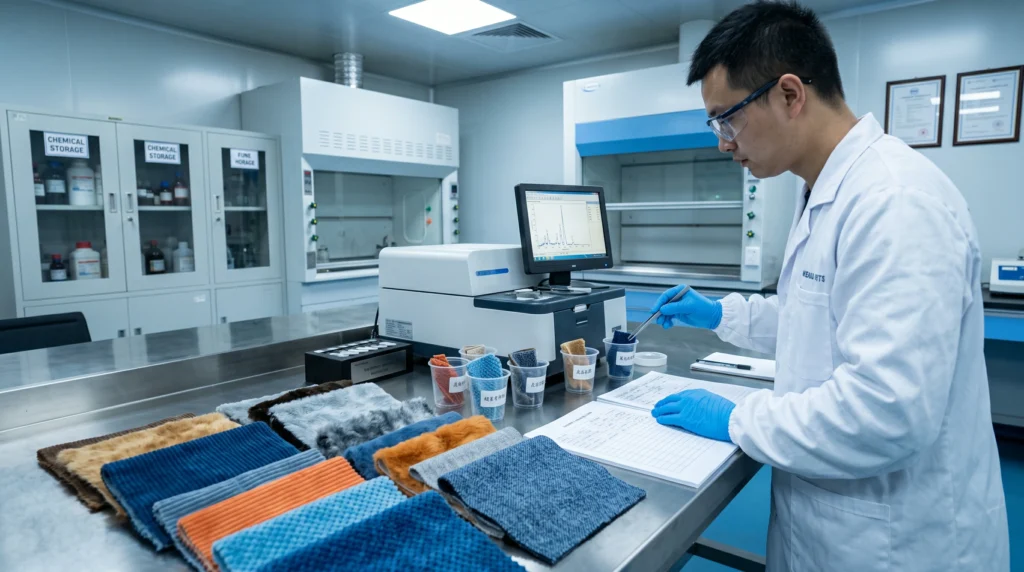
Because RPET originates from post-consumer plastics, there is an inherent risk of trace contamination from non-PET materials, adhesives from bottle labels, or antimony catalysts used in original bottle production. To guarantee consistency across different fabric dye lots, our raw material quarantine process mandates strict third-party testing before the fabric ever reaches the cutting floor.
We utilize third-party SGS testing to verify that all incoming RPET bales comply with the Registration, Evaluation, Authorisation and Restriction of Chemicals (REACH) directives, specifically concerning Substances of Very High Concern (SVHC). If the antimony (Sb) levels exceed the permissible limits for pet oral contact, the entire batch is rejected.
Chemical Testing Thresholds for Pet Toy Fabrics
| Chemical Parameter | Standard Test Method | Allowable Limit (Pet Contact) | RPET Specific Risk Level |
| Azo Dyes (Cleavable amines) | EN 14362-1 | < 30 mg/kg | Low (Depends on dye house) |
| Heavy Metals (Pb, Cd, Sb) | EN71-3 (Migration) | Varies by element | High (Due to recycled origin) |
| Phthalates (BBP, DBP, DEHP) | CPSC-CH-C1001-09.4 | < 0.1% | Medium (Contaminated sorting) |
| Formaldehyde | ISO 14184-1 | < 75 mg/kg | Low |
Dyeing Profiles and Color Matching Under D65 Light Boxes
The visual presentation of a product is paramount to your brand identity, but achieving Pantone-perfect color matching with RPET requires distinct thermodynamic control.
Azo-Free Dyeing Certificates and Thermal Curves
Both virgin and recycled polyester utilize disperse dyes. However, because RPET fibers possess a slightly different crystalline structure and orientation than virgin fibers, their dye uptake rate is fundamentally altered. If a factory uses the same temperature curve (typically peaking at 130°C) for RPET as they do for virgin polyester, the resulting fabric will often appear dull, or the colorfastness to saliva and rubbing will fail ISO 105-E04 standards.
In our workshop, we require azo-free dyeing certificates for every lot. We also program bespoke thermal dyeing curves specifically calibrated for the batch’s IV rating. This ensures the disperse dyes penetrate the fiber core fully, preventing dye migration when the toy is subjected to a dog’s saliva.
Metamerism and Quality Control
To prevent metamerism—where two colors appear to match under one light source but differ under another—our quality assurance technicians evaluate all dye lots using color matching under D65 light boxes. D65 simulates standard daylight. If an RPET batch requires an excessive amount of optical brighteners to achieve a stark white base, we advise clients that this may compromise the fabric’s tensile strength, and we suggest standardizing on “off-white” or unbleached bases for eco-friendly lines.
Mechanical Durability and Bite-Force Resistance
Transitioning to sustainable materials cannot come at the expense of product durability. For heavy-duty pet gear, structural integrity is a non-negotiable metric.
Seam Slippage and Tear Resistance
When sewing plush toys, the needle pierces the fabric, severing individual yarns. Because RPET yarns can have slightly lower tenacity (as outlined in Table 1), the risk of seam slippage during a dog’s play session increases. To counteract this, our factory implements a multi-stage physical reinforcement protocol.
Our mandatory mechanical testing checklist for RPET plush toys includes:
- ISO 13936-2 Seam Slippage Test: Ensuring the warp and weft yarns do not separate under 100N of localized force.
- ASTM D1424 Tear Resistance (Elmendorf): Measuring the force required to propagate an existing tear in the fabric.
- Needle Detection Protocol: Passing all finished units through a highly calibrated 1.0mm ferrous needle detector prior to packing.
- Bite-Force Simulation: Utilizing pneumatic clamp testing to replicate canine jaw pressure on squeaker insertion points and major seams.
Cost Impact Analysis on Mass Scale (100,000+ Units)
Procurement managers must justify the transition to RPET mathematically. While the environmental benefits are clear, the economic reality of the factory floor dictates that RPET incurs a premium.
Resin Costs and Processing Premiums
The base cost of GRS-certified RPET resin is historically 15% to 25% higher than virgin polyester resin. This premium is driven by the complex collection, sorting, washing, and polycondensation processes required to make the material safe for textile extrusion. Furthermore, the mandatory transaction certificates (TCs) required to maintain the GRS chain of custody introduce administrative overhead.
However, when scaling to a 100,000-unit mass production run, economies of scale begin to compress this delta. The cutting, sewing, embroidery, and packaging labor costs remain identical regardless of the fabric base. Therefore, the total landed cost increase of an RPET toy is typically only 4% to 8% higher per unit compared to its virgin counterpart.
Economic Scaling Analysis (Based on 100,000 Units)
| Cost Component | Virgin Polyester (Baseline) | RPET (GRS Certified) | Cost Delta (%) |
| Raw Material (Fabric/Yarn) | Baseline | + 22% | + 22.0% |
| Labor (Cutting/Sewing/QC) | Baseline | Baseline | 0.0% |
| Compliance & TC Documentation | Baseline | Additional $500/lot | + 1.5% (Amortized) |
| Packaging (Standard) | Baseline | Baseline | 0.0% |
| Total Finished Good Cost | $1.00 (Example) | $1.06 | + 6.0% Total |
Container Loading and Vacuum Compression Recovery
The final hurdle in bridging the gap between prototype and mass production is logistics. To maximize shipping efficiency, bulk orders of plush toys undergo intense vacuum compression.
Loft Recovery Testing
Virgin polyester stuffing (PP cotton) has exceptional resilience; it recovers 95% of its loft within 24 hours of being unpacked. RPET stuffing, while highly sustainable, requires specific siliconized treatments to match this memory. Our container loading protocols mandate that every new RPET stuffing blend undergoes a 30-day compression test.
We compress the prototypes to 30% of their original volume, hold them in a climate-controlled chamber mimicking a trans-Pacific sea freight container, and then measure the exact recovery time. If the RPET fibers fail to regain structural volume, the toy will look deflated on the retail shelf. By engineering the denier and crimp of our RPET fibers, we guarantee parity with virgin polyester loft recovery, maximizing your container CBM (Cubic Meters) without sacrificing the end-consumer experience.
Technical B2B Frequently Asked Questions
Why does the color of RPET fabric vary slightly between mass production batches?
Because RPET is derived from post-consumer plastics, the base color of the recycled flake can vary depending on the regional source of the bottles. While virgin polyester provides a perfectly clear baseline for dye, RPET flakes often have a slight green or grey undertone.
We mitigate this through strict color matching under D65 light boxes and by utilizing digital spectrophotometers to adjust dye formulations dynamically. However, procurement teams should factor in a standard ±5% color tolerance when dealing with recycled materials compared to virgin fibers.
Are azo-free dyeing certificates standard for all RPET mass production runs?
Yes, azo-free dyeing is a strict requirement in our facility for both virgin and RPET fabrics. Azo dyes can break down into carcinogenic aromatic amines, which pose a severe risk if a pet ingests the fabric.
We ensure that all dye houses in our supply chain provide up-to-date azo-free certifications and conform to REACH Annex XVII limits. We routinely verify this through our third-party SGS testing protocols before accepting any fabric rolls into our warehouse.
How does vacuum compression impact the shipping volume of RPET toys versus virgin polyester?
When engineered correctly, there is zero difference in shipping volume. We use advanced vacuum compression machinery to reduce plush toy volume by up to 70%, which significantly lowers freight costs per unit.
The critical factor is the use of high-crimp, siliconized RPET stuffing. This specific fiber structure allows the RPET to withstand extreme compression during 30-day ocean transit and spring back to its original shape upon opening, matching the performance of premium virgin PP cotton.
What documentation is provided to prove the RPET material is genuine and compliant?
To prevent greenwashing, strict chain-of-custody documentation is required. We provide Global Recycled Standard (GRS) Transaction Certificates (TCs) for bulk orders, which trace the exact tonnage of recycled material from the sorting facility to our final finished goods.
Additionally, we supply comprehensive chemical compliance reports, including heavy metal migration tests (EN71-3) and REACH SVHC declarations, ensuring that your shipment clears international customs without delays or quarantine holds.
Does transitioning from virgin polyester to RPET compromise the tear resistance of heavy-duty toys?
If raw, untreated RPET is used, there can be a 10-15% reduction in tear resistance. The mechanical recycling process naturally shortens polymer chains.
To prevent this, our factory specifies RPET yarns that have undergone solid-state polycondensation (SSP) to restore intrinsic viscosity. We also adjust our sewing specifications, utilizing reinforced double-stitching and bar-tacking on stress points, ensuring the final RPET toy matches the ASTM D1424 tear resistance benchmarks of a virgin polyester product.
How do you handle heavy metal contamination risks in recycled post-consumer plastics?
Heavy metals, particularly antimony which is used as a catalyst in PET bottle production, are the primary contamination risk in RPET.
Our raw material quarantine process mandates testing incoming bales for lead, cadmium, and antimony. We only partner with GRS-certified extrusion facilities that utilize advanced optical sorting and multi-stage washing protocols to eliminate non-PET contaminants before the melting phase.
What is the realistic cost increase when scaling an RPET order to 100,000 units?
While RPET resin costs roughly 20% more than virgin resin, fabric is only one component of the total manufacturing cost. Labor, cutting, sewing, assembly, and packaging costs remain completely static.
Therefore, when amortizing the cost of the material premium and the GRS transaction certificates across a 100,000-unit run, the landed unit cost typically only increases by 4% to 8%. We provide full transparent bill-of-materials (BOM) pricing to help procurement managers forecast these exact margins.
Optimize Your Sustainable Supply Chain Today
Transitioning to recycled materials requires a manufacturing partner capable of executing strict chemical oversight and advanced mechanical testing. If your procurement team is evaluating the shift from virgin polyester to RPET for your upcoming Q3/Q4 volume, our factory engineers are ready to assist. We can provide comparative material swatch books, GRS compliance roadmaps, and exact mass-production cost analyses based on your current technical packs. Reach out to our technical wholesale team to ensure your next production run meets both environmental standards and strict physical tolerances; contact our wholesale team today to begin the audit process.