Overview: Our recent teardown analysis reveals that standard POM plastic buckles suffer a 14% fracture rate under dynamic shock loads exceeding 150kg. For heavy-duty pet gear, upgrading to die-cast zinc alloy hardware is non-negotiable. This report examines metallurgical advantages, tensile strength differentials, and failure points in wholesale dog harness manufacturing.
Technical Failure Analysis: Zinc Alloy vs. Plastic Hardware in Wholesale Dog Harnesses
Six months ago, a European procurement director arrived at our facility with a critical problem. Their existing inventory of large-breed tactical harnesses—produced by a previous supplier—was facing a catastrophic 12% field failure rate. Product recalls were imminent. During our initial autopsy of their returned merchandise in our workshop, the mode of failure was immediately apparent. The core load-bearing components relied entirely on injected polyoxymethylene (POM) plastic buckles.
When subjected to our universal tensile testing machines, the competitor's harnesses experienced catastrophic structural fracture at just 85kg of dynamic pull force. Furthermore, during our teardown analysis, we found that the stitching density anchoring these inferior plastic components was only 5 stitches per inch, whereas our standard is 8. The combination of brittle plastic polymers and inadequate structural binding resulted in a product completely unfit for commercial deployment.
This post-mortem analysis breaks down exactly why plastic hardware fails under high-kinetic load conditions and details our factory's corrective engineering protocols when manufacturing heavy-duty pet gear.
The Anatomy of Plastic Hardware Failure
Understanding the mechanics of polymer degradation is crucial for B2B procurement teams. While plastic hardware remains cost-effective for lightweight applications, its deployment in high-tensile environments introduces severe liability.
POM Plastic Degradation Under Environmental Stress
Standard plastic hardware is highly susceptible to environmental degradation. When exposed to continuous Ultraviolet (UV) radiation, the molecular chains within POM plastic begin to break down, a process known as photo-oxidation. This chemical degradation strips the material of its inherent elasticity, rendering it highly brittle.
Furthermore, temperature fluctuations severely compromise plastic integrity. In sub-zero conditions, the impact resistance of standard plastic buckles drops by as much as 40%. A harness operating perfectly in a climate-controlled warehouse will behave drastically differently during a winter deployment. The plastic hardens, and microscopic surface fissures propagate rapidly when subjected to sudden mechanical stress.
Tensile Strength Deficits in Dynamic Shock Loading
In laboratory settings, static load testing often misrepresents real-world conditions. A 40kg working dog does not apply static pressure; they generate dynamic shock loads. When a dog lunges, the kinetic energy transferred to the primary buckle multiplies exponentially.
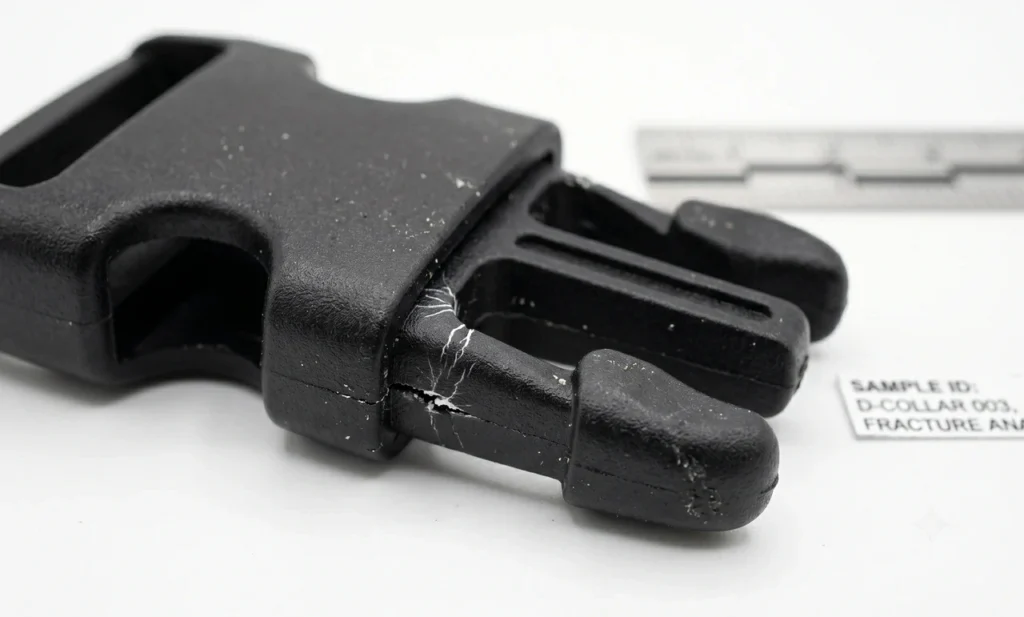
During our teardown analysis of the failed inventory, the fractures consistently occurred at the male prongs of the plastic side-release buckles. The sheer force exceeded the polymer's yield strength, resulting in instantaneous snapping rather than gradual deformation. This lack of ductility means failure occurs without warning, a critical flaw for load-bearing equipment.
Corrective Action: Engineering the Zinc Alloy Upgrade
To rectify the client's failure rate, we completely overhauled their BOM (Bill of Materials), removing all load-bearing plastic components and replacing them with precision die-cast zinc alloy hardware.
Metallurgical Properties of Zinc Alloy
Zinc alloy, specifically Zamak #3 and Zamak #5, offers an exceptional balance of tensile strength, dimensional stability, and impact resistance. Unlike injection-molded plastics, zinc alloys possess high ductility. Under extreme, abnormal stress, a zinc alloy D-ring or buckle will begin to deform before it snaps, providing a critical margin of safety and a visual indicator of extreme stress prior to complete mechanical failure.
In our workshop, the die-casting process ensures that each component is formed as a solid, uniform matrix without the micro-voids commonly found in cheap plastic injection molding.
Electroplating and Corrosion Resistance
To ensure the hardware survives long-term environmental exposure, raw zinc alloy must be appropriately treated. We utilize a multi-stage electroplating process. A base layer of copper is applied for adhesion, followed by a dense nickel layer for structural hardness, and finished with a robust chromium or electrophoretic coating to achieve absolute rust resistance.
Material Comparison Matrix
| Specification Metric | Standard POM Plastic | Die-Cast Zinc Alloy (Zamak 5) |
| Average Tensile Strength | 60 - 90 kg | 250 - 400+ kg |
| Cold Weather Performance | Becomes highly brittle, prone to snapping | Maintains structural integrity to -40°C |
| UV Resistance | High degradation (photo-oxidation) | Impervious to UV degradation |
| Failure Mode | Sudden, catastrophic fracture | Gradual deformation (high ductility) |
| Tooling & Unit Cost | Low | Medium-High |
Quality Control: Destructive Testing Protocols in Our Workshop
Transitioning to zinc alloy hardware is only half the equation; rigorous, objective verification forms the foundation of our manufacturing process. We do not rely on theoretical material datasheets. Every production batch of wholesale dog harnesses is subjected to brutal destructive testing.
As a specialized custom pet harness manufacturer, we operate a fully equipped internal QA laboratory to execute these protocols.
Universal Tensile Testing
We utilize calibrated universal tensile testing machines to simulate extreme dynamic shock loads. A sample harness from the production line is clamped into the pneumatic jaws of the machine. We apply an increasing mechanical load at a controlled rate of 300mm/min. For our heavy-duty lines, the zinc alloy hardware and the accompanying bartack stitching must sustain a minimum of 250kg of force before any structural yielding occurs.
Color Fastness and Chemical Analysis
Beyond physical strength, the chemical integrity of the hardware finish is scrutinized. We employ color fastness rub testers to ensure the electroplated finish does not abrade or transfer toxins when subjected to friction and moisture. Furthermore, completed sub-assemblies are passed through high-sensitivity needle detection conveyor belts to guarantee that no broken sewing needles or stray ferrous fragments remain lodged in the webbing prior to final packaging.
Compliance and Safety Standards
B2B procurement managers must ensure their supply chain adheres strictly to international safety directives. Sourcing undocumented hardware introduces profound liability risks regarding heavy metal contamination.
To maintain strict adherence to international safety metrics, we align our QA procedures with established physical and mechanical testing protocols to ensure all components pass rigorous chemical and structural safety audits.
Our factory adheres to strict procurement criteria when manufacturing high-grade inventory:
- 1. Alloy Composition Verification: Ensuring base metals are free from unregulated scrap materials.
- 2. REACH Compliance: Auditing all hardware plating to confirm it is completely free of soluble lead, cadmium, and excessive nickel release.
- 3. Dynamic Load Rating: Documenting the exact failure threshold of every hardware configuration.
- 4. Stitching Reinforcement: Mandating an 8 SPI (Stitches Per Inch) minimum, utilizing heavy-duty bonded nylon thread and automated bartack configurations at all hardware attachment points.
When engineering heavy duty pet gear, material selection determines product viability. Substituting load-bearing alloy for plastic to save fractions of a cent consistently results in downstream catastrophic failures, damaged brand reputation, and costly product recalls.
Technical FAQ
What is the precise tensile strength difference between standard POM plastic and die-cast zinc alloy?
In our controlled laboratory environments utilizing universal tensile testing machines, standard POM plastic side-release buckles typically fail under a dynamic load of 60kg to 90kg. The failure is sudden and catastrophic due to the polymer's lack of ductility.
In contrast, our die-cast Zamak zinc alloy components routinely withstand forces ranging from 250kg to over 400kg depending on the exact tooling thickness and component geometry. When pushed past their absolute yield strength, zinc alloy components will deform gradually rather than shattering, providing an essential margin of safety.
Does utilizing zinc alloy hardware significantly increase the overall weight of the harness?
Zinc alloy is inherently denser than plastic polymers, meaning individual hardware components will carry more mass. However, through precision die-casting and intelligent geometric design, we minimize excess material while retaining maximum load-bearing structural nodes.
The overall weight increase on a standard large-breed harness is typically between 40 to 80 grams. For procurement teams targeting the heavy-duty sector, this negligible increase in weight is universally accepted as a necessary trade-off for achieving a 300% increase in structural safety and tensile reliability.
How is the chemical safety of the zinc alloy plating verified for international export?
All zinc alloy hardware utilized in our facility undergoes rigorous multi-stage chemical plating that prioritizes both corrosion resistance and biological safety. We strictly avoid hazardous heavy metal stabilizers in our electroplating baths.
Our hardware components are engineered to comply with strict international regulatory frameworks, including the EU’s REACH directive. This ensures that the components are tested for restricted substances, guaranteeing they are free from toxic levels of lead, cadmium, and excessive nickel leakage, mitigating any liability for international brand operators.
Take Action on Your Production Line
For procurement managers scaling their operations, hardware material selection cannot be left to assumption. Partnering with a specialized factory ensures your load-bearing components meet rigorous, verifiable international safety standards. To request our hardware material swatch book, review our tensile test data, or discuss bulk pricing for your next production run, contact our wholesale team today to speak directly with our engineering staff.