Overview: As an OEM/ODM manufacturing factory focused entirely on B2B partnerships, our business model centers on mitigating supply chain risks for global brands. Procurement managers constantly battle to balance raw material costs with the strict chew-resistance demands of the market. When a product line fails, it is rarely the aesthetic design—it is material engineering. Understanding and specifying exact durometer ratings is the definitive factor that solves durability pain points and ensures your wholesale TPR dog toys perform under extreme mechanical stress.
The Invisible Metric: Why Shore A Hardness Dictates Product Lifespan
Buyers often obsess over the external geometry, the Pantone color match, and the texture of a new product mold. However, it is the microscopic arrangement of the polymer chains—measured quantifiably by Shore A hardness—that dictates whether a custom rubber pet toy lasts a single afternoon or an entire year.
In our Dongguan workshop, we frequently consult with brand founders who have experienced catastrophic product failures due to a misunderstanding of durometer ratings. When a canine jaw exerts up to 300 PSI of bite force, a TPR (Thermoplastic Rubber) compound that is just five degrees too soft on the Shore A scale will puncture and tear instantly. Conversely, a formulation that is five degrees too hard becomes brittle, lacking the elastomeric rebound necessary to absorb kinetic impact, leading to micro-fractures and eventual shattering. As a premier indestructible dog toys factory, we start every production dialogue not with shapes, but with Shore A specifications.
Raw Material Inspection: TPR Formulation and Durometer Calibration
The manufacturing assembly line begins long before the injection molding machines are powered on; it starts in the raw material quarantine zone. TPR is not a monolith. It is a mechanical blend of SBS (Styrene-Butadiene-Styrene) or SEBS (Styrene-Ethylene-Butylene-Styrene) block copolymers with various plasticizers, fillers, and stabilizers.
When resin pellets arrive at our facility, our quality control engineers extract randomized samples to measure the baseline durometer. We utilize analog and digital Shore A durometers, applying a standardized presser foot against a cured sample to measure the depth of indentation. The higher the number, the greater the resistance to indentation, and thus, the harder the material.
Standard TPR Hardness Scale (Shore A) and Mechanical Applications
| Shore A Durometer | Tactile Feedback | Tensile Strength Output | Optimal Canine Target Size | Typical B2B Product Application |
| 30A – 40A | Highly pliable, gel-like | Low (Prone to shearing) | Small Breeds (<15 lbs) | Teething rings, sensory chew textures |
| 45A – 55A | Flexible rubber | Moderate | Medium Breeds (15-40 lbs) | Standard squeaker cores, fetching balls |
| 60A – 70A | Firm, slight yield | High (Excellent rebound) | Large Breeds (40-80 lbs) | Heavy-duty chew bones, tug-of-war gears |
| 75A – 85A | Rigid, hard plastic feel | Maximum (Impact resistant) | Giant Breeds (>80 lbs) | Extreme structural cores, dental treads |
Achieving the exact durometer rating requires precise formulation variables. Our chemical engineers adjust the oil-to-resin ratio at a microscopic level.
To ensure the compound performs to specification, our technicians monitor the following critical formulation variables prior to mixing:
- Base Polymer Grade: Selection between SBS (for high friction and elasticity) versus SEBS (for superior UV and thermal degradation resistance).
- Plasticizer Saturation Levels: The exact percentage of mineral oil injected into the polymer matrix to lower the durometer without compromising the tear strength.
- Mineral Filler Ratios: Utilizing calcium carbonate or silica to adjust specific gravity and stabilize the durometer, ensuring consistent shrinkage rates.
- Colorant and Additive Dispersion: Ensuring that masterbatch pigments and UV stabilizers are uniformly distributed, as poor dispersion creates weak points that artificially lower local durometer readings.
- Moisture Content: Enforcing a strict pre-drying protocol, as hygroscopic moisture absorption leads to steam voids during injection, drastically reducing structural hardness.
Injection Molding: Thermal Dynamics and Hardness Retention
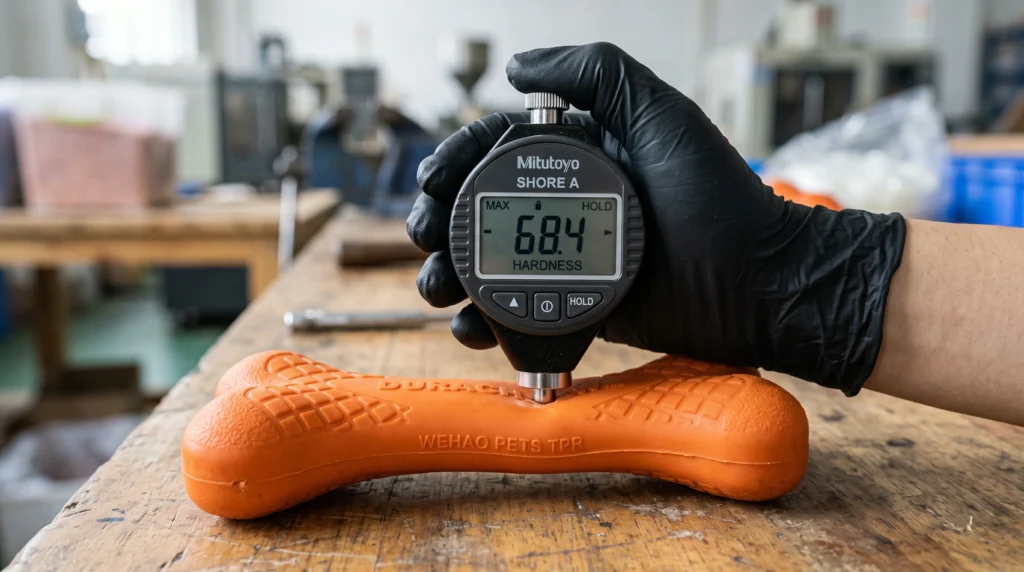
Once the TPR formulation is locked and the durometer baseline is established, the material moves to the injection molding floor. The transition from raw pellets to a finished three-dimensional structure involves extreme thermal dynamics. It is here that poor manufacturing controls can completely alter the intended hardness of wholesale TPR dog toys.
Wall Thickness vs. Durometer Optimization
The mold design itself directly interacts with the durometer rating. A 50A TPR will behave entirely differently in a mold with a 2mm wall thickness compared to a 6mm wall thickness. In our engineering department, we run mold flow analysis to predict how the molten TPR will behave. If a buyer requests an aggressively textured surface for dental cleaning, we must carefully calculate the shear rate. High shear rates during injection can cause polymer chain degradation, which permanently reduces the final Shore A hardness of the toy by up to 5 points.
We maintain rigid control over the injection machinery. The melting temperature must perfectly align with the specific durometer being processed. Softer TPR formulations (30A-45A) require lower barrel temperatures to prevent scorching, while harder formulations (70A+) require higher temperatures and higher injection pressures to overcome their intrinsic viscosity.
Critical Injection Molding Parameters Based on TPR Durometer
| Parameter | Soft TPR (30A-45A) | Medium TPR (50A-65A) | Hard TPR (70A-85A) |
| Barrel Temperature | 150°C – 170°C | 170°C – 190°C | 190°C – 210°C |
| Injection Pressure | 40 – 60 MPa | 60 – 80 MPa | 80 – 110 MPa |
| Mold Temperature | 25°C – 35°C | 30°C – 40°C | 40°C – 50°C |
| Cooling Time | Extended (Requires stability) | Standard | Short (Rapid solidification) |
Our operators manually recalibrate machine tension, screw RPM, and back pressure for every unique batch. If the holding pressure is released a fraction of a second too early, the center of a thick-walled toy will remain in a semi-molten state, creating a sink mark and an inconsistent internal durometer that acts as a structural weak point for aggressive chewers.
Post-Production Curing and Physical Testing
Manufacturing does not end when the mold opens. TPR requires a specific curing window to allow the polymer chains to completely cross-link and stabilize. Immediately testing a toy as it drops from the mold will yield an inaccurate, artificially low durometer reading. We quarantine all freshly molded batches in a climate-controlled holding area for a minimum of 24 hours.
Once cured, the items proceed to our physical testing laboratory. Hardness is only useful if it corresponds with mechanical durability. We subject our production runs to grueling mechanical evaluations. Under a magnifying loupe, our engineers inspect the gate vestiges and parting lines for fiber fraying or stress whitening—early indicators of material failure.
Our internal testing protocols include:
- Tensile Strength and Elongation Testing: Using a universal testing machine to stretch the material until the breaking point, measuring the exact MPa (Megapascals) of force required to snap the TPR.
- Tear Resistance Testing: Utilizing a crescent-cut specimen to measure how easily a puncture (simulating a canine tooth) propagates into a complete tear.
- Accelerated Thermal Aging: Placing samples in industrial ovens at 70°C for 72 hours to ensure the plasticizers do not leach out over time, which would cause the toy to harden and crack on retail shelves.
- Compression Set Testing: Measuring the material’s ability to return to its original shape after prolonged compression, simulating hours of sustained jaw pressure.
- Specific Gravity Verification: Weighing the finished toy in air and in water to detect any internal micro-porosities that would compromise the structural integrity.
When validating our materials for international markets, we strictly align our internal testing with authoritative global bodies. We frequently submit our materials to independent laboratories like SGS to ensure physical and chemical compliance with standards such as ASTM F963 and the European REACH directive, guaranteeing zero heavy metal or phthalate contamination.
Structuring Your Custom Rubber Pet Toys Portfolio
For B2B procurement teams, balancing a product portfolio means scaling durometer ratings alongside target demographics. Stocking only 75A hard rubber toys will alienate buyers with senior dogs or small breeds, while exclusively stocking 40A soft toys will result in high return rates from owners of aggressive power chewers.
We work closely with clients to diversify their SKU matrix. For instance, when designing heavy-duty dog toys wholesale collections, we recommend a dual-durometer overmolding technique. This process involves a rigid 80A structural core overlaid with a softer 50A exterior, providing both immediate tactile satisfaction and long-term mechanical resilience.
Strategic Portfolio Matrix for TPR Durometer Allocation
| Product Category | Recommended Durometer | Core Engineering Objective | Structural Considerations |
| Puppy Teething Toys | 35A – 45A | Gingival stimulation, zero damage | Thin-walled, high surface texture |
| Interactive Fetch Toys | 50A – 60A | High kinetic rebound, elasticity | Hollow cores for aerodynamic flight |
| Dental Cleaning Chews | 65A – 75A | Plaque removal, sustained abrasion | Deep grooves, thick exterior walls |
| Extreme Power Chews | 80A – 85A | Maximum tensile tear resistance | Solid injection, zero internal voids |
Quality Assurance: Our AQL Standards and Factory Capabilities
As your dedicated OEM/ODM services provider, we enforce a strict Acceptable Quality Limit (AQL) 1.5 standard for physical integrity. Visual aesthetics mean nothing if the underlying engineering is flawed. Our production directors systematically walk the floor, verifying that the actual product matches the approved golden sample down to the exact decimal of Shore hardness.
If a batch drifts beyond a ±3 Shore A tolerance, it is immediately rejected and recycled. Our clients rely on this uncompromising objectivity to protect their brand equity in competitive markets like the USA, Canada, Europe, and Singapore.
FAQ: Technical Specifications for TPR Pet Toys
1. What is the ideal Shore A durometer for aggressive chewers?
For aggressive chewers, we recommend a Shore A hardness between 70A and 85A. This range provides the necessary structural rigidity to resist deep punctures from canine incisors and canines.
Materials softer than 70A will lack the shear strength to withstand sustained jaw pressure, while anything harder than 85A risks becoming too brittle and could potentially cause dental trauma to the animal.
2. How does temperature affect TPR hardness during shipping?
Thermoplastic Rubber is sensitive to extreme temperature fluctuations. During trans-oceanic shipping in non-climate-controlled containers, ambient temperatures can exceed 60°C, temporarily softening the TPR.
Conversely, freezing temperatures during winter ground transit will cause the material to temporarily stiffen. We engineer our TPR formulations with high-grade SEBS polymers to ensure the material returns exactly to its calibrated Shore A hardness once acclimated to room temperature.
3. Can we mix different TPR durometers in a single mold?
Yes, through a highly advanced process known as two-shot injection molding or overmolding. We can inject a rigid TPR core (e.g., 80A) and follow it with a softer exterior TPR skin (e.g., 45A).
This allows procurement teams to design toys that feature a tough, indestructible skeleton with a soft, tactile exterior that appeals to the end-user’s sensory preferences.
4. What is the shrinkage rate difference between 40A and 60A TPR?
Softer TPR formulations (such as 40A) contain higher volumes of plasticizing oils, resulting in a slightly higher shrinkage rate (typically around 1.5% to 2.5%) during the cooling phase.
Harder formulations (60A and above) have denser polymer matrices and lower oil content, yielding a lower, more predictable shrinkage rate (1.0% to 1.8%). We must cut the steel molds to exact oversized dimensions based on the specific durometer requested.
5. Does color pigmentation impact the final durometer of custom rubber pet toys?
Yes, poorly formulated color masterbatches can act as unintended fillers, altering the molecular cross-linking of the TPR. Heavy concentrations of carbon black or titanium dioxide can slightly increase the Shore A hardness.
Our chemical engineers precisely calibrate the masterbatch carrier resin to perfectly match the base TPR resin, ensuring that a neon green toy and a solid black toy from the same batch yield identical durometer readings.
6. How do you test the tear strength of TPR dog toys?
We measure tear strength using a standardized universal testing machine, applying steady mechanical force to a pre-cut, crescent-shaped specimen. The machine records the exact force required to propagate the tear, measured in kilonewtons per meter (kN/m).
A high Shore A hardness does not automatically equal high tear strength. The formulation must strike a precise balance between rigid polymer blocks and elastic segments to prevent catastrophic tearing.
7. What certifications should wholesale TPR dog toys hold for the US market?
For the US market, TPR dog toys should theoretically align with the safety parameters outlined in ASTM F963 (the standard for children’s toys), ensuring zero presence of heavy metals like lead and cadmium.
Additionally, the TPR material must pass rigorous phthalate screening. We provide full Material Safety Data Sheets (MSDS) and coordinate with third-party testing labs to verify that our formulations meet all necessary chemical compliance thresholds.
If you are a procurement manager experiencing high return rates due to material failure, it is time to audit your product specifications. Stop guessing on polymer blends and let our engineering team calibrate the perfect Shore A hardness for your next production run. Contact our wholesale team to request a physical TPR durometer swatch book, review our technical capabilities, and secure bulk pricing for your upcoming pipeline.