Overview: Interactive puzzle toys dominate because they solve canine cognitive boredom, yet most fail mechanically due to subpar plastic tolerances. As a leading interactive dog toy manufacturer, we utilize precision injection molding (+/- 0.05mm) and optimized ABS/PP friction coefficients to eliminate slider jamming, ensuring superior product longevity and market dominance.
The 1-Star Review Crisis: Analyzing Competitor Failures on Amazon
Analyzing the recent 1-star review trends across the top-selling Amazon and Chewy pet product listings reveals a glaring engineering oversight that plagues the current market. When you examine the negative feedback for top-ranking interactive canine puzzles, the complaints rarely focus on the conceptual design; they overwhelmingly target mechanical failures. Customers consistently report that puzzle sliders jam after a few weeks of use, or worse, that aggressive chewers are able to pry the sliding plastic bone covers off the tracks, turning a cognitive enrichment tool into a dangerous choking hazard. From an engineering standpoint, this is not a user error; it is a fundamental failure in factory-level execution, specifically regarding poor plastic injection tolerances and incorrect polymer selection. When a puzzle pet toy factory relies on outdated single-cavity molds with poor cooling line designs, the resulting plastic warpage causes the tracks to shrink unpredictably. When the tolerance deviates beyond +/- 0.05mm, the sliders either bind up due to excessive friction or become too loose, allowing a dog’s teeth to gain leverage under the lip. By applying rigorous structural engineering and advanced mold-flow analysis at the prototyping stage, we systematically eradicate these flaws before mass production begins.
Reverse-Engineering the Market: From Complaint to Specification
To truly capture market share in the US pet sector, brands must stop viewing these products as simple toys and start treating them as durable mechanical assemblies. As a dedicated interactive dog toy manufacturer, our approach involves a direct translation of consumer friction points into hard manufacturing specifications. We call this our Review-to-Spec protocol.
Below is the definitive breakdown of how we reverse-engineer competitor failures and upgrade the technical foundation of the product.
Table 1: MANDATORY REVIEW-TO-SPEC TRANSLATION
| Common Consumer Complaint (from Amazon/Chewy) | The Engineering Flaw | The Wehaopets Manufacturing Fix | Impact on Unit Cost |
| “The sliding covers get stuck when wet with dog saliva.” | Miscalculated friction coefficients between identical PP (Polypropylene) components. | Utilizing dissimilar materials: ABS for the sliders and PP for the base tracks, plus applying a micro-texture (VDI 24) to reduce surface tension. | +$0.12 per unit (Material upgrade) |
| “My dog ripped the sliding bone out in 5 minutes.” | Insufficient undercut geometry on the sliding rail and poor draft angles leading to weak snap-fits. | Deepening the rail undercut to 1.5mm and increasing wall thickness around the track edge to 2.8mm to resist canine jaw leverage. | +$600 to total mold cost (Slider cam mechanisms required) |
| “The toy slides all over the hardwood floor.” | Glued-on EVA foam pads that shear off under lateral canine pushing force. | Two-shot injection molding (Overmolding) a TPR (Thermoplastic Rubber) anti-slip ring directly onto the PP base. | +$0.25 per unit, higher upfront tooling cost for 2K mold. |
| “It broke in half when dropped from the counter.” | Lack of internal structural ribs and sink marks creating weak points in the chassis. | Implementing cross-hatched structural ribbing at 60% of nominal wall thickness to prevent sink marks while maximizing drop-test survival rates. | Negligible (Resolved via DFM / Tooling design phase) |
Material Science: ABS vs Polypropylene Friction Coefficients
When developing custom smart dog toys or mechanical puzzles, polymer selection dictates the entire user experience. Many amateur buyers source products from factories that use a single, cheap material—typically generic recycled Polypropylene (PP)—for both the base unit and the moving sliders. When identical polymers rub against each other, their identical molecular structure causes galling and a high coefficient of friction, especially when introduced to dog saliva and kibble dust.
To engineer a buttery-smooth mechanical slide that withstands years of use, we strictly separate our polymer assignments. We utilize high-impact ABS (Acrylonitrile Butadiene Styrene) for the interactive moving parts. ABS offers exceptional dimensional stability, high tensile strength, and resistance to impact. For the main chassis and puzzle base, we utilize food-grade Polypropylene (PP). PP is slightly more flexible, highly resistant to fatigue, and completely non-toxic, which is critical for components in direct contact with food. By sliding an ABS component over a PP track, the differing friction coefficients naturally reduce mechanical binding. Furthermore, our tooling engineers implement precise draft angles (typically 1.5 to 2 degrees) to ensure smooth ejection from the mold, which prevents the micro-abrasions on the plastic surface that often cause sliders to catch and jam in cheaper products.
Table 2: Polymer Selection Matrix for Mechanical Pet Toys
| Material | Primary Application in Puzzle Toys | Key Mechanical Properties | Limitations / Considerations |
| Polypropylene (PP) | Main base, chassis, food compartments | High fatigue resistance, food-safe, low cost, excellent chemical resistance. | Prone to higher shrinkage rates (1.5% – 2.0%), making tight tolerance control difficult without expert molding. |
| ABS | Sliders, lids, moving buttons | High impact resistance, excellent dimensional stability, glossy finish. | Not ideal for soft-chew applications; more rigid, meaning thin walls can crack under extreme pressure. |
| TPR (Thermoplastic Rubber) | Anti-slip bases, bite-friendly outer bumpers | High friction for grip, soft shore hardness (e.g., 50A – 70A), easily overmolded onto PP. | Cannot be used for structural or load-bearing internal tracks. |
| Polycarbonate (PC) | Clear domes or transparent smart-toy screens | Extreme impact resistance (virtually unbreakable), optical clarity. | Higher cost, prone to scratching from claws unless hard-coated. |
Precision Injection Molding: The Tooling Engineer’s Perspective
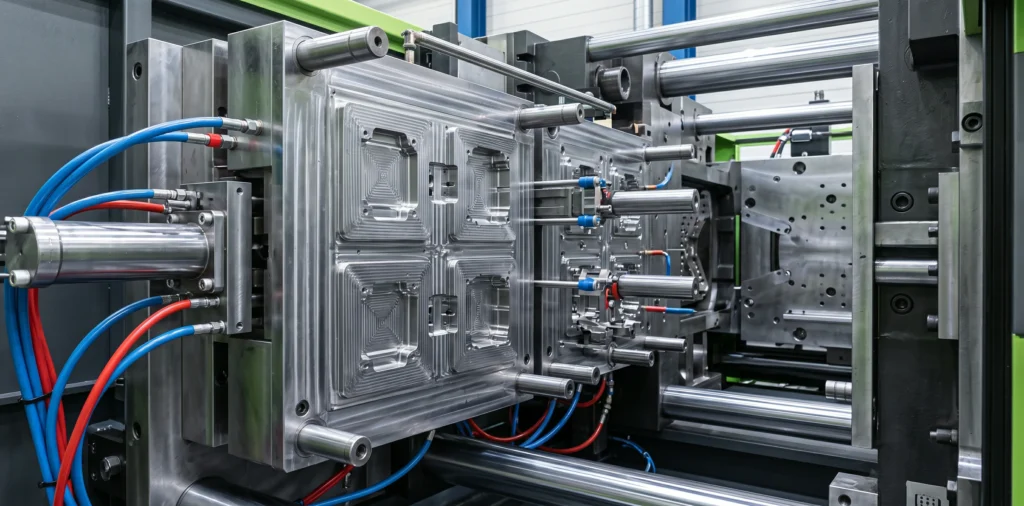
The secret to dominating the US pet market does not lie in marketing; it lies in CNC mold polishing and gate optimization. When you partner with our OEM/ODM services team, you are tapping into industrial-grade manufacturing. An interactive puzzle toy often requires 5 to 10 distinct plastic components. If the base shrinks by 1.2% during cooling, but the sliding lid shrinks by 1.8%, the parts will never fit together on the assembly line.
To combat this, our engineers utilize advanced Moldflow software to simulate the cooling process before a single block of P20 or H13 steel is cut. We meticulously map the gate locations—often opting for sub-gates or edge gates hidden on non-cosmetic surfaces—to ensure an even flow of molten plastic. This prevents knit lines (where two flows of plastic meet) from forming at high-stress areas, such as the edge of a treat compartment.
Furthermore, we utilize CNC mold polishing to achieve specific SPI finishes. For moving tracks, we specify an SPI B-2 finish (medium polish) to reduce surface friction, while the exterior cosmetic surfaces might receive an SPI A-2 (high diamond polish) to make the product visually pop in Amazon listing photos. The precision of our injection molding tolerances (+/- 0.05mm) means that every slider snaps into the track with a satisfying click, requiring exactly the right amount of force (e.g., 2.5 Newtons) for a dog’s nose or paw to move it, without allowing it to rattle or fall out during shipping.
Drop-Test Survival Rates & Structural Integrity
Unlike plush items, rigid plastic puzzle toys face a brutal lifecycle. They are stepped on, dropped from kitchen counters, and violently pawed at by 80-pound Golden Retrievers. According to data from market research leaders in the pet industry, durability is the second highest driver of brand loyalty in the hard-goods pet category.
To ensure maximum drop-test survival rates, we move away from traditional screw-based assembly wherever possible. Screws create concentrated stress points where the plastic is prone to fracturing upon impact. Instead, we heavily rely on ultrasonic welding to join the upper and lower halves of our wholesale dog puzzle toys. Ultrasonic welding uses high-frequency acoustic vibrations to melt the mating surfaces together, creating a continuous, hermetic seal that distributes impact energy evenly across the entire chassis.
During our Quality Control phase, we subject all production batches to a grueling standardized testing protocol.
Table 3: Factory Quality Control & Stress Protocol
| Test Category | Methodology | Passing Criteria | Relevance to Buyer |
| Standard Drop Test | 1.5-meter drop onto a concrete surface, hitting all 6 faces and 4 corners. | No functional damage, no detaching of small sliders (choking hazard prevention). | Ensures the product survives Amazon warehouse fulfillment and clumsy home usage. |
| Bite Force Simulation | Pneumatic press applies localized pressure to the thinnest wall of the sliding components. | Must withstand up to 150 lbs of localized pressure without catastrophic fracturing. | Guarantees safety against aggressive chewers trying to pry the toy apart. |
| Slider Cycle Testing | Automated pneumatic arm slides the puzzle compartments back and forth. | 10,000 continuous cycles with no jamming, binding, or severe abrasive wear. | Proves the ABS/PP friction optimization works, eliminating the “stuck slider” 1-star reviews. |
| Dishwasher Heat Test | Submerged in 80°C (176°F) water for 45 minutes. | Zero structural warping; sliders must still operate smoothly after cooling. | Allows brands to market the puzzle toy as “Top-Rack Dishwasher Safe” (A massive USP). |
Mandatory Tech Pack Upgrades for Product Developers
If you are a product developer preparing to launch a new puzzle toy, sending a simple 3D rendering to a factory is a recipe for disaster. To ensure your product outperforms the market average and establishes dominance in the Amazon Top 100, you must demand absolute technical clarity from your manufacturing partner.
Ensure the following 3 parameters are explicitly added to your Tech Packs:
- ⚙️ Specify Tolerance Thresholds on Moving Assemblies: Do not just specify “Slider A fits into Track B.” Your Tech Pack must explicitly state: “Clearance between Slider A and Track B must be maintained at 0.15mm with a general manufacturing tolerance of +/- 0.05mm to ensure anti-jamming functionality under dynamic load.”
- 🔧 Demand Dissimilar Polymers for Friction Zones: Require a material breakdown that explicitly assigns ABS (or POM/Delrin for ultra-high end) to the kinetic components, and PP to the static tracks. Include a note: “Under no circumstances shall identical polymers be used for interlocking kinetic slide mechanisms.”
- ⚙️ Mandate Wall Thickness Uniformity and Ribbing: Include a cross-sectional requirement stating: “Nominal wall thickness to remain constant at 2.5mm. All structural ribs supporting the puzzle floor must not exceed 60% of the nominal wall thickness to prevent cosmetic sink marks on the top surface.”
Navigating Prototyping and Mold Costs
The barrier to entry for high-quality custom smart dog toys is the initial tooling phase. A sophisticated interactive puzzle toy with multiple sliding compartments, rotating dials, and a squeaker integration requires a multi-cavity family mold or multiple dedicated steel tools.
For a typical Level 2 or Level 3 puzzle toy, the tooling investment can range from $4,500 to $8,000 depending on the complexity of the cam actions required to mold the internal undercuts. However, this is an investment in market dominance. Cheap aluminum molds degrade quickly, leading to the exact flashing and tolerance issues that cause sliders to jam. We exclusively cut our molds from hardened steel (such as H13), which guarantees over 500,000 flawless injection cycles.
During the prototyping phase, we utilize SLA 3D printing to create highly accurate physical models. This allows your team to test the mechanical resistance of the sliders, the volume of the treat compartments, and the overall ergonomics before we commit to cutting steel. Once the prototype is approved, our engineers initiate the DFM (Design for Manufacturing) process, tweaking draft angles, optimizing gate sizes, and refining the cooling channels to ensure a rapid, cost-effective injection cycle time.
The manufacturing process is a delicate balance of thermodynamics, polymer science, and supply chain logistics. By elevating your production standards, you instantly separate your brand from the sea of generic, white-labeled failures that currently clutter the lower ranks of the e-commerce landscape.
Get a Manufacturing Teardown
Are you currently fighting a losing battle with an underperforming factory? Do your products suffer from high return rates due to mechanical jamming or poor durability?
Take control of your supply chain. Send your current Amazon competitor ASIN or your CAD files to our engineering team. We will provide a comprehensive “Manufacturing Teardown and Improvement Quote,” outlining exactly how we will redesign the tooling to eliminate mechanical flaws, optimize unit costs, and prepare your brand for massive scalability.
Contact Us Today to Start Your Engineering Teardown
Frequently Asked Questions (FAQ)
1. What is the typical mold cost for a multi-part interactive puzzle toy?
Mold costs for interactive puzzle toys typically range from $4,500 to $8,000. This depends heavily on the number of moving parts, the requirement for slide cams to create undercuts, and whether we utilize overmolding (like a TPR anti-slip base) which requires a more complex 2K injection mold. We use hardened steel to ensure longevity.
2. How long does the prototyping timeline take for custom smart dog toys?
The initial SLA 3D printing and mechanical prototyping phase takes about 7 to 10 days. Once the physical prototype is approved and the DFM (Design for Manufacturing) report is finalized, the actual steel mold tooling phase requires 30 to 45 days before the first T1 (Test 1) samples are ejected.
3. What are the MOQ requirements for injection-molded puzzle pet toys?
Because of the setup time involved in heating the molds, purging the injection barrels, and calibrating the robotics, our standard Minimum Order Quantity (MOQ) for custom injection-molded puzzle toys is typically 2,000 units per colorway.
4. How do you prevent mold shrinkage in large polypropylene puzzle bases?
We control shrinkage through meticulous mold-flow analysis prior to cutting steel. We optimize the cooling water channels within the mold to ensure uniform temperature reduction, and we maintain precise packing pressure during the injection cycle. Structural ribbing is also utilized to maintain chassis flatness.
5. Can we use post-consumer recycled (PCR) plastics for interactive dog toys?
While PCR plastics are highly sustainable, we must carefully evaluate their mechanical properties. For the structural tracks and moving sliders, virgin PP and ABS are recommended to ensure strict tolerances and food-safety compliance. PCR can be successfully integrated into the outer chassis or non-kinetic components.
6. What testing certifications are required for puzzle dog toys in the US market?
While dog toys are not as strictly regulated as children’s toys, top brands adhere to ASTM F963 (Standard Consumer Safety Specification for Toy Safety) testing protocols. We ensure all polymers and colorants pass heavy metal, lead, and phthalate testing, ensuring complete non-toxicity for pets.
7. How do your tooling engineers optimize the friction coefficient between sliding parts?
We avoid using identical materials for interlocking kinetic parts to prevent galling. We pair ABS sliders with PP tracks. Additionally, we apply a specific micro-texture (such as VDI 24) to the mold surfaces of the sliding tracks, which significantly reduces the surface tension and friction, ensuring a smooth, jam-free slide.