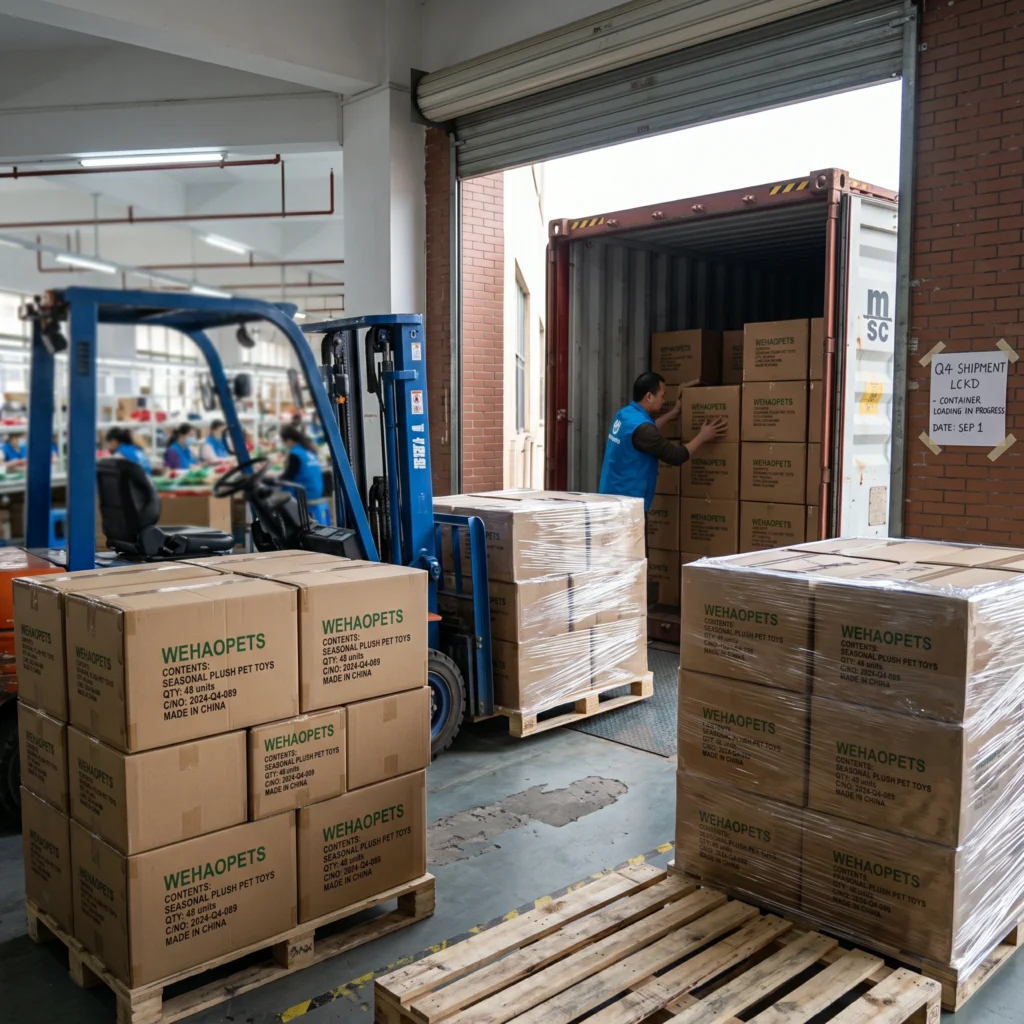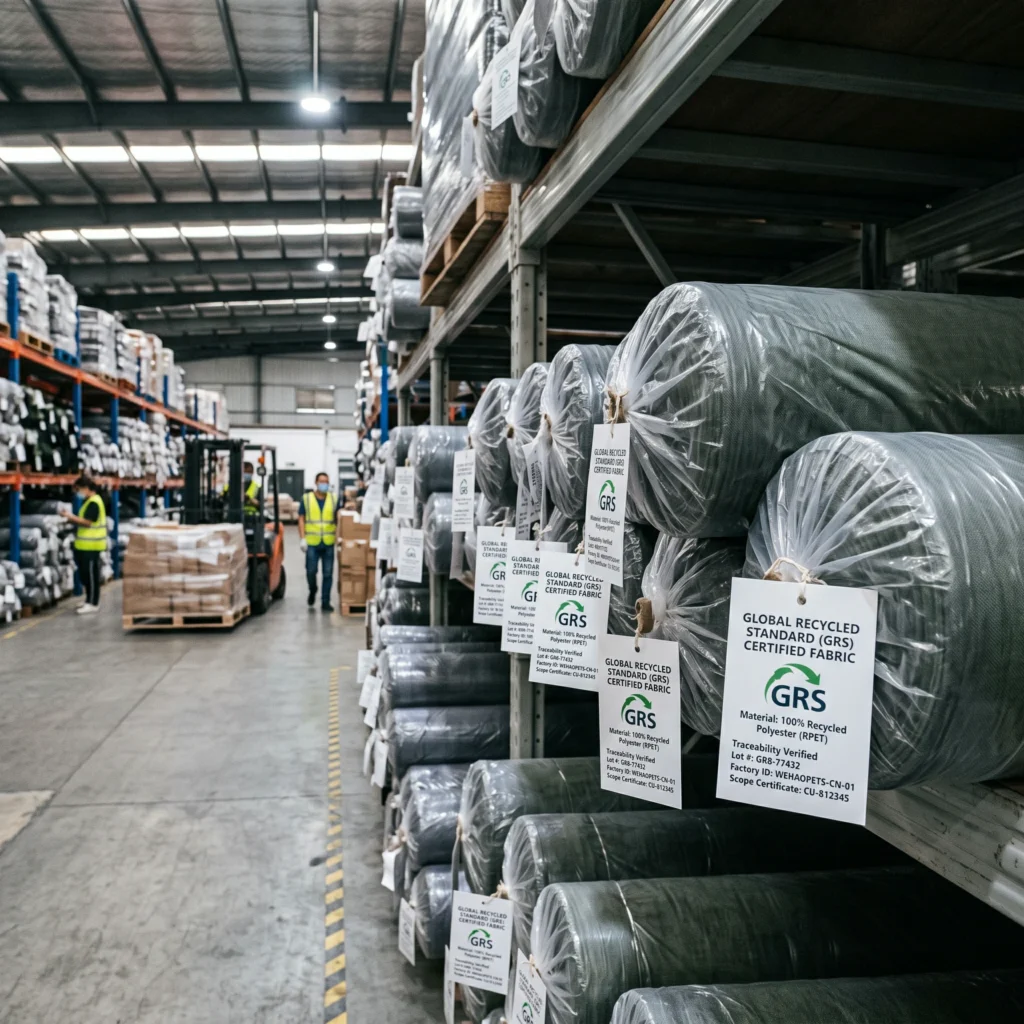
Overview: Shifting to RPET fabrics typically increases unit costs by 12% to 18% compared to virgin polyester. However, securing Global Recycled Standard (GRS) certification is now legally mandatory to claim eco-friendly status in the EU. Without GRS Transaction Certificates, brands face customs seizures and severe fines under new greenwashing directives.
The End of “Greenwashing” in the Pet Industry
The era of slapping a green leaf logo on polybag packaging and calling it a day is decisively over. As a premier eco-friendly pet toy manufacturer, our material sourcing team watches countless Western brands risk legal catastrophe by relying on unverified factory promises. European and North American regulators are no longer asking politely for sustainability efforts; they are demanding incontrovertible, documented proof.
Starting any sustainability transition with vague claims like “made with recycled materials” without a fortified paper trail is corporate suicide. The legal risks importers face today are unprecedented. Under the stringent regulations currently rolling out, if your factory cannot provide valid, batch-specific traceability certificates, your goods can and will be held at customs. Furthermore, exposing your brand to accusations of greenwashing not only triggers massive fines but irrevocably damages trust with major B2B retail buyers like Fressnapf, Pets at Home, and PetSmart. Retail procurement teams are being audited on their Scope 3 emissions and supply chain compliance; if your sustainable pet products lack rigorous documentation, you will simply be delisted.
We write this guide not as marketers, but as operators. We manage the factory floor, the compliance audits, and the yield rates. We understand that procurement managers are tasked with an incredibly difficult balancing act: you must upgrade your product lines to meet EU sustainability mandates without destroying your profit margins. This guide provides the technical, regulatory, and financial blueprint for making the switch to Recycled Polyethylene Terephthalate (RPET) successfully.
Virgin Polyester vs. RPET: The Manufacturing Reality
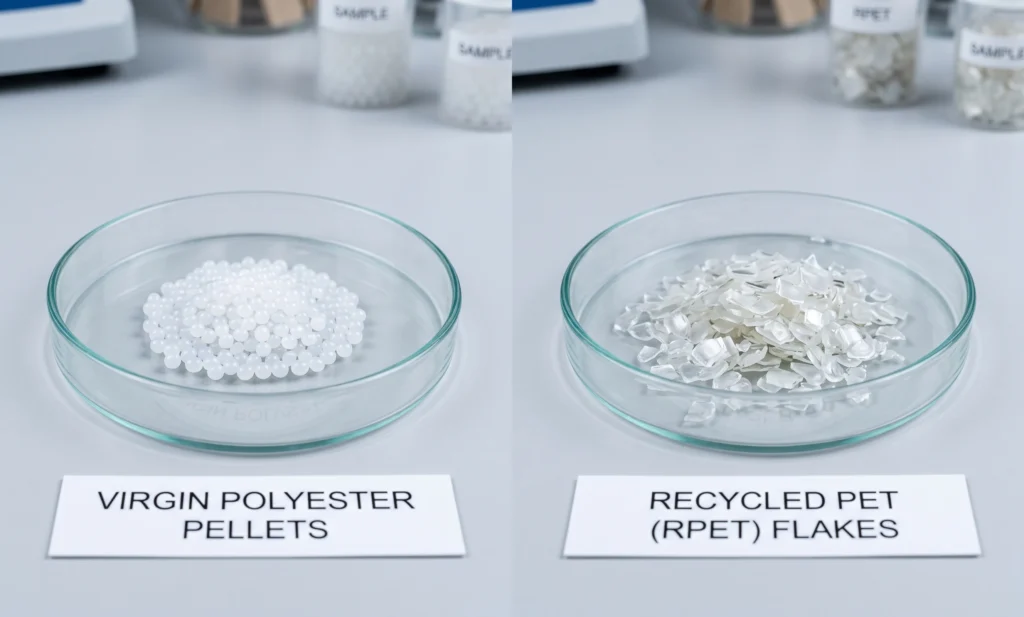
Understanding the transition requires looking closely at the material science. RPET is derived from post-consumer recycled resin, predominantly sourced from discarded PET beverage bottles. The mechanical recycling process involves collecting, sorting, washing, and shredding these bottles into flakes, which are then melted down and extruded into new yarn.
While the chemical composition of RPET is virtually identical to virgin polyester, the physical realities on the manufacturing floor present distinct challenges. Because the input materials come from varied post-consumer sources, maintaining baseline metrics like yarn denier consistency (the thickness and weight of the yarn) requires highly sophisticated extrusion control. In the past, early iterations of RPET fabrics were notorious for poor colorfastness and weaker tensile strength, making them unsuitable for the aggressive chewing and pulling inherent to dog toys.
Today, advanced sorting and polymer solid-state polycondensation (SSP) techniques have bridged that gap. As your manufacturing partner, we calibrate our weaving and knitting machines specifically to handle the slight variances in RPET yarn tension. By adjusting the warp and weft density during the weaving process, we ensure that our custom dog plush toys constructed from RPET meet the exact same bite-force and tear-resistance thresholds as those made from virgin plastics.
The Mandatory Transition Matrix
For procurement teams running cost-benefit analyses, the raw data is what matters. Below is our internal material transition matrix, outlining exactly what changes when you shift a standard plush toy SKU from virgin polyester to RPET.
| Material Metric | Virgin Polyester Spec | RPET Spec | Estimated Unit Cost Difference | Required Certification |
| Base Polymer Source | Petroleum-based raw chemicals | Post-consumer recycled resin | +12% to +18% base material | Global Recycled Standard (GRS) |
| Tensile Strength (Tear) | Baseline (e.g., 250N/5cm) | 95% – 98% of baseline | N/A (Yield loss during QC: ~2%) | Intertek / SGS Mechanical Test |
| Yarn Denier Consistency | Extremely High (±1% variance) | Moderate to High (±3% variance) | N/A (Requires slower weaving) | GRS Quality Audit |
| Dye Uptake / Colorfastness | Standard processing | Requires longer dye times/temps | +3% to +5% on dyeing costs | OEKO-TEX Standard 100 |
| Traceability Overhead | Standard commercial invoice | Strict mass-balance accounting | +$200 – $300 per batch for TC | GRS Transaction Certificate |
Bulletproof Your Supply Chain: The Greenwashing Defense List
When a European retail buyer asks for proof of your eco-friendly claims, an invoice stating “RPET Fabric” is insufficient. The EU is actively enforcing transparency, and brands must back their claims with internationally recognized verification. To protect your brand from greenwashing penalties, you must force your manufacturing partner to provide chain-of-custody documentation.
As a certified facility, we mandate that our clients maintain the following documents on file for every single production run.
Here are the 3 specific supply chain documents you MUST collect from your factory to legally prove eco-compliance:
📋 GRS Scope Certificate (SC): This is the foundational document proving that the factory itself has been audited and certified by an accredited third-party body (like Control Union or IDFL). It verifies that the facility meets the environmental, social, and chemical requirements of the Global Recycled Standard. Ensure the certificate is unexpired and specifically lists “Pet Toys” or “Stuffed Toys” in its product categories.
📋 GRS Transaction Certificates (TC): This is the most critical document and the hardest to fake. A TC is issued for a specific batch of goods changing ownership. It traces the exact volume of recycled material from the yarn spinner, to the fabric weaver, to our assembly floor, and finally to your shipping container. If you order 10,000 RPET dog toys, the TC proves that the exact metric tonnage of RPET required to make those toys was legally purchased and utilized.
📋 Material Declaration of Conformity (DoC): Alongside the GRS documentation, you need a signed DoC from the manufacturer tying the specific purchase order (PO) to the SVHC (Substances of Very High Concern) limits under EU REACH regulations. Because RPET comes from recycled consumer waste, it must be rigorously tested to ensure heavy metals or banned plasticizers didn’t contaminate the batch during the recycling process.
Navigating the Technical Hurdles of RPET Production
Transitioning a product line involves more than just swapping the outer plush fabric. A plush dog toy is a composite product. It contains the outer shell, the inner mesh lining (for heavy-duty chewers), polyfill stuffing, squeakers, crinkle paper, and heavy-duty threading. If you label a product “100% Recycled,” every component must comply.
The Inner Workings: Squeakers and TPR Components
One of the most complex challenges we face on the production floor involves the internal sound mechanisms and chew components. Many procurement managers ask if we can use biodegradable plastics for internal squeakers to enhance the sustainability profile. However, there are strict biodegradable masterbatch limitations in injection molding.
When creating durable internal components, adding biodegradable additives or high percentages of recycled TPR (Thermoplastic Rubber) can drastically alter the melt flow index (MFI) during injection molding. This leads to brittle squeakers that shatter upon high-impact chewing—a severe choking hazard. Therefore, while we transition the plush, lining, and polyfill to 100% RPET, we often must advise clients to keep internal squeakers as virgin PP (Polypropylene) or highly controlled, lower-percentage recycled TPR to maintain strict pet product safety standards. Transparency in your marketing—stating “Made with 100% RPET fabrics and virgin safety-grade internal components”—is far better than a blanket greenwashing claim that fails a regulatory audit.
Controlling the Cost-Margin Equation
The +12% to +18% increase in raw material costs for RPET is a reality of the current global commodities market. Post-consumer recycled resin requires extensive processing, and the demand outpaces the supply of high-grade, clear PET flakes. However, destroying your profit margins is not a prerequisite for eco-compliance.
We work with B2B buyers to offset these material cost increases through manufacturing efficiencies. Strategies include:
- Pattern Optimization: RPET fabric is more expensive per yard, so minimizing scrap during the cutting phase is critical. We utilize AI-driven laser cutting software to nest patterns more tightly, reducing fabric waste by up to 8% compared to traditional die-cutting.
- Packaging Reductions: Sustainable products should not be shipped in excessive virgin plastic packaging. By transitioning from bulky blister packs to minimal, recycled kraft paper hangtags and optimizing the master carton dimensions for vacuum-compressed shipping, we frequently recoup 5% to 7% of the unit cost in freight and packaging savings.
- Consolidated TCs: Transaction Certificates cost money (often hundreds of dollars per issuance). By consolidating your POs and running larger, quarterly batch orders rather than frequent small runs, we can amortize the cost of the GRS TC across a larger volume of units, drastically reducing the per-unit compliance overhead.
Navigating the EU Green Claims Directive
For brands targeting the European Union, the regulatory landscape is shifting from voluntary guidelines to strict legal mandates. The EU Green Claims Directive establishes clear rules on how companies substantiate their environmental labels.
The directive mandates that any explicit environmental claim must be independently verified and scientifically sound. You can no longer use generic terms like “Eco-Friendly,” “Green,” or “Sustainable” on your packaging without a QR code or direct link to the verifiable lifecycle data and third-party certifications backing up that claim. As an RPET dog toys wholesale partner, our facility’s adherence to GRS mass-balance accounting provides the exact empirical data your legal team needs to pass these stringent EU verifications. We supply the raw material data, the energy consumption metrics of our assembly line, and the certified chain of custody required for your compliance dossiers.
Frequently Asked Questions
Below, we address the most common technical questions procurement teams ask when planning an RPET transition.
Q: What is the Minimum Order Quantity (MOQ) for custom-dyed RPET fabrics?
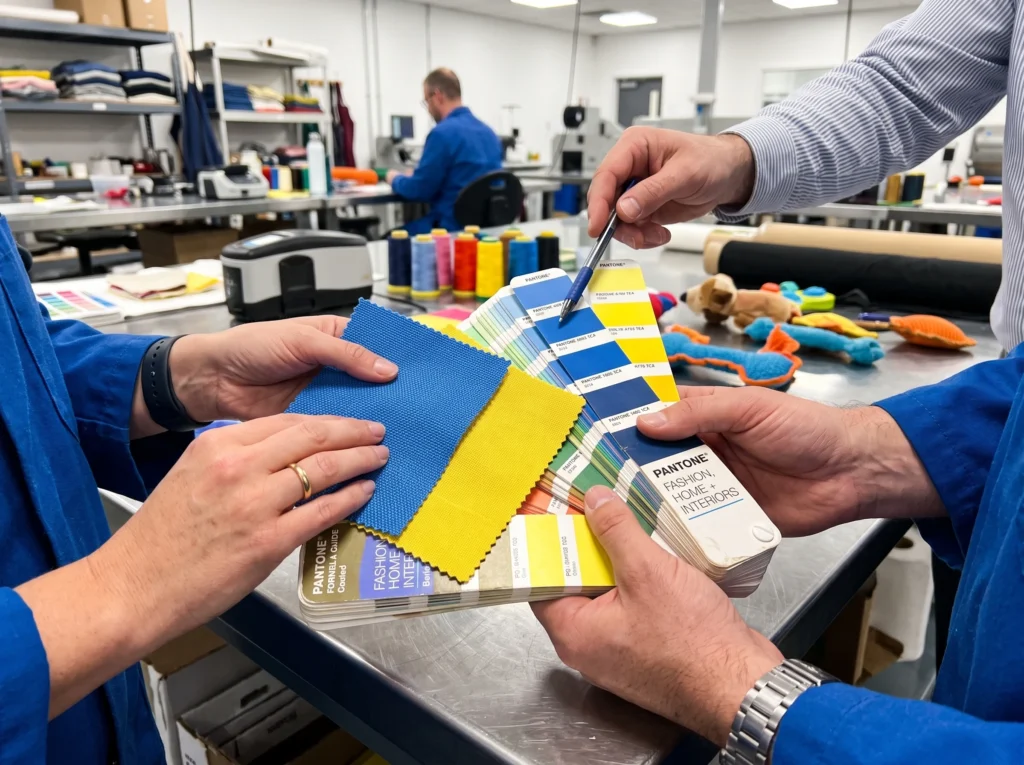
Because RPET yarn requires specific batch processing at the dyeing facility to ensure colorfastness, the MOQ for custom Pantone-matched RPET fabric is typically 1,000 meters per color. For standard plush toys, this translates to roughly 3,000 to 5,000 units per colorway, depending on the toy’s dimensions.
Q: How much does it cost to obtain a GRS Transaction Certificate for my order?
The certifying body (e.g., Control Union) charges a processing fee to audit the mass-balance records and issue the TC. This fee generally ranges from $200 to $350 per certificate. We highly recommend consolidating multiple SKUs into a single shipment and PO to cover all items under one TC, minimizing the cost impact on your margins.
Q: Can RPET plush toys withstand the same wash testing as virgin polyester?
Yes, but the construction must be adjusted. RPET maintains excellent durability, but we mandate a minimum of 12 stitches per inch and reinforced double-stitched seams using heavy-duty nylon or recycled PET thread to ensure the toys survive standard machine washing without seam slippage or denier degradation.
Ready to Upgrade Your Product Line?
Transitioning to sustainable manufacturing is a complex engineering and compliance challenge, but it is the only path forward for brands that wish to remain competitive and legally compliant in the EU and North American markets. Do not wait for a customs hold or a retailer delisting to audit your supply chain.
We invite procurement managers and brand owners to take the first step with empirical data. Send us the spec sheet or a physical sample of your current best-selling toy. Our material science team will tear it down, map out the required RPET alternatives, and provide you with a comprehensive, transparent cost analysis.
Protect your margins, secure your supply chain, and guarantee your eco-compliance. Contact Us today to request your free Eco-Transition Cost Analysis.