Overview: In the contemporary landscape of highly durable pet products, single-material extrusion and basic textile stitching are no longer sufficient to meet the rigorous demands of aggressive chewers. Our engineering focus has shifted toward complex multi-material integration, specifically combining thermoplastic rubber (TPR) cores with technical textiles and integrated acoustic modules. The conclusion drawn from our extensive production data and mechanical testing is that successful multi-layer integration absolutely requires strict tolerance control, advanced structural webbing, and ultrasonic welding to prevent catastrophic seam rupture under high shear forces. The relevant implication for R&D purchasers and product developers is that relying on traditional single-needle stitching for mixed-material toys will result in high field failure rates; therefore, brands must mandate multi-stage assembly lines and precise acoustic cavity preservation to achieve a defect rate below 0.5% in mass production.
Mandatory Project Brief
- Client Concept: A heavy-duty, 3-in-1 sensory canine toy combining high-impact chew resistance, a high-frequency sound element, and a textured plush exterior to stimulate predatory and masticatory instincts.
- The Engineering Challenge: Securing a rigid, food-grade TPR internal core inside a compliant, soft plush outer shell while maintaining the dimensional integrity of the internal acoustic cavity. The primary risk factor was seam rupture at the transition zones between the elastomer core and the woven textile under bite-force loads exceeding 80 PSI.
- The Wehaopets Solution: The implementation of custom internal structural webbing pouches to isolate the modules, combined with precision overmolding of the TPR elements and high-frequency ultrasonic welding to fuse the thermoplastic anchors directly to the structural mesh, eliminating the reliance on vulnerable thread seams.
- Defect Rate Achieved: < 0.5% in continuous mass production, validated through rigorous statistical process control (SPC) and destructive testing.
The Anatomy of a 3-in-1 Sensory Toy: Material Science and Selection
Developing a multi-layer product requires an uncompromising approach to bill of materials (BOM) specification. Our tooling engineers and material scientists evaluate every individual layer for its mechanical properties, chemical stability, and compatibility with adjacent substrates.
For this project, the core chew substrate required an elastomer that could withstand continuous cyclic loading without experiencing brittle failure or excessive plastic deformation. We selected a specific grade of Thermoplastic Rubber (Styrene-Ethylene-Butylene-Styrene block copolymer), formulated to a Shore A hardness of 55. This specific durometer provides the optimal balance between puncture resistance and elastic recovery, ensuring the dog’s dentition is not damaged while protecting the internal modules. The exterior shell required a textile with extremely high abrasion resistance, leading us to specify a 600-Denier Oxford polyester fabric, treated with a polyurethane (PU) backing to prevent moisture ingress from canine saliva, which can degrade internal acoustic components.
Mandatory Bill of Materials (BOM) Table
| Component Layer | Material Specification | Factory Sourcing & Assembly Method |
| Outer Plush Shell | 600D Oxford Polyester with PU Coating (Anti-Bacterial) | Precision CNC Laser Cutting; Heavy-duty double stitching with Kevlar thread. |
| Internal Structural Mesh | 1000D Nylon Webbing (Cross-hatched) | Die-cut and heat-sealed edges; Box-X stitching for anchor points. |
| Chew Resistant Core | Food-Grade TPR (Shore 55A durometer) | Injection molding via Engel servo-hydraulic presses; Dual-cavity tooling. |
| Acoustic Module (Squeaker) | High-Density EVA Bladder with Copper Reed | Automated insertion into the custom TPR acoustic cavity; Friction fit. |
| Sensory Texture Layer | PET Crinkle Film (1.2 mil thickness) | Ultrasonically tack-welded to the inner face of the Oxford outer shell. |
Navigating the Acoustic Cavity and Crinkle Film Integration
Integrating sound-producing elements into a densely packed, multi-material toy presents a significant thermodynamic and acoustic challenge. The internal EVA squeaker requires a specific volume of unobstructed airflow to allow the copper reed to vibrate at the target frequency. If the surrounding TPR core or the outer plush shell compresses this space, the acoustic wave is dampened, resulting in a muted or completely silenced toy.
To solve this, our tooling engineers designed a reinforced acoustic cavity within the TPR overmold. This cavity features rigid, 2.5mm thick ribbed internal walls that prevent the elastomer from collapsing under direct bite pressure. During the injection molding process, we carefully control the cooling rate to prevent internal shrinkage that could alter the cavity’s precise dimensions.
Following assembly, every batch undergoes strict decibel testing in our anechoic chamber to verify that the sound output meets the client’s specification of 85-90 dB at a distance of 1 meter.
Simultaneously, we addressed the sensory texture layer. Standard crinkle paper often degrades or clumps after repeated compression and exposure to moisture. Our advanced materials team specified a highly resilient Polyethylene Terephthalate (PET) crinkle film. A critical factor in this selection was the crinkle film mil thickness. Through exhaustive R&D, we determined that a 1.2 mil thickness provides the optimal tactile feedback and auditory crackle without piercing the adjacent textiles during aggressive chewing. To ensure compliance with international chemical safety standards, all plastics and polymers utilized in our acoustic and sensory modules are rigorously analyzed by third-party laboratories. For comprehensive polymer diagnostics, we benchmark our internal data against standards verified by SGS testing for plastics and polymers.
Acoustic and Sensory Performance Metrics
| Sensory Module | Target Frequency / Output | Material Specification | Quality Assurance Testing Standard |
| Primary Squeaker | 85 – 90 dB output | Heavy-Duty EVA Bladder | Pneumatic compression decibel testing (10,000 cycles). |
| Tactile Crinkle | High-frequency crackle (10-12 kHz) | 1.2 mil PET Film | Washability and thermal degradation test (ISO 6330). |
| Acoustic Cavity | Zero volume loss under 50 PSI | Ribbed TPR housing | UTM (Universal Testing Machine) static load compression. |
Structural Webbing and Multi-Stage Assembly Lines
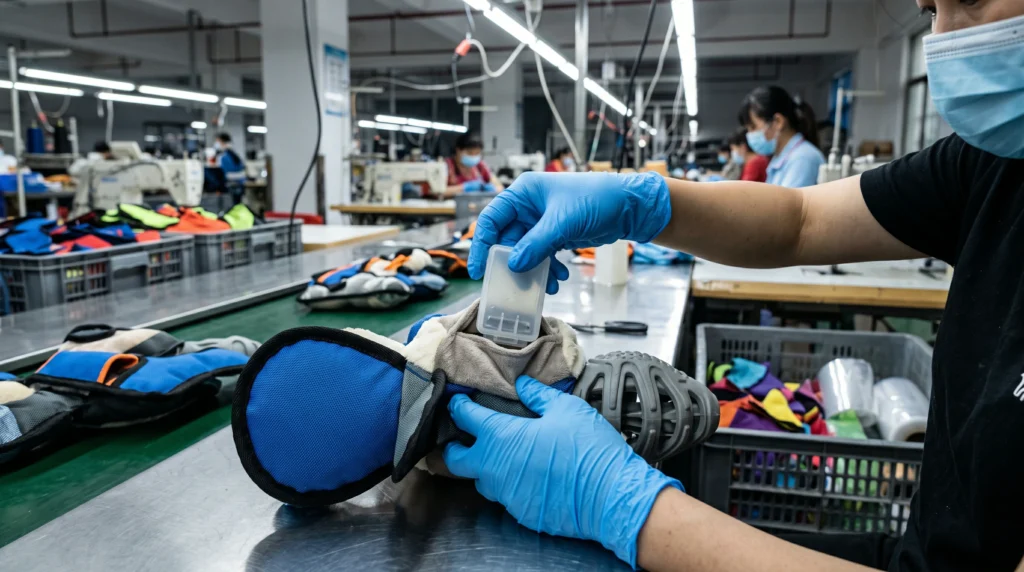
The true complexity of tpr dog toy manufacturing lies in the assembly sequence. Attempting to stitch heavy elastomers directly to woven textiles on a standard single-stage line inevitably leads to skipped stitches, needle breakage, and compromised seam integrity. To achieve our sub-0.5% defect rate, Wehaopets operates highly specialized multi-stage assembly lines, segregating the manufacturing process by material class and joining methodology.
The cornerstone of this assembly architecture is our proprietary structural webbing system. Rather than attaching the heavy TPR core directly to the softer 600D Oxford plush shell, we engineered an internal, high-tenacity nylon webbing pouch. This pouch acts as a structural chassis. The TPR core is mechanically fastened to this nylon chassis using heavy-duty bar-tack stitching and localized ultrasonic welding.
By isolating the heavy mass of the TPR core within this internal skeleton, we effectively decouple the kinetic energy of the dog’s shaking and chewing from the external plush seams. When a dog vigorously thrashes the toy, the centrifugal force is absorbed by the internal structural webbing, not the outer decorative shell. This methodology represents a massive leap forward in durability for custom dog plush toys.
Overmolding the Food-Grade TPR Core
Overmolding is a critical step in finalizing the internal chassis. During this phase of the multi-stage assembly lines, the pre-assembled acoustic cavity and anchor joints are placed into a secondary mold. We inject molten food-grade TPR at a precisely controlled melt temperature of 185°C. The injection pressure must be dynamically modulated to ensure the TPR flows entirely around the anchoring structures without flashing or burning the adjacent nylon webbing.
Our engineers meticulously calculate the shrinkage rate of the specific TPR batch (typically around 1.5% to 2.0%) to ensure that as the elastomer cools and solidifies, it forms a permanent mechanical interlock with the structural webbing. This overmolding process eliminates the need for toxic chemical adhesives, ensuring the final product remains 100% safe for canine ingestion in the rare event of absolute product destruction.
Mandatory Assembly Checklist
During the execution of our multi-stage assembly lines, our assembly technicians rigorously enforce the following critical quality control checkpoints to guarantee the structural integrity of every unit:
- ⚙️ Pre-Assembly Contamination Check: Mandatory metal and needle detection on all textile components and structural webbing pouches before inserting the TPR core, ensuring absolute safety for the end-user.
- 🛠️ Tensile Seam Verification: A destructive seam tensile strength test (pull test) applied to a statistical sampling of the internal webbing pouches, requiring a minimum resistance of 250 Newtons prior to final closure.
- ⚙️ Acoustic Integrity Validation: A pneumatic acoustic resonance check performed immediately after the overmolding phase to ensure the cooling TPR core has not warped or compressed the squeaker’s internal airflow valve.
Quality Assurance and Defect Reduction Protocols
Achieving a defect rate of less than 0.5% in a highly complex, multi-layered consumer good is not an accident; it is the result of applying stringent Failure Modes and Effects Analysis (FMEA) throughout the entire product lifecycle.
In standard manufacturing environments, mixed-material toys often fail at the boundary layers—the exact points where hard plastics meet soft textiles. Because these materials have vastly different coefficients of thermal expansion, elasticity, and tensile strength, they react differently to the kinetic forces applied by a dog’s jaw. Our engineering mandate is to eliminate stress concentrations at these boundaries. By utilizing the internal structural webbing as a transitional buffer zone, we distribute the mechanical load across a wider surface area.
Furthermore, our quality assurance technicians continuously monitor the calibration of our ultrasonic welders. If the amplitude or frequency of the ultrasonic horn deviates by even a fraction of a percent, the resulting molecular bond between the PET crinkle film and the nylon webbing can become embrittled. We perform hourly peel-strength tests on the production floor to guarantee optimal weld integrity.
Defect Analysis and Prevention Strategies
| Potential Defect Type | Root Cause Analysis in Standard Manufacturing | Wehaopets Engineering Solution |
| Seam Rupture (Plush to TPR) | Direct stitching of rigid rubber to soft textile creating a stress fracture point. | Implementation of intermediate internal structural webbing chassis to absorb kinetic energy. |
| Acoustic Failure (Muted Squeaker) | TPR overmold collapsing into the sound chamber during the high-pressure injection phase. | Design of a rigid, ribbed 2.5mm internal acoustic cavity to protect the EVA bladder. |
| Crinkle Film Piercing | Use of low-mil thickness film that degrades and fragments under cyclic compression. | Specification of 1.2 mil high-resilience PET film, ultrasonically welded to prevent migration. |
Conclusion and Technical Review
The engineering and production of multi-layered, mixed-material canine toys require a paradigm shift away from traditional garment manufacturing techniques toward advanced polymer and textile engineering. As demonstrated in this case study, successfully integrating a high-impact TPR core, an uncompromised acoustic cavity, and resilient sensory textiles demands precision tooling, meticulous material science, and strictly controlled multi-stage assembly lines. By prioritizing structural webbing and advanced joining techniques over basic stitching, we consistently achieve a defect rate of less than 0.5%, providing premium R&D purchasers with unparalleled reliability in the field.
For procurement managers, brand owners, and product developers facing challenges with seam rupture or acoustic failure in complex multi-material designs, our engineering team is ready to assist. We urge you to submit your detailed Tech Packs to our structural engineers for a comprehensive feasibility review and tooling analysis. Contact Us today to secure your mass production with Wehaopets’ advanced manufacturing protocols.
Frequently Asked Questions (FAQ)
1. What is the expected durability of the squeaker within the acoustic cavity under extreme bite pressure?
Our high-density EVA squeakers, when housed within our proprietary ribbed TPR acoustic cavity, are designed to withstand static compression loads exceeding 50 PSI without failing. The structural ribs prevent the elastomer from crushing the internal copper reed, ensuring a sustained lifespan even for aggressive chewers.
2. Is the 1.2 mil PET crinkle paper susceptible to thermal degradation during consumer machine washing?
No. We specifically engineer our toys using 1.2 mil PET crinkle film that is rated to withstand standard consumer washing machine temperatures (up to 40°C/104°F) without losing its structural integrity or acoustic properties, fully complying with ISO 6330 washability standards.
3. What are the combined MOQs for toys requiring both custom TPR overmolding and custom plush textiles?
For mixed-material toys requiring multi-stage assembly lines (combining injection molding and advanced textile fabrication), our standard Minimum Order Quantity (MOQ) is typically 3,000 units per design. This ensures the economic viability of the custom CNC tooling required for the TPR molds and the automated laser-cutting programming for the textiles.
4. What manufacturing tolerances are maintained during the TPR overmolding process?
Our Engel servo-hydraulic injection presses maintain volumetric shot consistencies with a tolerance of ±0.05 grams. This strict parameter control prevents polymer flashing onto the structural webbing and ensures the dimensional stability of the internal acoustic cavity.
5. How do you prevent the acoustic cavity from filling with synthetic fiberfill during the final stuffing stage?
Our internal structural webbing pouch acts as a physical barrier. The acoustic module is isolated within the TPR core, which is sealed inside the nylon chassis before the outer 600D Oxford shell is stuffed with synthetic polyfill, entirely preventing fiber migration into the air valve.
6. Are the TPR materials used in the overmolding process certified as food-grade?
Yes. Every batch of Styrene-Ethylene-Butylene-Styrene block copolymer we use is strictly sourced and certified to meet FDA CFR 21 177.2600 standards for rubber articles intended for repeated use, ensuring absolute safety for canine contact.
7. What is the standard lead time for developing custom structural webbing molds and TPR tooling?
From the final approval of the 3D CAD Tech Pack, the lead time for producing the CNC steel molds for the TPR core and configuring the ultrasonic welding jigs for the structural webbing is generally 25 to 30 days, followed by immediate prototype sampling.