Overview: Polyester webbing outperforms nylon in UV resistance, colorfastness, and minimal water absorption, making it the optimal substrate for outdoor and high-strain pet gear. Nylon offers superior elasticity and a softer hand-feel but requires specialized hydrophobic treatments. Selecting the correct polymer dictates long-term structural integrity and international compliance.
Last quarter, a European procurement manager approached our facility facing a critical failure rate with their existing supplier. Their high-visibility reflective dog harnesses were failing continuous pull tests at the D-ring attachment points after six months of field use. Upon analyzing the returned field samples in our laboratory, we identified the root cause: the previous manufacturer utilized untreated nylon webbing that degraded under prolonged UV exposure and retained moisture, leading to severe structural weakening of the box-X stitching. As a dedicated heavy duty dog leash manufacturer, we recognize that material selection at the polymer level is not a matter of aesthetic preference, but a strict engineering requirement.
In bulk pet product manufacturing, the choice between nylon (polyamide) and polyester (polyethylene terephthalate) directly impacts supply chain economics, product liability, and testing compliance. This technical brief details our internal testing protocols, structural observations, and manufacturing parameters to assist procurement teams in specifying the correct webbing for their custom pet gear.
Structural Polymer Differences and Base Yarn Sourcing
The fundamental mechanical properties of any dog lead originate from the molecular structure of the extruded synthetic fibers. In our workshop, we process kilometers of both substrates daily, and the behavioral differences during processing are stark.
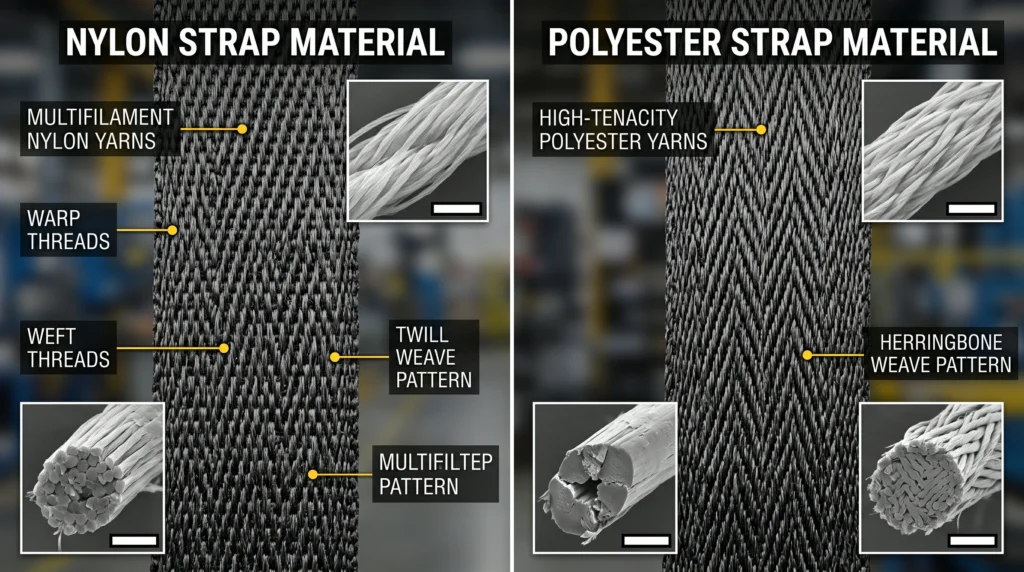
Nylon is a polyamide, inherently hydrophilic, meaning its molecular chain allows water molecules to bond with the polymer. This gives nylon its characteristic soft hand-feel and high elasticity. Conversely, polyester is hydrophobic. Its tightly packed molecular structure resists moisture penetration. When we source raw yarn for webbing extrusion, the denier count (the mass in grams of 9,000 meters of the fiber) must be strictly calibrated. We typically specify 1000D to 1500D yarns for heavy-duty applications.
Our material engineering team maintains strict incoming quality control for these yarns. The physical differences manifest immediately upon environmental exposure. Understanding these baseline metrics is crucial before moving into the weaving and dyeing phases.
Polymer Base Characteristics Comparison
| Parameter | Nylon (Polyamide 6 / 6.6) | Polyester (PET) | Manufacturing Implication |
| Specific Gravity | 1.14 g/cm³ | 1.38 g/cm³ | Nylon yields a lighter final product per meter. |
| Moisture Regain | 4.0% – 4.5% | 0.4% | Polyester dries rapidly; nylon requires drying time. |
| Melting Point | 250°C – 260°C | 250°C – 260°C | Both require identical heat-cutting blade calibration. |
| Elastic Recovery | 100% at 8% extension | 100% at 5% extension | Nylon absorbs sudden kinetic force better. |
| Acid Resistance | Poor | Excellent | Polyester withstands industrial cleaning agents. |
Tensile Strength and Break Force Dynamics
When a custom dog harness supplier designs gear for large breeds, static breaking strength and dynamic load absorption are the primary safety metrics. During our tensile testing on calibrated universal testing machines, we evaluate both the raw webbing and the finished sewn assemblies.
Nylon webbing inherently possesses a higher strength-to-weight ratio than standard polyester. A standard 25mm (1-inch) wide, 2.0mm thick nylon web can achieve a breaking strain exceeding 1,800 kg (approx. 4,000 lbs). However, this metric applies strictly to dry laboratory conditions. Nylon features an elongation factor of 15% to 20% under load. This elasticity acts as a mechanical shock absorber, which is highly beneficial for items like a wholesale nylon dog leash where kinetic energy from a pulling animal needs dissipation.
Polyester webbing of identical dimensions will typically yield a slightly lower initial breaking strength (around 1,500 kg to 1,600 kg) but exhibits an elongation of only 5% to 10%. This rigidity provides superior handler control and prevents the material from stretching out of tolerance over years of use.
Key Metrics for Tensile Testing Protocols (ASTM D5034)
To ensure consistency across production batches, we adhere strictly to established testing protocols. Our quality assurance engineers mandate the following parameters during physical testing:
- Gauge Length Calibration: The precise distance between the pneumatic clamping jaws must be set to exactly 250mm to ensure standardized elongation calculations.
- Crosshead Speed Regulation: The pulling mechanism is regulated at a constant rate of 300mm per minute to simulate sudden kinetic impact accurately.
- Grip Pressure and Slippage Prevention: Pneumatic jaws are maintained at 90 PSI to prevent the slick synthetic webbing from slipping, which invalidates the break force data.
- Conditioning Environment: All samples rest in a controlled climate chamber at 21°C and 65% relative humidity for 24 hours prior to clamping.
- Seam Rupture Analysis: We record whether the failure occurred within the continuous webbing strap or at the heavy-duty bartack stitching points.
Environmental Degradation: UV, Water, and Abrasion Testing
Pet gear operates in harsh environmental conditions. The degradation curves of nylon and polyester diverge significantly under exposure to ultraviolet radiation, moisture, and friction.
When subjected to accelerated UV aging in our QUV weathering testers, untreated nylon experiences rapid photo-oxidation. The molecular chains break down, resulting in a loss of up to 30% of its tensile strength after 500 hours of continuous exposure. Furthermore, the aesthetic degradation is severe; vibrant colors chalk and fade. Polyester, due to its aromatic rings, is inherently UV stable. It retains over 90% of its original strength and exhibits minimal color shift under identical UV exposure.
Water absorption is another critical vector. Because nylon absorbs up to 8% of its weight in water, it swells. When wet, nylon’s abrasion resistance plummets, and its tensile strength decreases by 10% to 15%. A wet nylon leash dragging across abrasive concrete will fray significantly faster than a dry one. Polyester absorbs less than 0.5% water. It remains dimensionally stable, retains its strength profile when submerged, and does not harbor the bacteria that cause damp odors.
Environmental Stress Equivalency (500-Hour Exposure)
| Stress Vector | Nylon Webbing Degradation Profile | Polyester Webbing Degradation Profile |
| UVA/UVB Exposure | Severe strength loss; high pigment fading. | Minimal strength loss; excellent color retention. |
| Saltwater Submergence | High absorption; prolonged drying; fiber swelling. | Zero swelling; rapid evaporation; no salt trapping. |
| Dry Abrasion (Taber Test) | Exceptional resistance; outperforms polyester. | High resistance, but prone to micro-pilling under extreme friction. |
| Wet Abrasion (Taber Test) | Poor resistance; fibers soften and snap easily. | Excellent resistance; unaffected by moisture presence. |
| Mildew/Bacterial Growth | Susceptible if stored damp; requires biocide finish. | Highly resistant; synthetic core prevents fungal rooting. |
Dyeing Processes, Colorfastness, and Custom Sublimation
For procurement teams building brand identity, accurate pantone matching and pattern application are non-negotiable. The chemical structure of these two polymers mandates entirely different dyeing technologies.
Nylon must be dyed using acid dyes. The process requires high temperatures and careful pH control to ensure the dye molecules bond with the polyamide sites. While this yields incredibly rich, deep solid colors, nylon is notoriously difficult to print on using modern sublimation techniques. The heat required for transfer often scorches the nylon, and the image clarity degrades over time.
Polyester utilizes disperse dyes and is the industry standard for heat transfer sublimation. If a client requests a wholesale nylon dog leash with a complex geometric pattern or photorealistic logo, we must advise them to pivot to polyester. During the sublimation process, disperse dyes transition from a solid to a gas at around 200°C, permanently embedding into the polyester fibers. This results in zero tactile difference on the webbing surface and permanent colorfastness that will not crack or peel.
Our laboratory tests colorfastness to washing (ISO 105-C06) and colorfastness to rubbing/crocking (ISO 105-X12). Polyester consistently scores a 4.5 to 5 (out of 5) on the grayscale, ensuring that dark dyes will not bleed onto a light-furred animal during heavy rain.
Industrial Sewing Compatibility and Hardware Integration
The structural integrity of pet gear is only as strong as its weakest seam. Webbing behaves dynamically under the rapid penetration of industrial sewing needles.
Our sewing operators report that nylon, due to its softer hand, is highly cooperative under the presser foot of our programmable Juki bartackers. It compresses well, allowing for extremely tight, dense stitching patterns. Polyester is stiffer and creates more needle friction. When sewing heavy-duty polyester, needle heat becomes a significant concern; if the needle temperature exceeds 250°C, the polyester fibers will melt, creating micro-fractures in the webbing that compromise the overall break strength.
To mitigate this, we utilize titanium-coated needles and specialized cooling systems. Furthermore, thread selection is critical. We strictly mandate the use of bonded nylon or bonded polyester continuous filament threads. Using a standard spun thread on heavy-duty webbing is a critical safety failure.
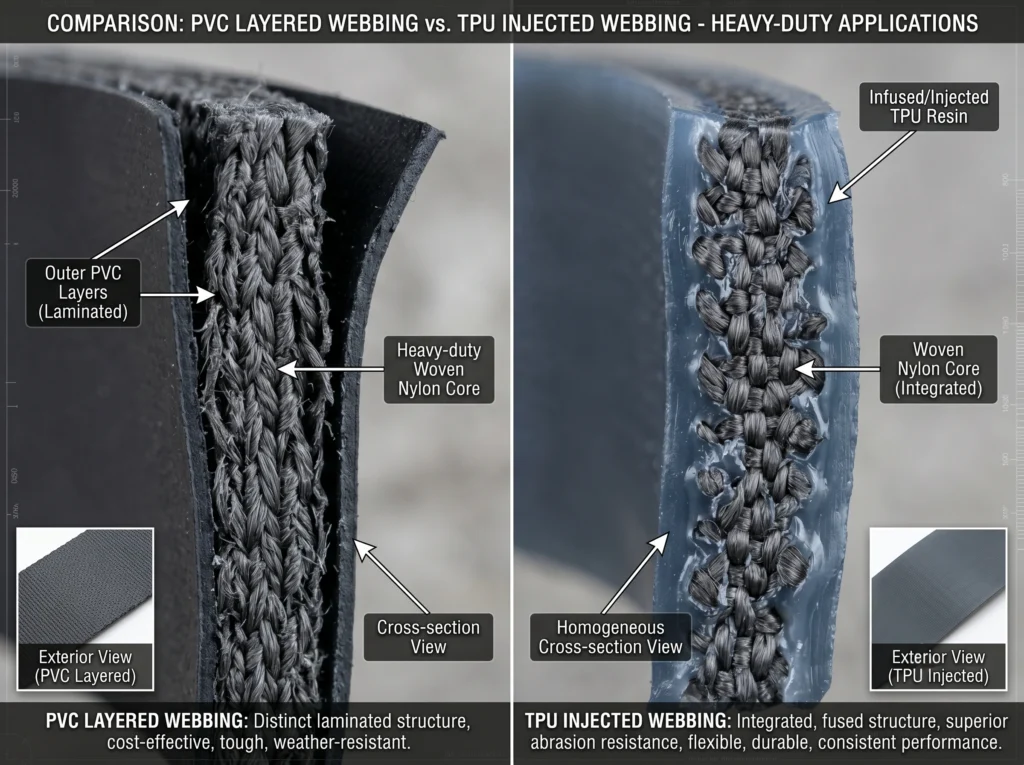
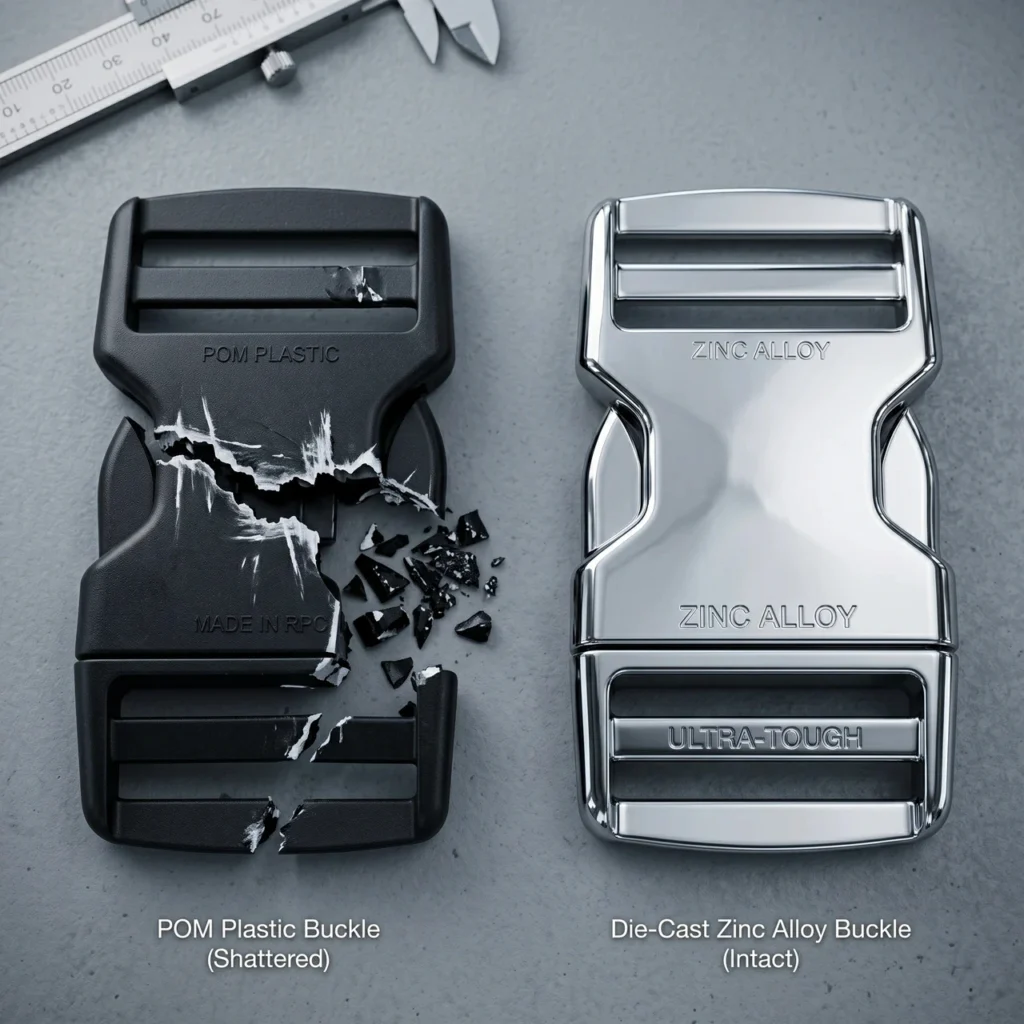
Hardware integration also relies on material thickness and compressibility. When threading a heavy-duty zinc alloy swivel snap hook onto a 2.5mm thick polyester web, the fold-over point is rigid. We must precisely calculate the loop tolerance to ensure the hardware articulates freely without excessive friction against the webbing edge.
Quality Control Checkpoints in the Sewing Department
To maintain a zero-defect output for our B2B clients, we have implemented strict parameters on the assembly floor:
- Needle Heat Monitoring: Infrared sensors continuously monitor needle temperatures to prevent synthetic polymer glazing and fiber melting during high-speed bartacking.
- Thread Tension Calibration: Upper and lower bobbin tensions are digitally calibrated per material batch to prevent loop formation and ensure the lockstitch is buried precisely in the center of the webbing layers.
- Stitch Density Verification: Quality inspectors manually verify the Stitches Per Inch (SPI) using optical loupes to ensure the optimal density—too few stitches cause weakness, while too many perforate and destroy the webbing structure.
- Structural Pattern Validation: Box-X and multi-pass zig-zag bartack patterns are verified against engineering schematics to ensure optimal load distribution across the hardware attachment loop.
- Needle Detection Scanning: 100% of finished assemblies pass through electromagnetic needle detection machines to guarantee no broken needle fragments remain inside the heavy-duty seams.
- Edge Sealing Inspection: Hot-cut webbing ends are visually inspected to ensure a clean, fused edge that prevents unraveling without creating a sharp, abrasive burr that could cause lacerations.
Economic Analysis for Bulk Procurement and Supply Chain Efficiency
From a procurement perspective, the unit economics of nylon versus polyester differ based on raw material costs, minimum order quantities (MOQs), and processing speeds.
Polyester is generally more cost-effective on a per-meter basis due to the global scale of PET production and the efficiency of the disperse dyeing process. Furthermore, because polyester can be sublimated seamlessly, we can hold large volumes of blank white polyester webbing and print custom patterns on demand. This drastically reduces the MOQ for custom patterned designs, allowing B2B buyers to test multiple SKUs in a single production run.
Nylon is structurally more complex to extrude and dye. If a brand founder requires a custom Pantone-matched nylon base, we must initiate a custom vat dyeing process. This requires a significantly higher MOQ (often exceeding 3,000 meters) to offset the chemical setup and water treatment costs. Procurement managers must weigh the tactile benefits of nylon against the supply chain flexibility and cost-efficiency of polyester.
B2B Procurement Economics Analysis
| Economic Factor | Nylon Supply Chain Profile | Polyester Supply Chain Profile |
| Raw Material Cost | Generally 15% – 25% higher | Highly commoditized, lower base cost |
| Custom Solid Color MOQ | High (Vat dyeing requirement) | Moderate (Standard disperse dyeing) |
| Custom Pattern MOQ | Extremely High (Woven jacquard required) | Very Low (Heat transfer sublimation) |
| Production Lead Time | 35 – 45 days (Dyeing and drying constraints) | 20 – 30 days (Rapid sublimation processing) |
| Storage & Warehousing | Requires climate control to prevent mildew | Stable in varying warehouse conditions |
Regulatory Compliance and Chemical Safety
Global distribution requires strict adherence to chemical safety regulations. When manufacturing gear intended for physical contact with animals (who frequently chew their leads), chemical compliance is a primary liability vector for brand owners.
Both nylon and polyester webs must be cleared of restricted substances. During the dyeing process, inferior facilities may utilize Azo dyes that release carcinogenic aromatic amines, or fail to wash out heavy metals used as mordants. Our factory mandates strict compliance with REACH (Europe) and Proposition 65 (California).
We require routine third-party chemical audits from accredited laboratories to certify our output. A compliant substrate ensures that if an animal ingests a frayed portion of the webbing, there is no acute toxicological risk from heavy metal leaching. Procurement teams must request current OEKO-TEX Standard 100 certifications or equivalent lab reports before approving a mass production run.
By analyzing the structural, environmental, and economic data, B2B buyers can confidently specify the exact webbing required for their product line. While nylon remains an excellent choice for basic, high-elasticity leads, polyester’s superiority in UV stability, moisture rejection, and sublimation capabilities makes it the preferred substrate for the next generation of technical pet gear.
Frequently Asked Questions
How does webbing thickness affect the operational lifespan of heavy-duty leads?
Webbing thickness, typically ranging from 1.5mm to 2.5mm for commercial applications, directly dictates the abrasion threshold and tensile rigidity of the product. Thicker webbing provides a higher concentration of structural yarns, which significantly delays the onset of critical fraying when dragged across harsh surfaces like asphalt or gravel.
However, increased thickness requires precise recalibration of hardware tolerances. If a 2.5mm webbing is forced through a D-ring optimized for 1.5mm material, the resulting friction will cause premature wear at the fold point and complicate the industrial sewing process due to excessive material density at the bartack.
Can sublimation printing be applied effectively to nylon substrates?
Applying heat transfer sublimation to nylon is highly problematic and generally not recommended for commercial production. Sublimation relies on disperse dyes, which are formulated specifically to bond with the molecular structure of polyester under high heat (approx. 200°C), resulting in permanent, sharp imagery.
When attempted on nylon, the required heat often exceeds the polymer’s stability threshold, leading to scorching or melting of the substrate. Furthermore, the dye molecules do not anchor deeply into the polyamide structure, causing the printed patterns to blur, fade, and degrade rapidly upon exposure to UV light and mechanical washing.
What are the standardized testing protocols for evaluating hardware attachment points?
Hardware attachment points are the primary failure zones in pet gear, necessitating strict evaluation under protocols such as ASTM D5034 (Breaking Strength and Elongation of Textile Fabrics). We utilize pneumatic universal testing machines to apply continuous kinetic pulling force against the sewn loop securing the D-ring or snap hook.
During these evaluations, we monitor the failure origin—whether the cast zinc hardware fractures, the bartack stitching ruptures, or the webbing itself shears. A passing grade requires the assembly to withstand peak loads exceeding 4 to 5 times the anticipated weight of the target animal breed without exhibiting any micro-tears in the thread path.
Why does untreated nylon webbing emit an odor after environmental exposure?
Nylon is an inherently hydrophilic polymer, meaning its molecular matrix absorbs and retains significant amounts of moisture—up to 8% of its total weight. When subjected to rain, saliva, or ambient humidity, the fibers trap water deep within the weave.
If the webbing is not rapidly dried in a highly ventilated environment, this trapped moisture creates an ideal incubation zone for mildew, mold, and anaerobic bacteria. The metabolic off-gassing from these biological growths produces the distinct, sour odor commonly associated with aged nylon pet gear, a problem virtually non-existent in hydrophobic polyester.
How do we mitigate webbing shrinkage during the bulk manufacturing process?
Both nylon and polyester are thermoplastic materials subject to dimensional changes when exposed to extreme heat during dyeing, finishing, or industrial washing. Unmanaged shrinkage can ruin standardized sizing metrics for collars and harnesses, rendering entire production batches out of spec.
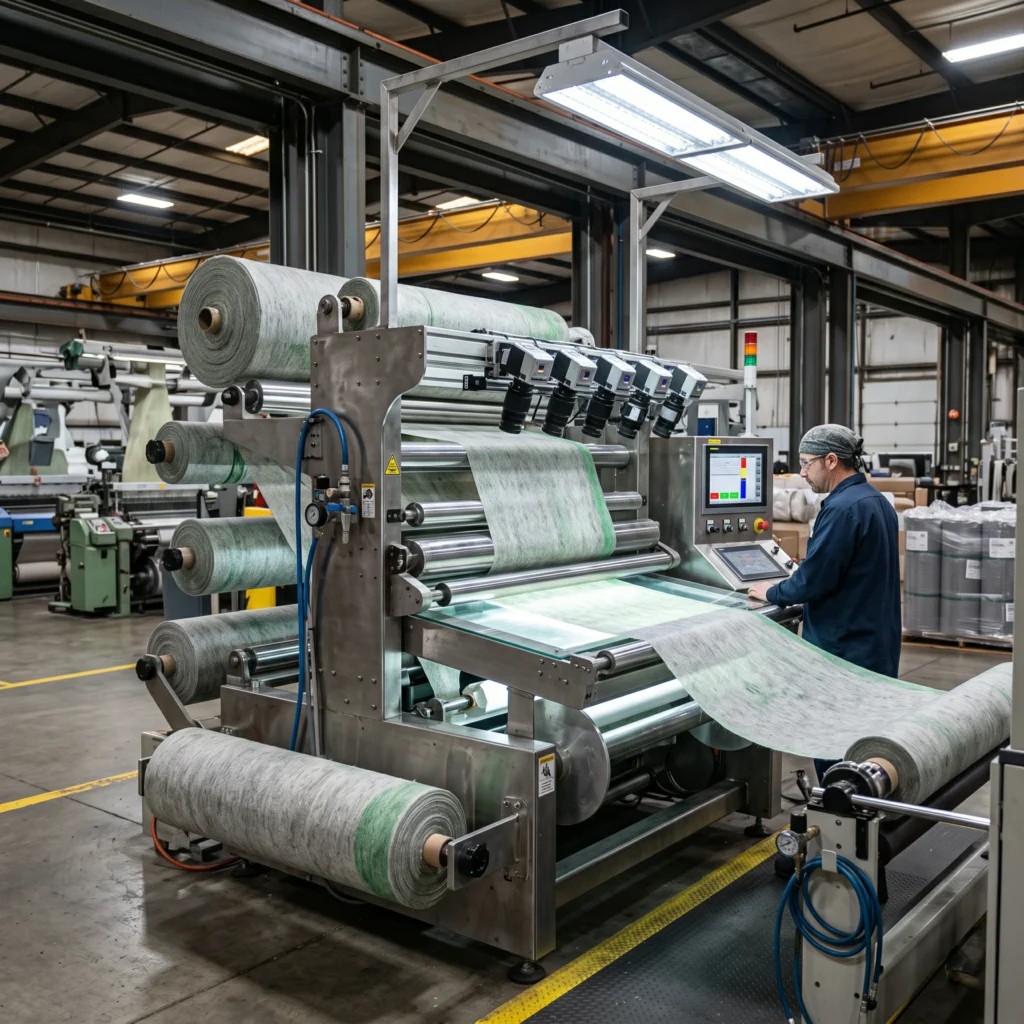
To mitigate this, raw webbing undergoes a rigorous heat-setting process at the extrusion facility. The material is run through heated calendering rollers under controlled tension, locking the molecular chains into place. This pre-shrinking stabilization ensures dimensional variance remains under 2% during subsequent manufacturing phases and final end-user washing.
What thread specifications do you mandate for assembling high-tension dog harnesses?
Standard spun polyester threads, commonly used in apparel, possess insufficient tensile strength and are highly susceptible to shearing under heavy dynamic loads. For high-tension pet gear, the strict mandate is the use of continuous filament bonded threads, typically bonded nylon 6.6 or heavy-duty bonded polyester.
The bonding process coats the continuous synthetic filaments in a specialized resin, preventing the thread from untwisting and fraying as it passes through the intense friction of industrial sewing needles. This results in a lockstitch that offers superior resistance to multidirectional strain, UV degradation, and chemical exposure.
How is colorfastness guaranteed across different manufacturing batches?
Ensuring identical color rendering across multiple production runs separated by months requires strict chemical and environmental controls. We rely on precise digital spectrophotometers to measure the exact light reflectance of the dyed webbing, matching it against the master Pantone reference standard.
Furthermore, we conduct standardized physical tests, including ISO 105-C06 for colorfastness to commercial washing and ISO 105-X12 for colorfastness to rubbing (crocking). Only batches that score a minimum of 4.5 out of 5 on the standardized grayscale evaluation are cleared for assembly, ensuring the dye will not bleed or fade prematurely.
Ready to upgrade your bulk material specifications?
Selecting the precise webbing substrate is the first step in engineering failure-proof pet gear. Whether you require the high-tensile shock absorption of nylon or the UV-stable, waterproof performance of sublimated polyester, our technical team is ready to supply extensive physical samples and testing data. Protect your brand’s liability and improve your product lifespan today. Please contact our wholesale team to request a comprehensive material swatch book and discuss custom bulk pricing for your next production run.